World Health Assembly 79: what it meant for cancer, and how UICC helped shape the conversation
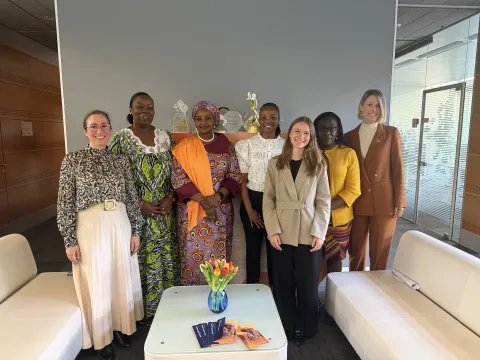
UICC convened a high level breast cancer side event at its offices, with governments and partners reflecting on progress under the WHO Global Breast Cancer Initiative since its launch five years ago. With the participation of Dr Zainab Shinkafi-Bagudu, UICC President-elect (third from left).
HIGHLIGHTS
- Cancer featured across WHA79 debates on NCDs, with a focus on diagnostics, essential medicines and the implementation of past commitments.
- A revised WHO Global Action Plan on AMR (2026–2036) was adopted, with UICC stressing the impact of drug-resistant infections on cancer outcomes.
- Member States advanced major reforms, including a new pandemic agreement and a strategy linking health investment to economic prosperity.
- UICC’s side events focused on turning policy into practice, with themes including political leadership on breast cancer, integrated lung health, people‑centred and rights‑based cancer care, the role of data and registries, sustainable financing, and the responsible use of AI to strengthen cancer systems without widening inequities.
The 79th World Health Assembly (WHA79), held in Geneva from 18 to 23 May, took place against a backdrop of tight budgets, competing global crises and growing pressure on health systems.
Cancer featured across several WHA agenda items, mainly through broader discussions on NCDs, health systems, diagnostics and access to care. Topics with direct relevance to cancer control included diagnostic imaging, radiation, precision medicine, essential medicines and the follow‑up to the Political Declaration on NCDs.
In an important related theme for UICC, this WHA marked a significant milestone in the global response to antimicrobial resistance (AMR) with the adoption of the revised WHO Global Action Plan on AMR (2026–2036). While the action plan has broad support from countries and sustained collaboration across the Quadripartite organizations - WHO, FAO, UNEP and WOAH – its true impact will depend on effective implementation, driven by collective action, strengthened coordination, accountability, and sustainable financing.
Integrating AMR into broader health systems and development agendas will be essential to ensure long-term, meaningful progress. UICC made a statement on the importance of including the cancer community in these discussions due to the negative impact of infections (and drug-resistant infections) on cancer care outcomes.
A consistent theme was implementation. Member States debated how commitments made in recent years can be put into practice, and delegations repeatedly acknowledged that global resolutions only matter if they lead to changes on the ground: earlier diagnosis, more reliable treatment pathways, better protection from financial hardship, and services that reach people who are currently left out.
“Every resolution you adopt, every agreement you reach, only has value when it changes what happens in a clinic, in a community, or in a household.”
– Dr Tedros Adhanom Ghebreyesus, Director‑General, WHO
On wider topics, Member States adopted the “Reform of the global health architecture and the UN80 Initiative”, intended to improve coordination across the global health system. While the reform was presented by WHO and several governments as a significant step toward strengthening global health governance, concerns remain regarding the limited scope of the mandate. The process explicitly excludes recommendations on revising institutional mandates or pursuing mergers and consolidations among UN health agencies, despite longstanding concerns about overlapping functions and inefficiencies.
Countries are also divided over key priorities, particularly around equity and representation between high-income and low- and middle-income countries. In addition, civil society organisations have expressed strong concerns about being sidelined from the process, criticizing their exclusion from the joint task force responsible for guiding the reform initiative.
WHA79 also saw the adoption of the Strategy on the economics of health for all (2026–2030), establishing a close link between health and economic prosperity, particularly in the context of a global health financing crisis The strategy aims to strengthen the case for sustained investment in health, embed health considerations into economic decision‑making, and support countries to move from commitment to implementation. The adoption signals a shift towards placing health, equity and well‑being at the centre of economic policy.
Finally, in the context of much debate around the outbreaks of the Ebola and Hanta viruses, Member States formally adopted by consensus the world's first pandemic agreement after three years of intense negotiations. The agreement was developed in response to the devastating impacts of the COVID-19 pandemic, with the goal of making the world safer from future pandemics and to have a more equitable response.
UICC’s side events: practical discussions, political leadership
Alongside the formal WHA programme, UICC convened and co‑hosted a series of side events that created space for more practical, detailed conversations. These sessions focused on how countries are organising cancer services, how partnerships are supporting national plans, and how lessons from one setting can be adapted elsewhere.
There was notably a high-level side event on breast cancer, co‑sponsored by the Ministries of Health of Botswana, Egypt, and Indonesia, as well as by the Organisation of African First Ladies for Development (OAFLAD), and with the support of the World Health Organization (WHO).
The event reflected on five years of the WHO Global Breast Cancer Initiative, and underscored the importance of political leadership in moving towards the 60:60:80 targets for early detection, timely diagnosis, and treatment. It highlighted commitments from countries in the Eastern Mediterranean Region and the role of First Ladies in advancing breast cancer and wider women’s cancer agendas.
Speakers underlined the importance of cancer registries and the practical use of this data to guide strategy and track progress. They also highlighted pragmatic ways to reduce late‑stage diagnosis, even in low‑resource settings, including stronger patient navigation, better service integration and targeted public awareness. Progress in building radiotherapy capacity, expanding the workforce, and improving access to genetic testing was also noted.
The side event on lung cancer marked one year since the adoption of the WHO resolution on integrated lung health. The discussion focused on how to better integrate lung cancer within national NCD strategies, strengthen referral pathways, and address ongoing gaps in access to diagnostics and essential medicines.
The session underlined that progress on lung cancer depends on coordinated action across respiratory health, cancer, and primary care, alongside sustained political attention beyond technical advances. It was co-hosted by the Ministry of Health of Malaysia, The International Union Against TB and Lung Disease (The Union) ,and the Forum of International Respiratory Societies (FIRS), and supported by the Ministries of Health of the Philippines, Kenya, and Brazil, as well as the NCD Alliance.
UICC also drew attention to people‑centred cancer care with a session co-hosted with the McCabe Centre for Law and Cancer, Building people‑centred cancer systems: advancing rights, equity and support across the care pathway. The side event brought together speakers from UICC members, ABC Global Alliance and the King Hussein Cancer Foundation in Jordan, as well as the McCabe Centre for Law and Cancer and WHO.
The event showcased the reality and breadth of people-centred care, which stretches beyond the health system and must be addressed through a comprehensive whole-of-systems approach. While it is rooted in the right to health, which includes the right of all individuals and communities to be informed by and actively participate in decisions relating to their health, it must include the fulfilment of other human rights, such as the right to work, to non-discrimination and social security.
Noting that more than 53 million people worldwide are living within five years of a cancer diagnosis, speakers highlighted the importance of employment rights, income protection, and non‑discrimination for people living with and beyond cancer, and the role of policy in ensuring these protections are in place.
Finally, UICC co‑hosted a side event with its partner Amgen on how AI is being used to support clinical decision‑making, service planning and patient support, as well as the conditions needed to ensure these tools are safe, transparent and relevant to real‑world care. Speakers stressed that technology should support, not replace, clinical judgement, and that equity and patient benefit must remain central as AI is adopted more widely.
Many of the speakers at these events emphasised the need for predictable financing, better coordination between services, and stronger links between cancer and wider NCD and universal health coverage efforts.
“WHA79 really showed the value of working closely with governments. Conversations here tend to be open, practical and grounded in real experience. And these types of discussions are essential to turning global decisions into better care for people affected by cancer. The task now is to keep that collaboration going and make sure commitments are followed through where it matters most: in clinics, communities and people’s lives.”
— Sonali Johnson, Head of Advocacy, UICC
Last update
Thursday 09 July 2026