How stronger air quality laws can reduce cancer risk and mortality
Suzanne Zhou of the McCabe Centre for Law and Cancer and Weenarin Lulitanonda of ThailandCAN discuss how legislation, enforcement, monitoring, and public accountability can help governments deliver cleaner air and protect health.
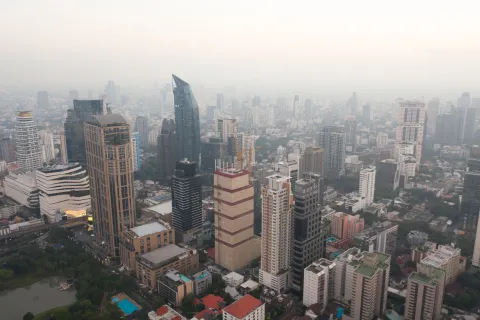
An aerial view of Bangkok, Thailand in the evening.
HIGHLIGHTS
- Evidence shows that long-term exposure to PM2.5 significantly increases the risk of developing and dying from cancer, underscoring the need for stronger air quality standards.
- Suzanne Zhou of the McCabe Centre for Law and Cancer says effective clean air laws require clear accountability, enforcement and coordination across sectors ranging from transport to energy and urban planning.
- After linking her recurring headaches to Bangkok's pollution, Weenarin Lulitanonda founded ThailandCAN to push for cleaner air and greater public awareness.
- ThailandCAN helped develop a citizen-led Clean Air Bill, but its impact will depend on whether Parliament preserves strong governance, accountability and rights-based provisions.
In 2017, Weenarin Lulitanonda set her sights on running the Paris Marathon the following spring. Soon after she began training, recurring headaches left her unable to function for weeks at a time. Around the same time, she was seeing family members affected by nosebleeds and other health problems.
She started looking more closely at air quality data in Bangkok, where she lives, and realised that running outdoors often exposed her to levels of air pollution she had never fully appreciated before. When she started asking around, she realised that no-one was really working on the issue, and there was little coordinated action to get clean air policies enacted.
She decided to found her own organisation. The Thailand Clean Air Network, or ThailandCAN, quickly grew from a small group of dedicated volunteers working on air monitoring to developing a citizen-led clean air bill with specialists and civil society organisations.
Compelling evidence for action
Air pollution is a health risk where government action is paramount to protect public health. Simply put, people cannot avoid the air they breathe.
In addition to causing a range of respiratory diseases, long-term exposure to air pollution significantly raises cancer risk and mortality across multiple cancer types and disproportionately affects women, children and lower-income populations, as shown in UICC's recent report.
Fine particulate matter known as PM2.5, which can penetrate deep into the lungs and enter the bloodstream, poses a particular concern. For every increase of 10 micrograms per cubic metre in long-term PM2.5 exposure, the report found an 11% increase in the overall risk of developing cancer and a 12% increase in the risk of dying from cancer.
To reduce exposure to these risks, governments need laws that establish acceptable air quality standards, assign responsibility for meeting them, require monitoring, and specify what happens when pollution exceeds legal limits.
UICC's report recommends legally binding national standards aligned with World Health Organization air quality guidelines, supported by monitoring and enforcement mechanisms that compel action and reduce emissions at their source. It also calls for clean air targets to be incorporated into national cancer control plans.
Translating evidence into action is particularly challenging, however, according to Suzanne Zhou, Manager of Prevention at the McCabe Centre for Law and Cancer.
“The main sources of air pollution are generally car traffic, power generation, factories, agricultural and waste burning, and fuels used for cooking and heating,” she explains. “So while reducing exposure depends largely on decisions made by governments, effective action requires coordination across a range of sectors, from transport and energy to planning and environmental regulation.”
“While a large number of countries already have some form of air quality legislation, there are several challenges that can make those laws difficult to apply,” says Zhou. The UICC report notes that more than 140 countries have established air quality standards, but only one-third enforce them.
“Common challenges include a lack of clear responsibility for air quality control, provisions that may not be enforceable, and little or no consequences when standards are breached,” she explains. “Or the limits themselves may not reflect current health evidence.”
Furthermore, pollution sources vary from country to country and region to region, meaning the required measures are not identical everywhere. Traffic may be a major contributor in one city, while coal-fired boilers, industrial activity, agricultural burning or household fuels may dominate elsewhere.
“Each country needs to assess the sources of air pollution and address those specific causes in different regions,” says Zhou. “Air quality legislation should provide the framework for monitoring pollution, identifying when limits have been exceeded, establishing who is accountable, and determining what action follows.”
Turning clean air into law: the experience in Thailand
When ThailandCAN was initially founded, Weenarin Lulitanonda and her group of volunteers focused on collecting air quality data. “At the time, PM2.5 was not included in Thailand's air quality index, despite years of advocacy by environmental groups,” she explains.
“We spent much of 2018 meeting officials in the Ministry of Public Health, arguing that air pollution should be treated as a health issue and that better monitoring was needed. We told them, ‘If you have the data, you'd be able to map it with illnesses and come up with a solution.’”
As severe pollution episodes became more frequent and more people connected poor air quality with illness and hospitalisations, regulators eventually agreed to include PM2.5 in the national air quality index.
Recognising that the problem was rooted in transport, industry, energy production and urban development, ThailandCAN broadened its work, bringing together public health experts, researchers, lawyers, environmental specialists and civil society organisations to develop a national clean air law.
Drawing on international models, the group spent two years producing background papers and drafting legislation before submitting a citizen-led bill to Parliament in February 2022.
It was subsequently considered alongside other proposals, which were drawn together into a new version. Although a clean air law is expected to pass soon, ThailandCAN remains concerned that changes made during the parliamentary process could weaken its governance and accountability provisions.
“A law will be passed, but what will pass is the question,” says Lulitanonda. “The devil really is in the details.”
The debate around Thailand's Clean Air Bill has also included whether access to clean air should be recognised as a fundamental right. “We all need to breathe, right?” says Weena. “One of the principles underpinning ThailandCAN's proposed legislation is that people should have a right to breathe clean air and to know what they are being exposed to.”
For Suzanne Zhou, framing air pollution as a human rights issue can help move the discussion beyond technical standards and emissions limits. “Human rights also opens up more avenues for accountability,” she says, noting that communities around the world have increasingly used human rights mechanisms and litigation to seek remedies for air pollution and challenge government inaction.
“Many of the highest exposure levels are found in low- and middle-income countries, but in every country children, older people, pregnant women, people living with pre-existing health conditions and lower-income communities often bear a disproportionate share of the burden from air pollution,” adds Zhou. “Clean air, therefore, is not simply an environmental issue, but a matter of health, equity and fundamental rights.”
Last update
Monday 07 September 2026