
UICC's actions on cervical cancer
UICC collaborates closely with the World Health Organization (WHO), other UN agencies and partners towards the elimination of cervical cancer as a public health problem, leveraging its platforms and resources to drive progress.

Following the call to action to eliminate cervical cancer in 2018, by the World Health Organization Director General, Dr Tedros Adhanom Ghebreyesus, UICC directly supported WHO’s efforts to conceive, draft and present the Global Strategy to accelerate the elimination of cervical cancer as a public health problem, which was launched on 17 November 2020.
Since then, UICC has been committed to the WHO-led Cervical Cancer Elimination initiative, supporting and working with its diverse and global membership to assist countries in achieving the 90:70:90 targets for vaccination, screening and treatment, and continuing to maintain a spotlight on cervical cancer elimination, leveraging its global platforms and harness its convening role across sectors to drive global impact.
In fulfilment of these commitments, UICC is delivering and provides a series of activities, opportunities and projects, working with partners, members and organisations around the world to support collective progress towards the 2030 targets.
Supporting the cancer community
UICC is supporting its members and national organisations in their respective efforts to advance cervical cancer elimination in their context, and offers the following opportunities.
- Training and learning: UICC offers 'The Cervical Cancer Elimination Initiative foundational course' on UICC Connect. This online course provides essential knowledge on the WHO Cervical Cancer Elimination Initiative and its Global Strategy for the elimination of cervical cancer as a public health problem. It helps participants understand the key components of the strategy, strengthen their capacity to take action, and support implementation efforts at national and regional levels.
- Advocacy: In 2025, UICC launched an updated version of its Cervical Cancer Advocacy Handbook, which serves as a practical guide to support civil society organisations (CSOs) and patient groups in advocating for comprehensive cervical cancer prevention, screening, and treatment services, in line with the WHO Global Strategy to eliminate cervical cancer and the latest recommendations since its launch. The handbook is available in English, French and Spanish, with additional translations to be made available in 2026.
- Technical skills and knowledge: UICC leverages its established Fellowships programme to enable individuals to visit another organisation to learn from their experience and develop specialist skills and knowledge in cervical cancer.
- Communications: To assist members around the world, UICC prepares videos, infographics, important documents, social media cards, toolkits, and other resources that are available in the cervical cancer resource hub.
- Networking: To foster collaboration and knowledge sharing, UICC is hosting via the Cervical Cancer Elimination Room, a dedicated online space that brings together professionals working in cervical cancer elimination to connect, exchange insights, and support one another on UICC Connect. Members can share experiences, access learning opportunities, and stay informed about the latest developments in the field.
- Raising awareness: Each year, UICC marks World Cervical Cancer Elimination Day on 17 November- the anniversary of the WHO's Global Strategy to accelerate the elimination of cervical cancer as a public health problem, and formally recognised following the World Health Assembly resolution in 2025. In addition, UICC actively supports Cervical Cancer Awareness Month every January, helping raise visibility and encourage global action to prevent and eliminate cervical cancer.
- Workshops and events: UICC regularly leverages its convening power to bring together the community and facilitate discussions across its network on the implementation of the Global Strategy. In 2022-2023, UICC organised a series of in-person Regional Dialogues in three regions, to enable the sharing of experiences across organisations and individuals working in similar contexts. Through UICC's Virtual Dialogues, UICC provides regular virtual opportunities for individuals from its network to exchange, knowledge, experiences and learning across UICC's community.
- Funding: UICC regularly opens calls for applications for grants to provide financial support to UICC member organisations to increase the impact or reach of their work. In 2024, UICC has invested in ten projects focused on HPV vaccination, following needs raised by UICC members, across Asia, Latin America, Africa and Europe.
Driving global impact
In addition, UICC also leverages its global role to raise the profile of key topics within cervical cancer, including engaging in and supporting collaborative efforts, showcasing and highlighting key topics and progress at its global events - the World Cancer Congress, the World Cancer Leaders’ Summit – through its communication channels, and its advocacy work.
- Publications: UICC has published a series of reports on regional or topical challenges to elimination to inform action. These include analyses on the situation in Africa, the global and national opportunities to finance elimination, and the role of civil society in HPV vaccination. UICC has also developed a Cervical Cancer Advocacy Handbook, a practical guide supporting civil society organisations and patient groups in advocating for comprehensive cervical cancer prevention, screening, and treatment services.
- Influencing national policy: Through UICC's Cancer Advocates programme, UICC is providing dedicated support to selected organisations to develop and implement national advocacy strategies on cervical cancer.
- Collaboration: UICC is working across its partners to leverage opportunities to bring greater attention to cervical cancer, both for example, through its events, as well as programmatic partnerships, such as the Elimination Partnership in the Indo Pacific region on Cervical Cancer (EPICC). UICC also helped to establish the Commonwealth taskforce in May 2021. The taskforce aims to encourage and facilitate cooperation between Commonwealth countries, and support progress towards the 90:70:90 goals outlined in the Global Strategy. As part of this collaboration, the publication 'Conquering Cervical Cancer in the Commonwealth: Addressing Myths and Misconceptions' was developed to respond to misinformation and vaccine hesitancy, providing evidence-based messages to strengthen cervical cancer prevention and control efforts.
Focus areas
Through its activities below, UICC has brought particular attention to the following topics, although recognising and emphasising across all of these the importance of a holistic approach to elimination, addressing all three pillars of the Strategy.
Primary prevention
Building on current momentum to accelerate access and coverage of the HPV vaccine, in 2023 UICC conducted a landscaping to explore and increase understanding of the role played by local CSOs in order to further support efforts to increase access to and uptake of HPV vaccination. In response to the needs raised by UICC members as part of this landscaping , UICC has developed and delivered a range of tailored and specific opportunities, including funding for CSO-led projects, Virtual Dialogues including 'Navigating Gavi: Supporting CSOs in advancing access to HPV vaccination', training on leadership and storytelling, with new opportunities to come in 2026, including training and funding on implementation research.
Secondary prevention
As a consortium partner in the SUCCESS project (Scale-up Cervical Cancer Elimination with Secondary prevention Strategy) from 2019-2023, funded by Unitaid, and led by Expertise France, UICC worked together with Jhpiego to intensify cervical cancer secondary prevention in Burkina Faso, Cote d’Ivoire, Guatemala and the Philippines. The SUCCESS project focused upon the implementation and scale-up of innovative technologies (HPV testing, thermal ablation, self-collection) for secondary prevention of cervical cancer. In this project, UICC worked with civil society to support national advocacy on secondary prevention, alongside the other pillars of the elimination strategy; to strengthen CSO inclusion in national governance structures; and supporting them across their various roles, including community mobilisation, and awareness-raising. UICC has built on the investment in these countries to develop, refine and share resources with its wider and global community and contributed to reaching the milestone of a million women screened in LMICs.
Access to treatment and palliative care
Alongside its broader work in the ATOM coalition to increase access to medicines, UICC is committed to highlighting the importance of treatment and palliative care for all those diagnosed with cervical cancer. As part of its role in the Elimination Partnership in the Indo-Pacific for Cervical Cancer (EPICC), UICC is working with civil society to strengthen national advocacy across the elimination agenda, with a specific focus on access to treatment and palliative care given the unique geographical context of Pacific island nations.
Financing for elimination
A critical enabling factor to achieve elimination, UICC has commissioned a series of reports, by Thinkwell and the Economist Intelligence Unit, bringing attention to the opportunities and challenges involved in securing financing for elimination, both at the global and national level. These reports bring concrete insights for civil society organisations and key in-country stakeholders to inform evidence-based policy dialogues and to empower them to advocate for the integration of cervical cancer interventions into national health financing frameworks, and within the context of UHC.
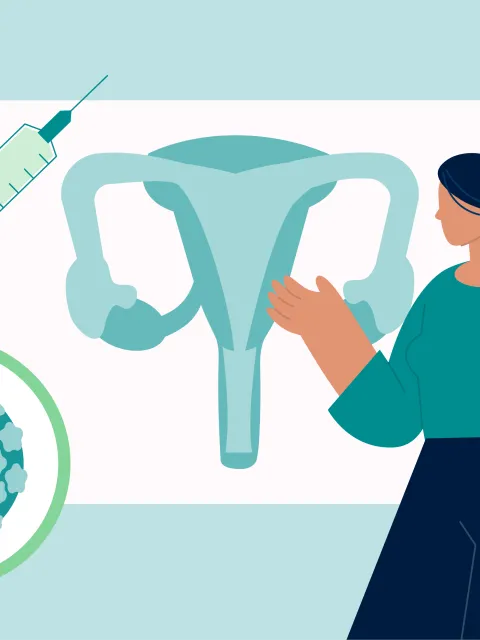
Cervical cancer is the fourth most common cancer among women globally and currently, one life is lost every two minutes to this disease.
Cervical cancer
This page regroups resources on cervical cancer elimination such as infographics, videos, documents and links.
Cervical cancer resources
Cervical cancer partners


Cervical cancer institutional funders
Last update
Tuesday 07 April 2026