Podcast "Let’s Talk Cancer" – Cancer awareness and prevention in younger adults
In this episode:
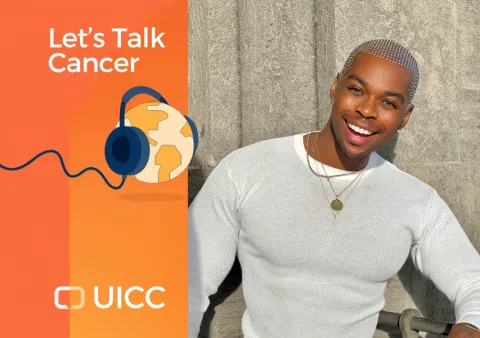
In this new episode of Let’s Talk Cancer, Cary Adams speaks with Jaym O’Esso, a performer, songwriter, dancer, who lost both parents to cancer and was himself diagnosed twice at a young age, about prevention, early awareness, and the lived experience of younger adults.
Together they explore Jaym’s personal journey – from his life and creative career before being treated twice for colorectal cancer – and how this experience reshaped his perspective on health, priorities and the future. The conversation highlights the rise of early-onset cancers and the importance of recognising symptoms, listening to one's body, and seeking care without delay.
Jaym reflects on the power of community, storytelling, and connection throughout his treatment, and how he now uses his platform to advocate for greater awareness and prevention-focused conversations.
See podcast transcript below
Listen on:
Spotify | Stitcher | Apple Podcasts | Amazon Music | Audible | Deezer
Podcast transcript
Cary Adams: Welcome to a new episode of Let's Talk Cancer, the podcast where we explore the latest developments, stories, and insights shaping cancer control worldwide. I'm your host, Cary Adams, the CEO of UICC, which unites and supports the global cancer community to reduce the burden of cancer and improve outcomes for people everywhere. In this episode, we focus on early awareness and the lived experience of cancer, particularly among young adults, where we are seeing a rise in early-onset cancer cases. While prevention is often discussed in technical terms, personal stories play a crucial role in helping people recognise risk, listen to their bodies, and seek care early.
Our guest today is Jaym O'Esso. Jaym is a performer, songwriter, and singer who studied at the Geneva School of Art and Design, joined Ballet Béjart in 2013, and now is a cancer advocate with a strong following on social media. Jaym lost both his parents to cancer before he was in his early 20s, and then he was diagnosed with colorectal cancer as a young adult, twice. Earlier this year, he shared publicly that he now has no evidence of disease after months of treatment and recovery. Today, we'll talk about his life before cancer, how his diagnosis reshaped his outlook on health and the future, what his experience tells us about rising cancer rates in younger people, and why his openness on social media and in creating awareness about cancer has helped him and also helped a broader community around the world. Jaym, it's great to have you with us, and thank you for joining Let's Talk Cancer. For those who may be discovering you for the first time, can you tell us a bit about you and what you do, your work, your creative life, and also your role on social media and how you connect with people?
Jaym O'Esso: Good question. So I am a singer, songwriter, performer. I'm a former ballet dancer. I was trained to become a ballet dancer. But ever since I was a little kid, I always wanted to be a pop star. Music is my thing because I express myself best in art, in music. So I've been writing a lot. I lost my mum when I was ten to cancer, and I started writing my thoughts and emotions down ever since. It really helped me to process and articulate my emotions better. And I feel like I'm not a shy person, but I've been really reserved ever since I was a kid. So writing my emotions and my music really helped me to grow. And I don’t know, I just express myself best in music and art in general. And on social media, I feel like I can be myself. I can attract the right people when they see what I'm posting and everything, the right people are going to come to me. And I can be vulnerable. It just became my chosen family a bit because I lost my family when I was a little kid.
Cary Adams: And how big is your social media following then?
Jaym O'Esso: So I'm posting a lot, I would say, on TikTok. I have over 220K followers, which is a good number. And on Instagram, I have maybe 19K, something like that. I feel like I'm attracting more people on TikTok because I can truly be myself. People are more judgmental on Instagram for some reason. And on TikTok, I feel like I can just vent, I can just be myself and just kind of be silly. I can be a kid, and it’s just great. It makes me feel good. I go live very often, and when I’m live, they come to me, they send me DMs, and we can just connect. And there is something more real on TikTok, so I like it better there.
Cary Adams: It sounds very vibrant. And you mentioned your mother. So cancer has affected your life since you were a young child then, basically.
Jaym O'Esso: Yes. I lost my mum, she had breast cancer, and she passed when I was ten. I lost my dad to brain cancer when I was 18. So cancer has been part of my life my entire life. So I grew up with that, and it really shapes how you evolve, how you communicate with people, and how you see the world, because you live differently, you love differently, and you experience life very differently too. So you enjoy every single moment with your people, your friends, and family.
Cary Adams: Were you particularly conscious as a younger person? Because you’re in your early 30s now, were you particularly conscious about the symptoms of cancer yourself? I mean, how did you come about having a diagnosis of cancer?
Jaym O'Esso: Good question. Because I was a ballet dancer, I don’t drink, I don’t smoke, I don’t do any drugs. I’m extremely connected to my body. So my body was talking to me, and I’m used to pain. I don’t know if you guys know ballet, but we’re used to pain. But this type of pain, I had never felt that before. And my body was definitely communicating something, and I was like, there is something wrong. I know something's wrong, but I can’t tell what’s happening. So I went to see my doctor, and he was like, everything’s fine. We ran a couple of tests, and I don’t see anything. But I was like, there is something, I can’t tell, but I’m exhausted and have huge cramps in my stomach. And so cancer was not even part of the discussion. It was not even an idea because I was so young. The first time I was 24. So it was not even considered. And then I started to have blood in my stool and blood in my urine. I was like, there is something wrong. So we did a colonoscopy, and we saw polyps and everything. And it was cancer. So I had to go through chemotherapy. And six years later, which is recently, it came back stronger and bigger.
Cary Adams: Yeah, that story is not unusual for younger people, that it’s not even on the table as a potential health issue. Cancer at that age. Um, how did you progress? Was it you pushing it, saying, “No, there is something wrong and we need to do some more tests”? You were the driver, I guess.
Jaym O'Esso: Yes. Because the doctors were like, “Well, you’re very healthy. You’re a very healthy person. You’re very strong, and I don’t see anything wrong.” And because cancer was not even a possibility or even a thought. So yeah, I had to push it because I was like, there is something wrong.
Cary Adams: What about the second time then? How did that happen? Was it the same symptoms? Did you feel that it was the same thing, or how did that happen?
Jaym O'Esso: So right away, um, I didn’t have the same symptoms, though, because I had no pain. I had some pain in my knee, but there was nothing major. But I had blood in my stool. And to me, that was a red flag right away. I had no pain at all, so I was like, why do I have blood again? And I went to see the doctor. I said, “Okay, I had cancer before. I don’t know what’s happening, but let’s do a colonoscopy right away.” I don’t care what we’re going to do, let’s do a colonoscopy and a blood test. And it came back positive. So that time, I don’t know what happened. I don’t even know why I had a recurrence, but it was bigger. It was very terrifying, and the chemotherapy was definitely harder and stronger.
Cary Adams: But now you're free of cancer. Is that right?
Jaym O'Esso: Yes. I finished my treatment in January 2026, which was about five months ago. And now I’m NED, which is great, and I’m happy. I’m getting back on my feet because I was very active during chemotherapy as well. Because I hate being a victim, like a victim mentality. I didn’t want to be in that space, like, “Oh, I have cancer, something’s happening to me.” I just wanted to be like, okay, what’s next for me? I didn’t want to go down a rabbit hole of thinking, “What am I going to do?” or anything. I just wanted to be in control of my life, and I didn’t want to be in that victimhood. Like, I’m going to let life take care of it, but I also wanted to take care of myself. Because I have no more family, and I’m used to taking care of myself. But I just felt like survival mode took over. And I just wanted, I don’t know, I feel like it was my way of protecting myself, to say, “You’re going to be okay. You’re going to be fine. Just think about your next project and everything.” Even though the chemo was intense.
Cary Adams: You got through it, which is great.
Jaym O'Esso: Yeah.
Cary Adams: Some people may not be familiar with the term NED. What does that mean?
Jaym O'Esso: So, no evidence of disease. So cancer-free, if I may say so., but yeah, no evidence of disease.
Cary Adams: And you said on social media you announced that you were cancer-free. And presumably you got a lot of feedback and support from people around the world on that announcement, yeah?
Jaym O'Esso: Yeah, that was insane because it is extremely difficult to be vulnerable on social media, extremely. I didn’t know if I wanted to share my cancer journey because I didn’t want to be that vulnerable. I didn’t want people to know my life and everything. But I received so much support. Because the first time I had cancer, I didn’t tell a soul. I kept it to myself because I didn’t know how to react to it. I was extremely young. I didn’t have the tools to communicate or even to acknowledge what was happening to me. So I kept everything to myself because my entire life people always told me, “You’re a man. Don’t cry. Be strong.” When my mum died, same thing. When my dad died, same thing. I couldn’t show any emotions, even though I was already orphaned. So when I had cancer at 24, I was like, I don’t know what to do. But when it happened recently, I’m more of an adult. I have the tools to cope. I built a community, a support system. I know how to articulate my emotions. I know how to communicate. So it was actually easier to say, “Okay, this is what’s happening to me. I have to take a break.” And I received a crazy amount of support. And obviously, when I announced that I was NED, people were so kind, sending me flowers, multiple gifts. Even the nurses were so kind. They also gave me this necklace. They were like, “Oh, you’re free, you’re good. You’re NED, congratulations.” It’s so humbling because I had never received that amount of love and support. I was like, oh wow, what’s happening? Is this real life? That was just incredible.
Cary Adams: I’ve been privileged to be part of the cancer community for the last 17 years, and they are an incredible community, without any doubt. I mean, the support you get from around the world, the people who are prepared to help others who’ve been through cancer to support others as well, it really is quite extraordinary. So your story is something that I recognise a lot. And of course, it comes to life on World Cancer Day. On World Cancer Day, the world explodes with all these amazing stories of individuals who’ve survived cancer, or carers sharing their stories. And you were part of the World Cancer Day Upside Down challenge, so thank you for that. How did you find that?
Jaym O'Esso: I don’t know, I think I was just scrolling on Instagram and I saw this beautiful person showing their journey about World Cancer Day, how cancer turned their world upside down. I was like, oh wow, that’s so powerful, and I loved it. And I saw your profile on Instagram and I was like, oh wow, I love this. So I followed you right away. I was like, okay, I want to be part of this community. I love it. And I thought it was a challenge, and I wanted to be part of it. I was like, I need to share my story as well, because I feel like that could be very, very helpful for other people. I have noticed that many men don’t really share. They tend to keep everything inside because, in society, we’re not really allowed to show vulnerability, it’s seen as a weakness. So I was like, well, I don’t care. I’m just going to do it. I’m just going to share my journey, my story. It’s going to make me feel good. I’m NED, and I really want to vent. Because I have no space to actually talk about my journey and my story. Every time I bring up my cancer story, people feel uncomfortable. My friends feel uncomfortable. My family feel uncomfortable because they don’t know what to do or what to say. And I was just like, well, I’m going to go on the internet and find my people.
Cary Adams: Well, you found us, and that's great. How has it impacted your creativity and your music and your art? Has it had a major impact?
Jaym O'Esso: Good question. Really good question. Yes, because I usually turn my pain into creation. Ever since I was a kid, I feel like I was doing it very naturally. For my first cancer, obviously, I created my own hair, and it became my signature because I just feel like, I don’t know, when life gives you lemons, well, make lemonade out of it. And I just feel like it’s really great to turn your pain into passion and power. I just want to be in control of my life, and I didn’t want cancer to define me, but to be a part of me. So what happened to me doesn’t define who I’m going to become, it’s a part of my journey, and that’s pretty much it. So during cancer, most of the time I was writing songs. I probably wrote maybe three albums because I was so inspired. And because you're also more sensitive, to everything, your emotions, people, the way they react, the way they treat you, the way they interact with you. When you go for a walk, you're more sensitive to nature, the wind, the smells, the grass. So it’s very inspiring and so humbling because you're like, oh wow, life is so beautiful. So you live differently, you love differently. So it really impacted the way I was navigating through life and my art and my music and my dancing and everything.
Cary Adams: Do you think the community that you reach through your art are listening to the cancer story within you, or are they just appreciating the beauty of your music?
Jaym O'Esso: Good question, because I feel like music is very subjective. So some people are just going to love the melody and maybe the sound of my voice. Some people are going to love the lyrics because they can relate to the story, you know? Everybody is very, very different. But I’d say, because I have such a bright personality, I usually overshare on social media, the way I feel. So I feel like people are more attracted to me because of who I am and my story, more than just the sound of my music. That’s what I would say.
Cary Adams: And what you're doing is breaking down stigma as well, because there’s a lot of stigma associated, as we described earlier, with cancer. And I do wonder if the younger generation are really in tune with their bodies, as you were, and listening to those hints that something may be wrong. And if they do think something is wrong, do they feel they can go forward? Do they feel they can go to a doctor? Or do they think it’s just growing pains or something else? So I think a lot of your story is helping to improve understanding of cancer at a younger age, and also reducing the stigma of going forward and saying, “I think something may be wrong.” Has anyone contacted you from your community to say that you've helped them go to a doctor because they felt something was wrong?
Jaym O'Esso: Actually, yes. Every day I’m getting DMs from young people. And I actually share everything. People say, “Oh yeah, I have so much pain, and I was just wondering what your symptoms were.” And more and more, they’re opening up because I don’t hold back most of the time when I’m live, I go live every day on TikTok. So I really share what happened to me, my symptoms, and everything. There are so many people who can actually relate. I don’t know who has gone to do a colonoscopy or a blood test, I have no idea, but so many people reach out to say, “You actually helped me to process my emotions and to go see a doctor to check if something was wrong,” especially if they have cancer in their family. So it’s really humbling and really great. I can connect with people across the globe, and just talking about it really helps me too. It really helps me to process and heal.
Cary Adams: That’s great that you're doing that. There’s certainly a growing number of cancer cases in younger generations compared to the past, and it’s still unclear why that is happening. As you said earlier, you haven’t smoked, you haven’t drunk, you haven’t taken drugs, and yet you’ve had cancer twice. What do you think your message is to younger people who are worried about symptoms? Do you think they should be open and share this? Or, as you did the first time, keep it private? What’s your advice?
Jaym O'Esso: I would say do what’s best for you. There’s something I always follow: when I make a decision, my brain and my heart have to be aligned. That way, I won’t regret my decision. You can have remorse, that’s normal, but at least if you knew that at that moment it felt right for you, then you made the right decision. And I always say: you know your body best. Nobody else does. So do what’s best for you. If deep down you feel something is wrong, if it’s a pain you’ve never felt before, or fatigue you’ve never felt before, it’s a sign. And it costs nothing to go to a doctor. We live in a world where access to medical care exists. You have nothing to lose by checking, it could save your life.
Cary Adams: We’re doing work at the moment to help people understand the importance of presenting early when they have symptoms so that cancer can be treated at stage one or stage two. But I sometimes wonder whether the concept of stage one, stage two, stage three, stage four is even understood by younger people. That might be messaging we need to communicate more clearly, that survival rates are very high at stage one and two, but become more complicated at stages three and four. So yours was stage one, stage one or two, presumably?
Jaym O'Esso: Stage two.
Cary Adams: Right. So what’s next? You seem very driven, you’ve already had two careers. What’s next for you?
Jaym O'Esso: So I just recently got some good news. Because when I was having chemotherapy, I was studying for medical school. I had no idea if I would make it, I really didn’t know. But like I said before, I was always thinking about the future, what’s next for me. I wanted to focus on that, because I don’t have a safety net. I don’t have anyone to rely on, the only person who can take care of me is myself. So I studied for medical school, and I just got my acceptance letter last Friday, which is kind of crazy. So in September, I’m going to go to medical school, probably to become a physiotherapist and work with cancer patients and sports-related injuries. Because I was a ballet dancer, it makes sense with everything I’ve done in my life. So that’s what I’m going to do. And I’m going to keep working on my music because I’m signed with Universal Music. I need to perform, that’s what brings me joy, what makes me happy, what brings me peace. But I also want a safety net: if I can’t perform anymore, at least I can be a doctor. So yeah, that’s what’s next for me.
Cary Adams: Well, congratulations, that’s really great news. It’s amazing that you received that letter, and it’s a fantastic profession given your background. I hope it all goes well, and please stay in touch, because I’d really love to see how you get on. And we’d love to work with you again to help share your message with younger people in our community. I really appreciate everything you're doing, it’s amazing. Thank you.
Jaym O'Esso: I appreciate you, thank you.
Cary Adams: Thank you for listening to this episode of Let’s Talk Cancer. If you liked this podcast, please give us a rating and subscribe for more content every month. And if you want to learn more about UICC’s work, visit uicc.org or follow us on social media. And of course, World Cancer Day takes place on the 4th of February every year.
Last update
Tuesday 16 June 2026