Podcast "Let's Talk Cancer" – Access to cancer medicines: from innovation to patient impact
In this episode:
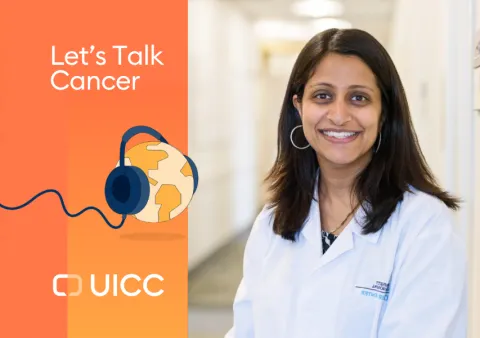
In this new episode of Let’s Talk Cancer, Cary Adams speaks with Dr Aparna Parikh about the complicated issues and challenges around access to cancer care, in particular access to medicines. Together they explore what it will take to make equitable cancer care a reality for people everywhere. With her experience the ground, she shares why improving access to cancer medicines requires much more than making treatment affordable. From diagnostics and workforce training to palliative care, she explains the many components needed to ensure that quality cancer reaches those who need it most.
Drawing on examples from her work across low- and middle-income countries, Dr Parikh discusses the barriers that continue to prevent patients from accessing timely diagnosis and treatment, the importance of building strong healthcare systems that acknowledge local realities and the role of local partnerships in driving change.
The conversation also explores cancer prevention and early detection, access to pain relief and palliative and the growing global challenge of early-onset colorectal cancer.
See podcast transcript below
Listen on:
Spotify | Stitcher | Apple Podcasts | Amazon Music | Audible | Deezer
Podcast transcript
Cary Adams: Hello and welcome to Let's Talk Cancer, the podcast where we explore some of the most important issues affecting people living with cancer and their families, healthcare professionals and policymakers, and the latest developments, stories and insights in cancer control around the world. Today, we're focusing on access to cancer care and in particular, access to cancer medicines and diagnostics. Despite decades of progress in cancer prevention, diagnosis and treatment, many people around the world still lack access not only to novel treatments but also to essential cancer medicines, diagnostics and services that have been recommended for years, particularly in many low- and middle-income countries. These gaps continue to affect patients across the entire cancer care pathway. Access is not simply about whether a medicine exists, but also about what needs to be in place for a healthcare system to receive it and deliver it safely and effectively to the right patient at the right time. To discuss this issue, I'm delighted to be joined by Dr Aparna Parikh, gastrointestinal oncologist and programme director for GI Medical Oncology at Mass General Brigham. Dr Parikh specialises in colorectal and pancreatic cancers, including young adult-onset colorectal cancer, and her research focuses on improving cancer detection and treatment through advances such as liquid biopsy technologies. She also works on supporting access to cancer treatments in LMICs on the ground, and brings to us a whole wealth of experience, examples and case studies of what's actually happening and what needs to be done. Aparna, thank you very much for joining us today. I really appreciate you being on this podcast. But before we talk about access to cancer care, could you tell us a little bit about Mass General Brigham? Tell me what it does and how it gets involved in global issues.
Dr Aparna Parikh: Yeah, absolutely. So thanks so much for having me. This is so fun to be here and talk about topics that are, I think, very near and dear to both of our hearts. So I'm a GI oncologist by day and see patients at Mass General Brigham. Mass General Brigham is, you know, a large general hospital in Boston. For as far back as the history of, you know, Mass General Brigham, I think one of the core tenets was, you know, caring for the community. I think the community is global, right? I think there's the Boston community, there's the New England community, there's the US community, and then there's the global community. And I think there have been many folks over the history of the hospital who, particularly on global issues, have really spent their entire careers ensuring that there is equity and access. Not just in oncology, but across, healthcare. We have really said that it's important to have a presence, a voice and advocacy in the global oncology space, just as we just as we did for HIV, for example.
Cary Adams: So where did you get your own personal calling to get involved in this then? Because obviously you could make a choice and stay very much, you know, Boston US focussed, but why? Why do you want to do this global work?
Dr Aparna Parikh: Yeah. So, as you may be able to glean from my name, I'm of Indian origin and I come from kind of a legacy of a family that has been in medicine or public health. I spent childhoods, every summer, the entire summer being in India and I think was exposed very early to just the tremendous disparities of healthcare. And, I think had family members that, you know, spent their lives trying to close that equity gap. So I think for me, it was a little bit just what I always saw and knew. And then as I went through my training, you know, I actually thought I was probably going to do infectious diseases. I had spent, some time through some time off during medical school, and in Eldoret, Kenya, as well as a couple other places. And then, actually, some time in Cameroon, again, with the intent of thinking I was going to be an ID doctor, I saw so much cancer, so much cancer and at incredibly late stages. And I think you read about this, but when you're, when you're there and you're seeing kind of women that come in, you know, with breast masses that are like unimaginable, or you see patients, that have advanced malignancies where access to pain control is not available and you see the death and dying, and the disparity between what I think should be done in a dignified and humane way, and when you don't even have access to kind of pain medications, it really kind of got me thinking: why aren't enough of us talking about cancer more? And how we can alleviate suffering in that space. And so I think that really launched my trajectory in oncology. One other just, you know, story I'll share with, I think just speaks to again, this disparity and even access to pain medicines is, my mum's brother, my uncle, when I was in medical school, in India, was diagnosed with stomach cancer and he was actually quite well off and had resources. And so he was able to access the kind of therapies that were still being tested in clinical trials. I was there when he passed and the challenge I had, even in India, was that he had access to these patented immunotherapies that we were just starting to understand how they would be used in Western practice and for stomach cancer had not yet all been approved. But then I couldn't get his doctors to prescribe him morphine, right? And, to me, it was just mind-boggling. This man who was able to access immunotherapy, couldn't get morphine. And, you know, the stigma around that and the suffering. And luckily, you are able to just find ways to source it yourself. And so, I had to sort of convince my aunt that I wasn't hastening his death. I was alleviating his suffering and easing his transition. So it was these, you know, personal like experiences that really got me thinking: we needed to start having these conversations more in the oncology space. And that's how I found myself in this domain.
Cary Adams: Well, there's a lot to unpack there, but I guess one of the key questions I'd ask is this: when we talk about cancer medicines, we sometimes, rather narrowly, call them chemotherapy and immunotherapy. What you're pointing out is actually an important aspect of treating cancer patients: pain relief, palliative care, availability of morphine and also antibiotics as well. So it's broader, beyond just chemotherapy and everything else?
Dr Aparna Parikh: Yeah, I think that's what makes it particularly challenging because there's this full spectrum that you have to provide that spans from appropriate diagnostics to therapies and therapeutics, and then to palliation. And there is this oncology continuum and I think to really move the needle, I think we have to be thinking about how, along that continuum, we are, working towards equitable care.
Cary Adams: Well, let's focus on the medicine side because obviously there's a lot of focus at the moment on the availability of medicines in low- and middle-income countries. From your perspective, I mean, we do hear that the big issue is pricing and availability, but for medicines, what's your experience on the ground? What is the challenge with medicines in low- and middle-income countries?
Dr Aparna Parikh: I think to me, access is really a systems outcome. I think it's what we were alluding to before. So you have to be able to know to which patients to give the medicines. So you have to know the medicine can work. You have to then have it be available. You have to have it be affordable. I think the medicine has to also be assured, quality, again, as I mentioned, the patient has to be correctly diagnosed, and then safely administered and then monitored. So the other thing that we see a lot of, and I think with some work that we had done in Uganda, you see that there is a tremendous attrition from care. So even if you get someone in care for kind of a definitive treatment, someone who might need therapy at the back end, there's a tremendous fallout. One of the organisations in India that I've been working with has been exploring ways to use a technology-enabled solution for patients receiving cancer treatment to try to track them and keep them retained in care. And I think that with high-tech-enabled touchpoints, we were able to, you know, have concordance and adherence to care kind of upwards of 80% whereas historically, I think it's well below that.
Cary Adams: Can I take you to the other end of the spectrum, which was on my, on my question. We've heard many times that cancer medicines are too expensive and that's why they're not available. I think through the ATOM Coalition, we are beginning to challenge that perspective, and make medicines available in low- and middle-income countries at a reasonable price point. However, morphine is cheap. It's very cheap. Opioids are really cheap. And yet they and yet their availability is it defies logic on why Opioids and morphine are not available, particularly for cancer patients in the last two or three weeks of their life. When, you know, as you expressed earlier, there really is a dire need. And, so what are your thoughts about that end of the spectrum on cancer treatment and care?
Dr Aparna Parikh: I think there are many factors that go into this, and I think there's a lot of regional heterogeneity in this too, in terms of what the barriers are. I think in many places, we used to just see overly strict regulations, right? I think some were entirely restricted or completely unavailable because those pain medicines just were not available. We saw, I think legal structures that really tried to stop 'illegal drug abuse'. I think massive paperwork and bureaucracy around procurement. I think there were quotas. And then, again, because of this, opiophobia, which I think has been described. And you know, I think many LMICs we saw there, you know, lack of local manufacturing, chronic stock-outs, especially in rural areas. I think there has historically been very little training in palliative care. There's this stigma of like addiction and overdoses and, I think from the patient perspective, even educated patients, you know, like my aunt, I think associate it strictly with the very end of life or there's a fear of dependency or that you're speeding up death. So I think those are some of the, some of the barriers. And I think what we have seen is that there are, you know, I think some really pioneering physicians, you know, this amazing palliative care organisation in India, Dr Rajagopal and then Christian in Rwanda who have I think really been trailblazers in this space to provide that training and education, that I think has really moved the needle and I think over, even the last ten-years, I've seen such an improvement in this space.
Cary Adams: So what I'm hearing is that it's different from country to country. And how do you go about in your work, or how would you recommend we go about understanding or getting to understand what those local barriers and issues are, the cultural barriers and the way the health system is established? What is your process? How do you go through that?
Dr Aparna Parikh: I think first and foremost, I would say relationships, relationships, relationships and time, right? I think, I can't think of an example where, you know, things haven't gone forward without trust building and relationship building on the part of both parties and just showing up. So I think if you look, in Africa in particular, and we can touch on this a little bit, the other area that I've been really interested in is workforce training because, you know, Kenya, I would say, actually has a good workforce in oncology compared to many others. But if you look at Kenya, it's probably about one oncologist for about half a million people. In Boston, it's like one for seven, probably with, you know, with the Dana-Farber and MGB. In Uganda, I think last, you know, there might have been one or two radiation oncologists for 45 million people. Even the oncology training is different. So in many parts of Africa, the radiation oncologists are also the medical oncologists. I think the last numbers I had seen was there maybe like 33 or 34 African countries that have no cancer professionals at all. And one example of evolution in that area is, you know, when Partners in Health was first setting up their cancer centre in Butaro, somewhere around 2010 to 2012 time point. You know, there was a lot of discussion at the beginning: who are the trained healthcare professionals that we feel comfortable having there? And over time, they were able to build up their staff with trained oncologists. And so if you have a workforce of healthcare workers that are trained in medicine, you know, with the right support and pathways and collaboration, you start to train up a workforce that is comfortable in some basic oncology principles, start to train nurses, start to train pharmacists and then over time try to bolster the workforce. So that you actually have, clinicians that are trained in oncology. So I think you just have to really understand the context and that just takes time and relationship building and lots of stakeholder involvement and discussions.
Cary Adams: What you've said about the healthcare workforce and about, you know, the available resources in those countries and training and getting them up to being almost like multi-skilled in some respects in order to solve today's problems. Is there a conversation you have about the long term? Do you get a sense that some countries understand that this is a long-term investment rather than a short-term solution to the immediate problem? Do you get countries saying to you, how do we get a pipeline of oncology nurses, pathologists, oncologists, medical oncologists, radiologists coming through? Is that a conversation that occurs a lot?
Dr Aparna Parikh: I don't think it happens enough, but I think we are seeing that conversation happen, more and more. Just a few months ago in Boston, I was having some discussions with someone from the Africa CDC and I think they're actually thinking a lot about this in terms of kind of workforce distribution and kind of thinking about the gaps and how they ensure that even regionally, where training programs are set up are better matched to provide the needs. I think we're seeing a shift towards, for example, regional hubs and trying to kind of develop these regional hubs of excellence for training, or even care, where maybe you don't need to have everything in every place but where can we set up these regional systems and have distributed care.
Cary Adams: Perhaps I can take you back to a couple of things you said at the beginning and bring them together. One was that you saw some very late presentation of cancers where essentially it was just pain relief and palliative care. Obviously a health system that is constantly facing late-presentation cancers finds it difficult to treat patients at that stage. If you wanted to improve things, of course, you'd want to get early-stage presentation in the country. That's a real challenge in many parts of the world, and particularly in the part of the world that you've been working in. So what do you think? What do you think needs to be done to do that?
Dr Aparna Parikh: I think one is awareness and with that awareness, the education around. I think the stigma that is still associated with cancer, you know, I've had patients tell me that cancer can be spread; they think about it as a communicable disease in many places too. And then I think what we have to think about, the way that I think about it, is what are the cancers where we have a high global prevalence, but we can still cure effectively, with early detection, and moving the needle even, with early intervention, like the HPV vaccination efforts that are happening. Cervical cancer is a leading cause of cancer morbidity and mortality but with vaccination efforts, I think is truly something over the next several decades we'll be able to get a handle of. But that requires, I think, you know, the, collective will, including the government to say, we're going to fully commit to HPV vaccination, not just for girls. And then I think with, for example, mammography, one of the challenges with mammography is, you know, imagine a world where, some of the diagnostic tools that are being developed and technology and AI you can get everyone a baseline mammography and then you understand based on that baseline mammography, what that person's ten-year risk is. Then you're saying, can you in a targeted way screen. So, if you can do risk assessments and someone has a family history of this is the person we really need to get into care because it's not going to be tenable to perform mammograms for, you know, every woman over 50 every year. So we have to figure out better tools to risk-adapt.
Cary Adams: Let's talk about the longer term very briefly. Our ambition obviously is in the longer term that most health systems have available the essential medicines that have been available for a long time, the generics and biosimilars, before we move into the more advanced new medicines. Do you think that's possible? Is it possible that we can really get the basics in place across LMICs within a ten-year horizon?
Dr Aparna Parikh: I wouldn't be doing this if I didn't think it was possible but do I think it's going to be hard, of course. I think we have to also understand how these medicines work in different populations. And one example that I was really kind of pushing people on was: okay, so novel immunotherapy works very well for melanoma but that is melanoma in a Western population. And the Western population gets, you know, fair complexion, fair complexion skin and the western population gets UV-associated melanomas. The UV-associated melanomas are the ones that tend to work really well with checkpoint inhibitors according to the limited data but we know that even in, kind of African Americans or people with darker complexions, the types of melanoma they get are a little bit different and don't respond as well to immunotherapy. And so I really encouraged the team there to think a little bit about like this is so great that we have the commitment to provide IO access in Uganda now, and I'm 110% behind that, but let's also be smart about the patient populations, that they're just different. And so I think as we're even rolling out basic medicines, we should be ensuring that we are capturing the efficacy data in those patient populations because we just don't know if it's going to be the same. So I think another part of this, even with these basic medicines is, I think encouraging healthcare systems to really, try to systematically pay attention and document the outcomes data because I think we're going to need that to ensure that effectiveness is the same in different populations because cancer, you know, cancer can be quite heterogeneous.
Cary Adams: Let's talk about your specific area of interest, which is, I guess, colorectal cancer. It's one of those cancers which seems to be developing a lot earlier in people's lives. What's causing that trend? Do we have any idea what's happening?
Dr Aparna Parikh: I think we don't yet know why. I think it is truly multifactorial, but it is genuinely striking. There was just a paper in Lancet Oncology, you know, looking at data across 50 countries, which found that that the early-onset trends we're seeing in the United States, among those aged 25 to 49, are also rising. In over half of those 50 countries, with about a quarter of those countries showing an exclusive rise in younger population versus the older population. I actually don't think it's just a high-income Western phenomenon anymore. We're now seeing it across the world, you know, we're seeing some of the highest increases in places like Chile and Puerto Rico. And I think as the westernisation of diets and other factors, including changes in the gut microbiome, microplastics everywhere. I think we're just seeing this trend more and more. So I think, you know, why it matters for health systems is that, you know, here, at least, and now in Canada too, they have recently lowered the screening age to be 45. But, you know, in LMICs, screening programs and even clinical suspicion, there's no screening programs. And so we're just going to start missing these patients. So I think they have to develop some awareness around, you know, rectal bleeding, abdominal pain, bowel habit changes and things. I'm biased, obviously, I don't think it's a Western priority anymore. I think it's needs to be a global priority because I think we're just going to see that rise, more and more. I think 2% to 3% is pretty staggering as an annual early-onset trend.
Cary Adams: Thank you for the great work you're doing. You've highlighted to me that it's a big challenge and we need a lot of people behind it. So thank you very much for the great work you do.
Dr Aparna Parikh: Thank you so much for having me.
Cary Adams: Thank you for listening to this episode of Let's Talk Cancer. If you like this podcast, please give us a rating and subscribe for more content every month. And if you want to know more about UICC's work, visit uicc.org or follow us on social media. See you again soon.
Last update
Thursday 17 September 2026