ATOM Coalition marks four years of advancing access to cancer medicines and diagnostics
The UICC-led ATOM Coalition has seen encouraging progress since its launch on 20 May 2022 in expanding access to quality assured cancer medicines and diagnostics in LLMICs. The next phase focuses on country uptake, readiness, and impact on people living with cancer.

HIGHLIGHTS
- Since the launch of the UICC-led Access to Oncology Medicines (ATOM) Coalition, 37 oncology medicines and 10 diagnostics have been made available for uptake across 46 countries across Africa, Latin America, and Asia.
- An estimated 1.3 million doses were delivered, enabling over 12,000 people with cancer to receive quality-assured and reliably available medicines.
- Country engagement has expanded and deepened, with Coalition partners collectively strengthening capacity in 11 countries and supporting more than 370 healthcare practitioners since January 2025, including 300 clinicians.
- The Coalition is entering a new phase focused on activating demand, strengthening country readiness, and increasing the use of medicines and diagnostics already available through ATOM pathways.
The UICC-led Access to Oncology Medicines (ATOM) Coalition marks four years since its launch on 20 May 2022, a period of collective progress in expanding access to essential cancer medicines and diagnostics in low- and lower middle-income countries (LLMICs).
Since its creation, the Coalition has grown to include governments, civil society, cancer centres, technical agencies, procurement partners, patient organisations, industry and global health actors around a shared objective: reducing suffering and deaths from cancer by improving the availability, affordability and appropriate use of quality assured cancer medicines and diagnostics.
Over the past year, the Coalition has moved from establishing access pathways and completing foundational country assessments to supporting more structured implementation in countries. This includes strengthening national planning, improving forecasting and procurement systems, expanding diagnostic capacity, supporting clinical readiness, and helping countries translate available products into meaningful patient access.
Through the Coalition’s access pathways, 37 oncology medicines, and 10 diagnostics are now available for uptake across 46 countries across Africa, Latin America and Asia. An estimated 1.3 million doses were delivered, enabling over 12,000 people with cancer to receive quality-assured and reliably available treatment.
In 2025, the Coalition also continued to build on the expansion of NCDconnect and the landmark voluntary licence for nilotinib, the first ever for a cancer medicine. People living with chronic myeloid leukaemia (CML) in El Salvador, Indonesia and the Philippines were among the first to receive a quality-assured generic of the medicine.
The Coalition has also taken important steps to ensure that expanded access to medicines is matched by access to diagnostics. In 2026, ATOM Coalition partner Cepheid made mRNA precision diagnostics for CML monitoring available through NCDconnect at an access price of around USD 50. These tests complement expanded access to nilotinib by supporting diagnosis and treatment monitoring, helping ensure that people who receive treatment can also be followed over time.
The Coalition is also supporting country readiness for innovative therapies through the Immune Checkpoint Inhibitor Sustainable Access Programme, supported by Bristol Myers Squibb (BMS) and active in Ethiopia, Kenya, Rwanda, Uganda, and Zambia. The programme reflects ATOM’s broader systems approach, combining medicines access with clinical capacity strengthening, diagnostics, health financing, patient engagement, and monitoring and evaluation to help ensure that innovative treatments can be delivered safely, equitably and sustainably.
Strengthening country-led action
Country engagement remains at the centre of the Coalition’s work.
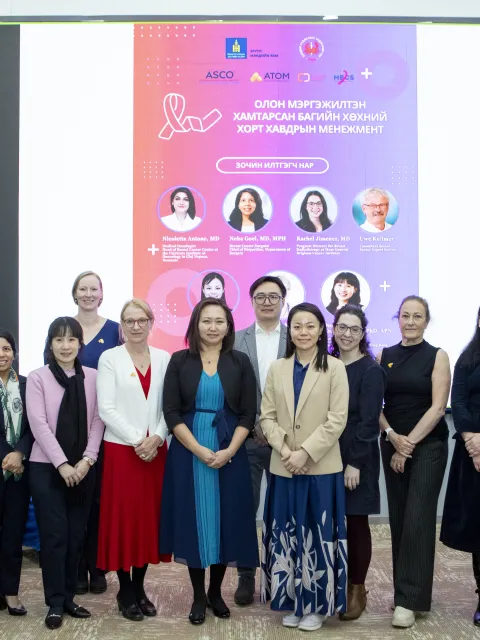
In Mongolia, the Coalition supported the rollout of updated national breast cancer clinical guidelines through clinician training delivered with the American Society of Clinical Oncology, a Coalition partner and UICC member, and supported a comprehensive national cancer action plan.
In El Salvador, a three-year national action plan to improve access to oncology medicines and diagnostics is being finalised, which is focused on strengthening regulatory frameworks, improving data for decision making and enhancing pathology capacity.
And Zambia now has a three-year action plan to strengthen access to essential cancer medicines, focusing on cancer data systems, diagnostics, procurement and the safe introduction of innovative treatments.
The Coalition has also expanded its country engagement. In Uganda, UICC has signed on behalf of the Coalition a memorandum of understanding with the Ministry of Health covering technical assessments, stakeholder coordination, and national governance arrangements.
In Indonesia, UICC also signed on behalf of the Coalition an agreement with the National Cancer Center, Dharmais Cancer Hospital, to strengthen access to affordable, quality assured medicines and diagnostics for chronic myeloid leukaemia.
The driving idea behind the creation of the ATOM Coalition is that the issue of medicines access cannot be separated from the systems that enable their safe and effective use.
This is why the Coalition’s country work increasingly focuses on practical enablers such as cancer data quality, forecasting, procurement planning, pathology, diagnostics, regulatory readiness, clinical guidelines, treatment monitoring and health financing.
The Coalition has also continued to develop global public goods to support country decision making. Its health financing work has produced case studies focusing on Georgia, Kenya, Zambia, and the Philippines, highlighting how countries are financing cancer care, where gaps remain and how essential oncology medicines and diagnostics can be better integrated into universal health coverage.
These achievements have been made possible by the breadth and commitment of the ATOM Coalition’s partners and network, including governments, UICC members, procurement and supply partners, clinical societies, diagnostics partners, industry, patient organisations and technical agencies. Over the past four years, their collective expertise has helped establish practical access pathways, generate global public goods and support country led action across the cancer care continuum.
“As we mark four years of the ATOM Coalition, we are proud of what this partnership model has already made possible: new access pathways, stronger country engagement, and tangible progress for people living with cancer in low and lower middle-income countries. The number of people living with cancer who now have access to medicines is growing rapidly. The next phase is about turning availability into uptake, and uptake into lasting patient impact. That will require continued trust, technical expertise, and collective action across the Coalition.”
– Dr Cary Adams, CEO, UICC.
As the ATOM Coalition enters its fifth year, it is moving into a new phase of work, the next 18 months will be focused on maximising the use and impact of the medicines and diagnostics already available through the Coalition pathways. The aim is to double the number of people living with cancer in ATOM Coalition countries who receive appropriate, priority, quality cancer medicines by 2030.
To achieve this objective, the Coalition will place greater emphasis on country engagement, partner enabled-delivery, and a more facilitative role for the Secretariat which is based in UICC. The aim is to connect partner capabilities, country needs and available access opportunities more effectively, so that medicines and diagnostics translate into real uptake and patient impact.
Last update
Thursday 21 May 2026