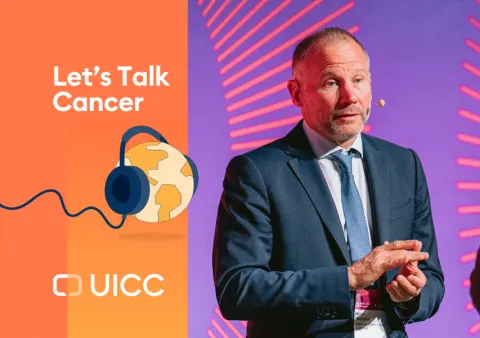
Podcast "Let’s Talk Cancer" – Making sense of cancer staging and treatment decisions
In this episode:
Cancer staging is one of the first things people hear after a diagnosis, yet many patients and families are unsure what it actually means.
In this new episode of Let's Talk Cancer, Cary Adams speaks with Professor Olivier Michielin, Chair of the Department of Oncology at Geneva University Hospitals, a UICC member and host of the World Cancer Congress in Geneva in 2022 and 2024, about how cancers are staged, how those assessments guide treatment decisions, and how advances in cancer care are changing the way clinicians think about treatment pathways.
Learn how doctors communicate often complex information to patients, respond to the use of AI by patients and in their own work, the role of multidisciplinary tumour boards, and how treatment decisions are shaped not only by scientific evidence and clinical guidelines, but also by a person's preferences, values, quality of life and individual circumstances.
See podcast transcript below
Listen on:
Spotify | Stitcher | Apple Podcasts | Amazon Music | Audible | Deezer
Podcast transcript
Cary Adams: Hello and welcome to Let's Talk Cancer, the podcast where we explore some of the latest developments, stories and insights in cancer control around the world. Today, we're looking at a topic that almost every person diagnosed with cancer faces very early in their journey, but one that can feel often confusing and intimidating: the cancer stage and the treatment decisions. The TNM staging system has been managed by UICC for many decades, and it allows oncologists to share and understand the nature of a particular cancer. The T in TNM describes the size of the tumour and its location. The N describes whether the cancer has spread to lymph nodes or not. And the M describes whether cancer has spread to another part of the body or not. What does it actually mean when a doctor says a cancer is at stage I, II, III or IV? How does that information guide treatment? How do doctors speak about this to their patients, and how do they balance the goal of treating the disease with respecting a person's wishes and their needs in terms of quality of life and well-being. To help us answer those questions, I'm delighted to be joined by Professor Olivier Michielin, Director of oncology at Geneva University Hospitals, one of Switzerland's leading cancer centres and a long-standing partner of UICC, including for the World Cancer Congress when it comes back to Geneva in 2028. Professor Michielin is both a practising oncologist and a leader in cancer research and care delivery, giving him a unique perspective on how treatment decisions are made, how they're explained to people living with cancer and their families. Olivier, thank you for joining us today. I really appreciate you making the time. But before we jump into staging and treatment, could you tell us a little bit about your role as the Director of oncology at the Geneva University Hospital Hospital? What does it do?
Dr Olivier Michielin: Yeah, the University Hospital of Geneva, like in many big centres, we're splitting our time between patient care but also research and also teaching. So, we have a mix of activities. Of course, patient care is at the heart of our occupation preoccupation. We really try to deliver the best possible care for each and every patient. And clearly staging is a very important part of this care. So, we really try to do staging for each patient very rapidly so that we can have a clear answer quickly. And of course, we then try to get the patient into one of the treatment lines as rapidly as possible.
Cary Adams: So, someone is diagnosed with cancer and one of the first things they hear is what you said, the stage of the cancer using the TNM system of staging. What does that staging mean from an oncologist perspective?
Dr Olivier Michielin: So, for us as medical oncologists, the staging is really important. It's the starting point of our action. First we need to really make sure we do stage the patient very carefully and the stage itself will determine how we're going to go and proceed with the patient. So, if the stage is very limited, we might have some strategies. If unfortunately, the disease has spread larger and is metastatic stage, for example we will have to use other strategies. We'll probably come back to this, but the stage is really just a starting point. It's a metric of how much the disease has spread. It's linked to the prognosis, but it doesn't tell everything about the cancer because the cancer still has a lot of differences between one tumour and another.
Cary Adams: And just for those who are unfamiliar with it, TNM stands for tumour node and metastases. So, it's quite a simple methodology, isn't it?
Dr Olivier Michielin: No, absolutely. It's clearly an oversimplification and one of the ways to see that this is oversimplified is the fact that two patients with the same TNM stage can have different outcomes. So, we clearly are not capturing all the complexity with this. Nevertheless, it's a very good way to get an overview of how far the disease has spread. It's an international norm, which means that you can take this stage all over the world, and it will be evaluated the same way, which is very important. It's also very important to build the evidence because we want to know what works at which stage of cancer. And clearly, if we want to bring the data for the whole planet together, we need this way to categorise the patient in an effective way.
Cary Adams: Who actually does the staging, is it you or is it a pathologist who actually does that?
Dr Olivier Michielin: So usually the staging is teamwork. Clearly, the medical oncologist will be an important partner there, but we need pathology for example, at the T stage, we need to know what's the size of the tumour, certain properties of the tumour. But then of course there are additional metrics like the end stage and there to get the N stage, you might need, for example, to go and capture a lymph node, and that will be done through surgeons. And then to quantify the M stage, the metastatic stage, you probably will rely on some whole-body imaging. So that's a collaboration either with nuclear medicine or radiology, where you're going to be able to really detect whether or not there are signs of the extent of the disease beyond just the local regional system.
Cary Adams: How much does the stage really affect the treatment line that you're going to go through. If it's stage I and II, is there a big difference in the treatment?
Dr Olivier Michielin: So, there are really no major differences in the early stages as well for sure. I'll take melanoma here as an example. If you have stage I melanoma, most likely this is going to be just surgery alone. And your chances of remission in the long run are really good. Now if you are on stage II, it depends a little bit on substage II. And there you're going to go from also just surgery and nothing else to maybe adjuvant treatment again which really does change a lot. And then when you move to stage III, that's again, a place where there is a debate for some stage III, whether you should do an adjuvant immunotherapy or not. So just, you know, from stage I to II to III already There is a huge complexity of treatment options that is really linked to the precise stage.
Cary Adams: And how do you explain the staging to the patient, so they understand what it all means?
Dr Olivier Michielin: Oftentimes we will see the patients at several occasions. As you know, usually they will come with just the primary diagnosis and then we need to work out the staging with them. Yet keeping very clear the fact that this is not determining everything about their future, their sensitivity to the treatment will be sometimes very important, sometimes more important than the initial staging, sometimes not. It depends a little bit on the tumour type, the treatments that we can deliver. But clearly, I think we need to go hand in hand with the patient and to really try to explain in very comprehensible terms and in simplified ways what it means for their specific case. And very importantly, how the changes in staging can impact what we need to do to get them to the best possible solution. And second, we need to to embark the patient with us. I think that's something that we have realised over the years that, you know, this sort of paternalistic way of doing medicine in general, where the doctor knows and the patient just follows, is not the most efficient way to do teamwork.
Cary Adams: Is it common for patients to come to you with information they found online? I ask because I did a quick check this morning. I looked up on the web stage III breast cancer and on the first site that came up the first bullet point was the five year relative survival rate for stage III breast cancer. It said that it is around 86% for females and 84% for males, but these rates are constantly improving. So, for me, it was interesting that the first thing that came up was on a website was about five-year relative survival rate for stage III breast cancer. I mean, surely that's a conversation you have quite regularly where people go away, do a bit of searching and come back and say: "my five-year survival rate is X percent". Is that something that comes up?
Dr Olivier Michielin: Well, absolutely. I mean, it depends a lot from one patient to another. We still have patients that come and haven't carried away a large search, but I would say most of them nowadays will have some level of AI being used to gather information. And I think it's actually a good thing because it's putting the patient up to speed. They know already some of the basics. And then for us it's a matter of contextualising what the patient got from the internet or from AI to his specific case. Sometimes the difficulty is for the patient to know enough about the details of his presentation so that we can really give him the complete picture.
Cary Adams: But presumably the more information that the patient is getting from you as their oncologist, they can put that into an AI agent on the web and come back with their own questions and challenges about their treatment and what treatment is available around the world, etc.
Dr Olivier Michielin: Absolutely. And we actually welcome this. I think it means that the patient is taking action on his or her hands. I think there are some caveats. Some of them around the fact that to get a precise answer, you have to upload a very precise case description and it's not as easy as it looks. You know, it's not just plugging the diagnosis because there might be a lot of additional factors. So, I think the issue with AI is not necessarily the answer that AI will give. Now the question is: are you uploading only correct information and most importantly, all the meaningful information. And that's where there is a big issue. And so, for us, it's very important when the patient comes back with, you know, AI generated treatment options to be able to justify why that's not an option, because there is this. And then probably the patient can go back to the chatbot and confirm that: "Yes. Oh, I didn't know that this was an important factor.” And I think it's an opportunity here to again mention that we're getting to a more and more scientific way to do medicine. And at the same time, we have to make medicine more and more human. It's not because we have a very scientific discussion that we cannot be human. I think, you know, at the end of the day, this human to human, doctor to patient discussion, comes as extraordinarily important and will not be changed by AI. So, I think it's really something that we need to engineer into our thought process and to make sure we actually enable patients to make the best use of AI because they will go and look at AI no matter what.
Cary Adams: Do you have any concerns about people uploading their medical records onto the web and asking AI chatbots to review them?
Dr Olivier Michielin: Absolutely. More than concerns, certainties that this is not something to be done. I mean, at least for doctors. It's absolutely clear that we will never, ever put a record on a chatbot. I mean, there are ways to run large language models locally under secured premises. All these things are happening as we speak. But for a patient, it has to be clear that no one masters what will happen to this information if released like that on the web. Now, that being said, I think it's reasonably easy to do a theoretical abstraction of a case, keeping in mind that if there are a lot of streams of data for that patient, there is always a risk that despite everything being anonymised, there is a way to recompose who this person eventually could be. I think at the patient level, asking theoretical questions out of some of the aspects that had been discussed during the consultation is reasonable.
Cary Adams: To alleviate the TNM manual UICC updates every few years. How do you stay up to date with what is the right treatment for your patients?
Dr Olivier Michielin: I would say it's a big part of our job. It's probably one of the most important ones. We go to Congress, we run clinical research ourselves, we discuss with our peers. So, it's a very important task to really know what are the critical studies that are being conducted, knowing when the results will be available, sometimes being able to anticipate some of these results because we already have other types of evidence that can be used... So basically, you know, being ahead of the curve or making sure that we are absolutely on time with new developments is critical.
Cary Adams: And presumably you run trials at the university as well? So how do you make a decision on what trials to actually get involved with?
Dr Olivier Michielin: So clearly, we want to have a portfolio of trials. We want to be able to maybe offer 1 to 3 trial options at every stage. And one of the things we're trying to do also is to have a sequence of trials so that in case someone doesn't get a benefit from one given trial, there is another one where he could be enrolled. And of course, we're trying to find space where clinical trials can be useful in the normal standard of care.
Cary Adams: You mentioned something about involving the patient more now than you did, maybe in the past. So not you specifically, but the oncology profession more generally. So presumably entering a trial is a big decision for a patient and for their family. So how does that conversation go?
Dr Olivier Michielin: Yeah, I think it's a little bit linked to what we were saying that, you know, if we offer a clinical trial, it has to make sense at the time when the patient enrolls. And then the second part is that we're going to learn also collectively. So, it's not just a benefit for the patient, but also it's a collective benefit because we might prove that treatment X is better than Y in that setting and probably in that stage. And so, I think if we can manage the patient benefit, yet, also collecting information that will be useful for the patients to come, then I think it's reasonable to propose a clinical trial. It's important to know that clinical trials, they have gone through a lot of regulatory elements. One of them is, of course, the ethics committee. So, there is an ethics committee that will make sure that it's totally reasonable to make this proposition to a patient at this time point.
Cary Adams: Olivier, do you find that the family do get engaged generally in the decisions about patient treatment and care?
Dr Olivier Michielin: So clearly in oncology and everywhere in medicine the person to which we talk to first is the patient and then the patient makes the call on how much and how large he wants a family involvement. As medical oncologists, we welcome this. In our experience patients who have strong family surrounding them, we see this as a big plus. I mean, it helps the discussion, it can help the openness, the expectation. It's very difficult for a patient to have the burden on its shoulder only. So, I think having also the information being shared is something very important.
Cary Adams: What about the family circumstances? What sort of factors outside the age, for example, of the individual that what do you take into consideration when you're considering the treatment? So, you've got TNM, and you've got your molecular analysis. What about those things?
Dr Olivier Michielin: Yeah. I think these are very important factors. I think the resources that the patient might have in the family or might not have can strongly influence, for example, the tolerance and the capacity of the patient to go through treatment. I think for us as medical oncologists, it's very difficult to assess that and also to assess the dynamics of the familial ecosystem. But I think what we need to do is, if there is a treatment that has a huge advantage, we're going to have to say that no matter what and say, no, that's clearly the best you can have, that's clearly what we recommend. Now, if you believe that for whatever reason this cannot be achieved, here is the second option. So that's an example where we would highly prioritise a treatment. But of course, sometimes the ecosystem around the patient or the patient himself can actually not sustain whatever constraints are linked to this. But then I think the patient needs to be fairly aware that he's reducing chances of response or, you know, some benefit. And then this decision has to be strongly balanced.
Cary Adams: Olivier, do you provide training to oncologists on how to have those conversations?
Dr Olivier Michielin: Yeah, I think it's essential. I think most centres, most curriculum have this engineered in the system. I think we really need to develop skills and it's probably a lifetime job, learning how to talk to the patient, learning how to accept that the patient can be saddened, can be depressed and not try to push this away as a clinician and just look at the the future in a positive way. I think sometimes we really have to fight ourselves to accept the very strong difficulties that the patient is going through. So, I think it's learning to get there, but it's absolutely essential.
Cary Adams: Finally, Olivier, you know, you've talked about AI and in the years to come, do you think that AI is going to have an impact on how patients are treated, as well as the way in which they're diagnosed?
Dr Olivier Michielin: Yes. I'm absolutely convinced that AI will revolutionise the way we do oncology. And also, of course, the way we look at at staging, I think clearly there are ways, for example, to look at images and now we can use deep neural networks to understand images, to actually understand the interactions between the various cells in the cut of the tumour and that's extremely important because it can tell us a little bit how, for example, the immune system is interacting with the tumour. And we are, for example, conducting research in that area. AI can find the way the immune cells are arranged around tumour cells, around blood vessels, around various structures, and from there we can sort of predict whether immunotherapy will be a good option for this patient. So that's an example where AI could become a tool to help select the treatment for the patient in a more personalised way. Not of course, in contradiction with the TNM, but maybe within one of the TNM classifications. For example, if a patient needs an immunotherapy, a melanoma patient to come back to this example, it's a stage III B. You could imagine having an image of the tumour that tells: well, I think with the immune component that we see there, the patient should have nevertheless a very good prognosis and perhaps does not need this treatment. Or on the contrary, it is an earlier stage but here we see that there is a very unfavourable interaction of the immune system with the tumour. Maybe despite the fact that this is a lower stage, we should think about having an adjuvant treatment with immunotherapy. So that's an example where AI could help within the TNM the classification be used to actually fine tune what would be the best treatment option.
Cary Adams: Olivier, thank you very much for that. It was fascinating as ever. Great to talk to you and I do hope we'll see you around since we're both in Geneva and perhaps at the World Cancer Congress in 2028 when we come back to Geneva.
Dr Olivier Michielin: Thank you so much, Cary. It was a pleasure.
Cary Adams: Thank you for listening to this episode of Let's Talk Cancer. If you like this podcast, give us a rating and subscribe for more content every month. And if you want to know more about UICC’s work, visit uicc.org or follow us on social media. See you again soon.
Last update
Wednesday 19 August 2026