48 hours to referral, 14 days to diagnosis: Qatar's precision cancer care model
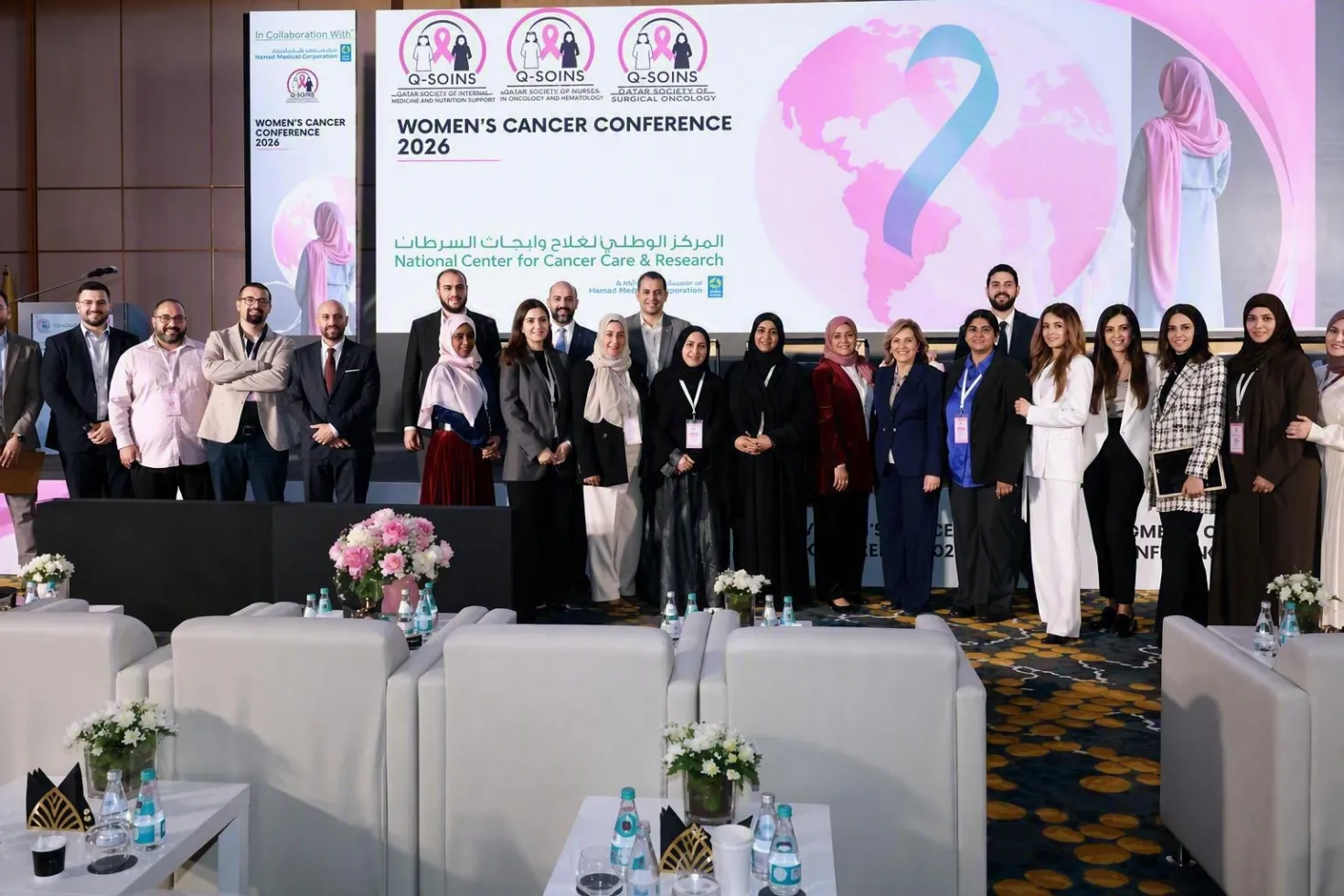
Dr Salha Bujassoum Al Bader, President of the Qatar Scientific Oncology Innovation and Networking Society (Q-SOINS), a UICC member organisation, discusses how Qatar has improved cancer care through education, raising awareness, and networking, and delivered more personalised care.
HIGHLIGHTS
- In an interview with UICC, Dr Salha Bujassoum Al Bader, President of the Qatar Scientific Oncology Innovation and Networking Society (Q-SOINS), a UICC member organisation, explains how multidisciplinary tumour boards, biomarker testing, and molecular diagnostics are helping to deliver more personalised cancer treatment across Qatar.
- Suspected cancer cases are referred to specialist care within 48 hours through a nationally monitored pathway.
- Dr Bujassoum describes how access to cancer treatment, genetic testing and precision medicine services has expanded through Qatar's evolving cancer control strategy.
- She emphasises that while clinical pathways have reduced system delays, increasing awareness and participation in screening remains critical to reducing late-stage diagnosis.
Qatar has spent more than a decade building a cancer care system that combines organised screening, rapid diagnostic pathways, multidisciplinary care, and the growing use of genomic technologies.
According to Dr Salha Bujassoum Al Bader, President of the Qatar Society for Oncology Innovations and Networking (Q-SOINS), a UICC member organisation, the goal is not simply to introduce new technologies, but to ensure that people with cancer receive more accurate diagnoses and treatments tailored to their disease.
“If we suspect cancer, the patient must be referred to a tertiary hospital within 48 hours and receive an appointment within 48 hours,” says Dr Bujassoum. “All necessary diagnostic tests, including imaging and biopsies, should then be completed within 14 days. The patient is discussed at the tumour board once those investigations are complete, and treatment should begin within 14 days of the multidisciplinary team discussion.”
Those deadlines are monitored with electronic medical records in both tertiary and primary centres that allow a person to be traced from initial suspicion through to referral. Key performance indicators show where the pathway is slipping.
Cancer testing and treatment are provided free of charge to Qatari citizens and at minimal cost to residents and nationals of other Gulf Cooperation Council (GCC) countries, who are eligible for care on the same terms.
“Most people face little or no financial barriers to receiving treatment, medicines, or genetic testing, with support from non-governmental organizations and charitable foundations,” Dr. Bujassoum confirmed. “In addition, Qatar is preparing to introduce an insurance scheme aimed at ensuring more consistent and equitable access to these services.” Together, these initiatives further strengthen Qatar’s commitment to ensuring equitable access to advanced cancer care and genetic testing for all patients
The development of personalised oncology
While Q-SOINS was founded in 2025, efforts to strengthen cancer screening, expand diagnostic services, and embed multidisciplinary decision-making throughout the health system, date back over a decade.
Dr Bujassoum trained in internal medicine, haematology, and oncology at the University of Toronto before returning to Qatar in 2003. At the time, the country did not yet have a national breast cancer screening programme, and she helped launch a hospital-based pilot initiative.
Then in 2011, Qatar launched its first national cancer strategy, which introduced national screening programmes, a cancer registry, and multidisciplinary tumour boards.
“As screening expanded and cancer registry data accumulated, clinicians began to identify a notable number of breast cancer cases occurring in younger women," says Dr Bujassoum Al Bader. “This is when I became interested in cancer genetic and precision medicine.”
Dr Bujassoum established specialised cancer genetics clinics for breast in 2013. Three years later, they extended testing in 2016 beyond breast cancer to other hereditary syndromes, including Lynch syndrome, an inherited genetic condition that greatly increases the risk of developing certain cancers, especially colorectal and uterine cancer.
This effort to better understand why some cancers are affecting people at a younger age has since evolved into a broader precision oncology programme that integrates genetic testing, molecular diagnostics, multidisciplinary care, and research into routine clinical practice.
“For many years, personalised or precision medicine was seen as the future of cancer care,” says Dr Bujassoum. “In Qatar, precision oncology is increasingly becoming part of everyday clinical practice.”
The term itself covers more ground than genetics alone. “With precision oncology, you treat and diagnose or prevent cancer using the genetic makeup or biological markers of a person, and also consider environmental factors and lifestyle,” says Dr Bujassoum.
She is also careful to separate two things that are often conflated: Most of the genetic changes that cause cancer occur in the tumour itself rather than being passed down from a parent. “Only about 5 to 10% of cancers are inherited diseases.”
While precision oncology is often associated with sophisticated genetic testing, the process starts with more familiar tools such as imaging, biopsies, pathology, and biomarker testing. These investigations help clinicians understand not only where a cancer has developed, but also the biological characteristics that may influence treatment decisions.
As Dr Bujassoum explains, different cancers can behave very differently even when they arise in the same organ. Analysing molecular markers allows clinicians to identify which treatments are most likely to benefit a particular individual, and which are unlikely to be effective.
To support these decisions, clinicians increasingly use advanced genomic tools, including next-generation sequencing panels, whole exome sequencing, liquid biopsies, and molecular tumour boards that review complex cases and assess potential treatment options. Research has also become more closely integrated with clinical care.
I served as Principal Investigator in collaboration with researchers from Hamad Medical Corporation, Qatar Biobank, and the Qatar Precision Health Institute. Together, we have identified inherited cancer-related genetic variants and established pathways to validate and return clinically significant findings to participants. In some cases, this has enabled the early detection of cancer among individuals and family members who might otherwise have remained unaware of their inherited risk, allowing them to benefit from earlier diagnosis and timely intervention.
The gap that remains: early detection
Today, Qatar’s cancer strategy places strong emphasis on early detection, evidence-based care, research, and precision medicine. A recent Lancet Oncology analysis, to which Dr Bujassoum contributed, explains how investments in specialised infrastructure, digital health systems, and cancer research have helped shape a regional model for cancer care and innovation what described as.
According to Dr. Bujassoum Al Bader, however, organised pathways and public awareness remain just as important as sophisticated technologies.
Qatar has invested heavily in reducing delays within the health system through clear referral criteria, an urgent cancer referral pathway and a national cancer framework that is updated every five years.
Late diagnosis has not disappeared, however. Across Saudi Arabia, Qatar, and Jordan, between 40% and 50% of people with cancer still present at a late stage, according to the Lancet Oncology Series on cancer control in the Middle East, for which Dr Bujassoum was one of the authors for Qatar.
“The main reason that I see is that people often wait too long before seeking medical advice or participating in screening programmes. Stigma, in particular, keeps people away from screening and from the clinic. Cultural factors can also influence how care is delivered.”
Many women, particularly Qatari nationals, prefer to be seen by a female oncologist, which is part of what drew Dr Bujassoum to women's cancers in the first place. The centre runs awareness programmes with the Qatar Cancer Society and the Gulf Cancer Federation, alongside conferences and masterclasses for health workers across the region.
The centre has also expanded its services to address the wider needs of people living with and beyond cancer. Cardio-oncology, run jointly with cardiologists, supports patients who develop heart complications during treatment. Reproductive oncology was established after clinicians found that some young women were declining chemotherapy because of concerns about fertility; the programme now offers fertility-preservation options, including egg freezing. And community survivorship programmes support people living five or ten years beyond diagnosis, helping to transition their care to community hospitals and primary health centres.
Equity in access: what health systems with fewer resources should prioritise
“At a minimum, health systems need access to ultrasound and plain X-rays," says Dr Bujassoum. "Where possible, CT scans should be available to identify lesions and determine the stage of disease.”
She emphasised that imaging alone is not enough. “You also need pathology services and biomarker testing to distinguish between different types of cancer and guide the most appropriate treatment,” she said. “Training can be strengthened through partnerships between countries and with established cancer centres.”
Some technologies now entering cancer care may also help address gaps in specialist expertise, according to Dr Bujassoum. “In our breast cancer screening programme, artificial intelligence is used as a second reader of screening images alongside a radiologist.”
She also sees potential for AI to support treatment selection and the remote interpretation of scans, which could be particularly relevant in settings where there are too few radiologists or cancer specialists to meet demand.
As precision medicine and artificial intelligence become more widely available, Dr Bujassoum sees new opportunities to extend specialised care beyond major cancer centres. Whether through a radiologist, a tumour board or an algorithm, the value of those technologies still depends, however, on people being diagnosed in time to benefit from them.
Last update
Tuesday 25 August 2026