Why are skin cancer cases still rising: contrasting challenges in Canada and Brazil
HIGHLIGHTS
- Rising skin cancer rates reflect both past sun-exposure habits and emerging challenges such as social media trends.
- In Canada, changing behaviour remains a major obstacle despite high levels of public awareness.
- In Brazil, cost and access to sunscreen are significant barriers for many outdoor workers and remote communities.
- Mobile clinics, community outreach and early detection programmes are helping bring prevention and care closer to those most at risk.
Although decades of awareness campaigns have stressed the dangers of sun exposure, cases continue to rise worldwide, making skin cancer, including melanoma, one of the most commonly diagnosed cancers. More than 1.4 million cases were recorded in 2024, with over 80% linked to UV or radiation.
While the circumstances may differ from country to country, organisations working to reduce the burden of skin cancer face many of the same challenges: raising awareness, promoting early detection, and improving access to prevention and care.
In Canada, for example, where skin cancer accounts for one-third of all new cases, changing behaviour, not awareness is often the greatest challenge, says Falyn Katz, CEO of Melanoma Canada, a UICC member.
Canada's long winters often mean people embrace every opportunity to spend time outdoors once warmer weather arrives. But according to Falyn, today's rising incidence of skin cancer also reflects behaviours established decades ago.
“The main problem isn’t a lack of awareness, but daily habits. In part, we’re seeing rising rates because the generation that is now in their sixties and seventies were the ones who sat outside with reflectors and baby oil and thought having their skin nice and crispy was the way to go,” Falyn explains. “And now they are paying the price.”
Yet new challenges continue to emerge. On social media, trends such as ‘tanmaxxing’ encourage prolonged UV exposure and even intentional sunburn without sunscreen. According to Falyn, these messages make it increasingly difficult to reach younger audiences.
“It’s a dangerous culture of listening to people online who are not necessarily medical professionals. Gen Zers are led to believe that a tan is sexy, and they are definitely harder audiences to educate.”
In Brazil, where skin cancer is among the country’s most common cancers, the main barrier for many communities is not misinformation but affordability, according to Juliana Caixêta, Medical Director at Saúde, Alegria e Sustentabilidade Brazil (SAS Brazil), a UICC member organisation who works closely with people living in large rural and remote areas.
“We have kind of a wave in Brazil of people who don't believe in sunscreen. For example, some artists, some influencers, digital media people say they don't wear sunscreen,” says Juliana. “But the main problem is that many people work outdoors and are always exposed to the sun for a long period of time, with low or no protection. If we don't give them the sunscreen, they don't have money to buy it, even really inexpensive sunscreen,” she explains.
To address this, SAS Brazil focuses on making sunscreen available to remote and exposed populations. “Once we give them the sunscreen, they use it,” says Juliana.
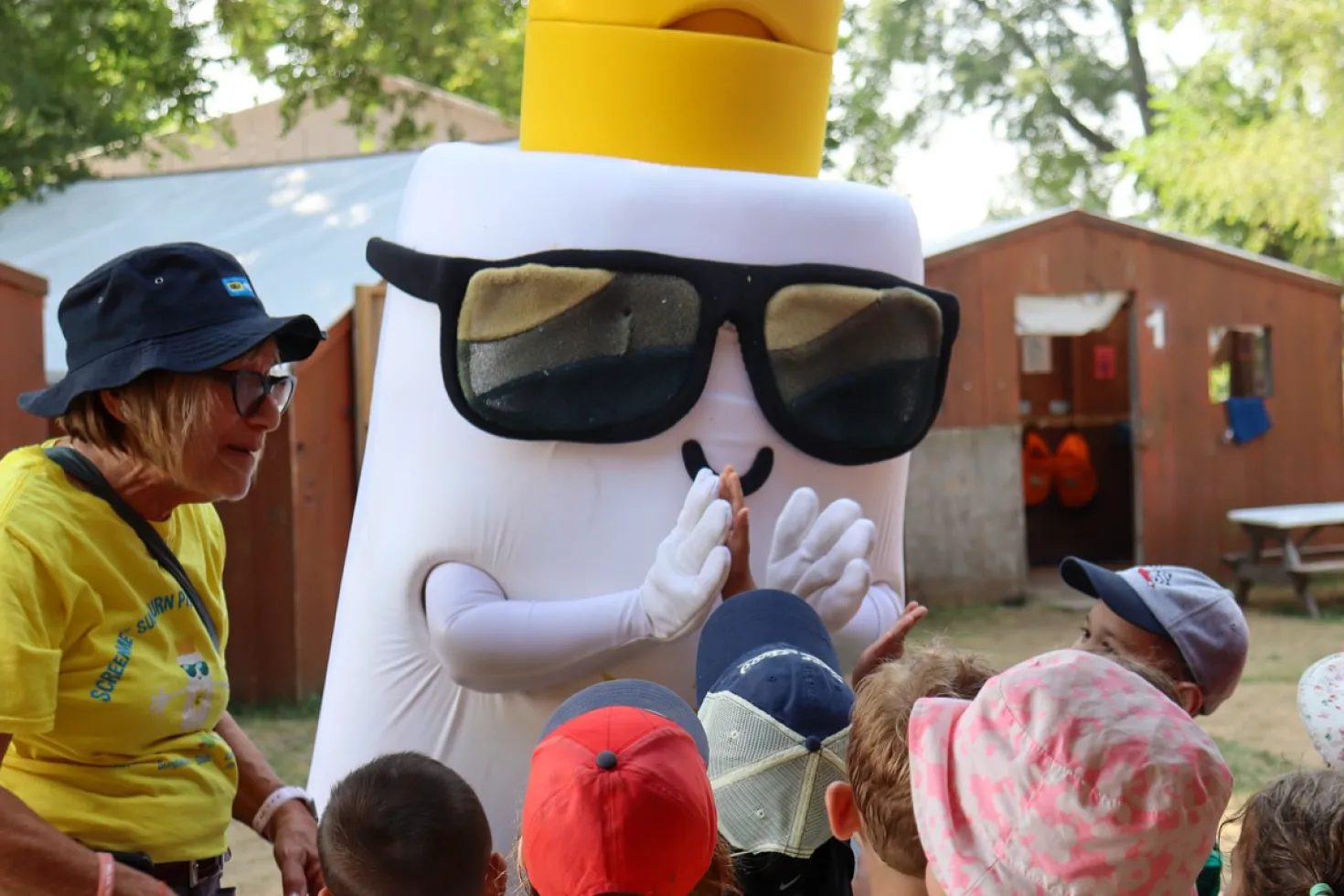
For Melanoma Canada, prevention means shaping behaviours before sun damage has a chance to accumulate. Falyn believes those efforts must begin early and involve both children and their parents. Through a series of initiatives in schools, camps, community outreach, online resources, and with SPF Sam – the organisation's friendly sunscreen-tube mascot and ambassador for sun safety – the organisation encourages Canadians to adopt sun-safe habits from an early age.
“At a certain point we understood smoking kills, and we implemented laws to restrict smoking, warn about the dangers, and encourage people to stop. We have to understand that the sun can also kill,” explains Falyn. “Our goal is not simply to raise awareness, but to help people make everyday decisions that will reduce their risk of developing skin cancer later in life.”
The importance of prevention and screening
Skin cancer encompasses several different diseases. Around 90% of cases are non-melanoma skin cancers, which are generally less aggressive and highly treatable when detected early. Melanoma represents only a small proportion of diagnoses, yet accounts for around 80% of skin cancer deaths because it is much more likely to spread.
Despite this, many people underestimate the seriousness of skin cancer. “People don't take skin cancer seriously enough,” Falyn Katz explains. “They think ‘it's a mole or a lesion, I'll get it taken off and I'll be fine’.” In a similar way, Juliana Caixêta highlights that because skin cancer is not always associated with high mortality, people often fail to recognise its seriousness.
For these reasons, both women stress the importance of prevention and screening. It is impossible to know from appearance alone whether a suspicious lesion is harmless or potentially life-threatening. A definitive diagnosis requires a clinical examination and skin biopsy. Even when not fatal, untreated skin cancers can lead to significant complications, including extensive surgery and permanent disfigurement.
In Brazil, SAS trains nurses and primary healthcare workers who travel around Brazil, as well as local health providers, to discover suspicious lesions and refer patients more quickly. They also work in close collaboration with the local healthcare systems to identify the patients in need and reach out to them directly.
For Melanoma Canada, one of the biggest challenges is helping people make skin protection part of everyday life.
“Many understand the risks associated with UV exposure and yet fail to consistently use sunscreen, seek shade, or monitor changes in their skin,” explains Falyn Katz. “It's not a part of their daily routine like the way we brush our teeth in the morning.”
To reinforce these habits, Melanoma Canada developed a range of online educational resources and different outreach initiatives, self-check symptom card that encourages people of all ages to examine their skin regularly and to apply sunscreen.
They also encourage regular skin self-checks and teach people how to recognise suspicious lesions using the ABCDE method , a widely used guide for spotting potentially concerning changes in moles, which prompts people to look for Asymmetry, irregular Borders, uneven Colour, a Diameter greater than about 6 mm, and any signs of Evolution or change in a mole over time.
When access to care becomes the barrier
Despite their very different healthcare systems and income levels, Canada and Brazil face surprisingly similar challenges in providing access to skin cancer care. Geography remains one of the biggest barriers. Many vulnerable populations live hours away from specialised centres, with little to no means of transportation, making diagnosis and treatment difficult to access.
Geography is compounded by a nationwide shortage of specialists. “There are 800 dermatologists in Canada for a population of over 40 million people,” says Falyn. “We need roughly twice as many dermatologists to provide adequate coverage. Part of the problem is that healthcare providers trained in Canada leave the country to work elsewhere.”
Brazil faces a different imbalance. While the country has enough dermatologists overall, many practise in the private sector, leaving shortages within the public health system. As a result, many patients experience long delays before seeing a specialist. “Sometimes people have to wait months to get a referral.”
To help bridge these gaps, Melanoma Canada operates the Mole Mobile, a travelling clinic that brings certified Canadian dermatologists into underserved communities to provide education, screening and referrals. “The Mole Mobile was really designed as a program to tackle accessibility and the lack of it, to bring dermatologists to these communities as best that we can,” says Falyn. “Although it cannot solve Canada's shortage of specialists, the initiative shortens delays for many patients.”
SAS Brazil also uses mobile screening units that travel to remote areas to reach populations that don’t have access to care or transportation. On board, people can meet with volunteer nurses trained to recognise suspicious lesions and volunteer dermatologists who examine patients and arrange referrals when needed. SAS Brazil also offers a tele-dermatology service to reach populations who cannot travel for a first consultation or a follow-up appointment.
Through their work, Melanoma Canda and SAS Brazil show that raising awareness is only one part of preventing skin cancer. Whether the barrier is distance, cost, trust or access to specialists, people also need to be able to act by protecting themselves and seeking care. Through different initiatives such as community outreach, mobile services and local partnerships, both organisations show the importance of meeting people where they are. Their work not only helps reduce barriers to skin cancer prevention and care but also highlights the broader health system changes still needed to ensure everyone has access to timely diagnosis, treatment and support.
Last update
Monday 27 July 2026