“If I can save one other man from going through what I went through”: a son’s message, a mother’s mission
When Joey Barnes was diagnosed with testicular cancer, he responded with humour, a podcast, and a promise to speak openly about a disease many men never discuss. After his death, his mother founded Having a Ball, a UICC member organisation, to keep that message alive.
HIGHLIGHTS
- Joey Barnes, a Canadian based in Neuchâtel, Switzerland, was diagnosed with advanced testicular cancer in 2021 at age 40, and died 16 months later. During treatment, he co-hosted a widely followed podcast to raise awareness and break taboos around the disease.
- Testicular cancer has an overall five-year survival rate of around 95% when caught early. Late diagnosis remains the key risk.
- Having a Ball, founded in Neuchâtelin 2023 by Joey's mother Annemarie Barnes, his brother Kevin and several friends, works to raise awareness of testicular cancer through outreach in companies, schools, festivals, social media, and fundraising events.
- The association joined UICC in 2026 and works to normalise conversations about men's health and encourage early self-examination.
Joey was 40, based in Neuchâtel, and working as a voiceover artist and radio presenter when he was diagnosed with testicular cancer in June 2021.
He immediately called his best friend Andreas Enehaug, a Norwegian filmmaker whom he had met at film school in London more than a decade earlier and who was now back in Norway. The two men had not seen each other in years, but had spoken almost every day without fail.
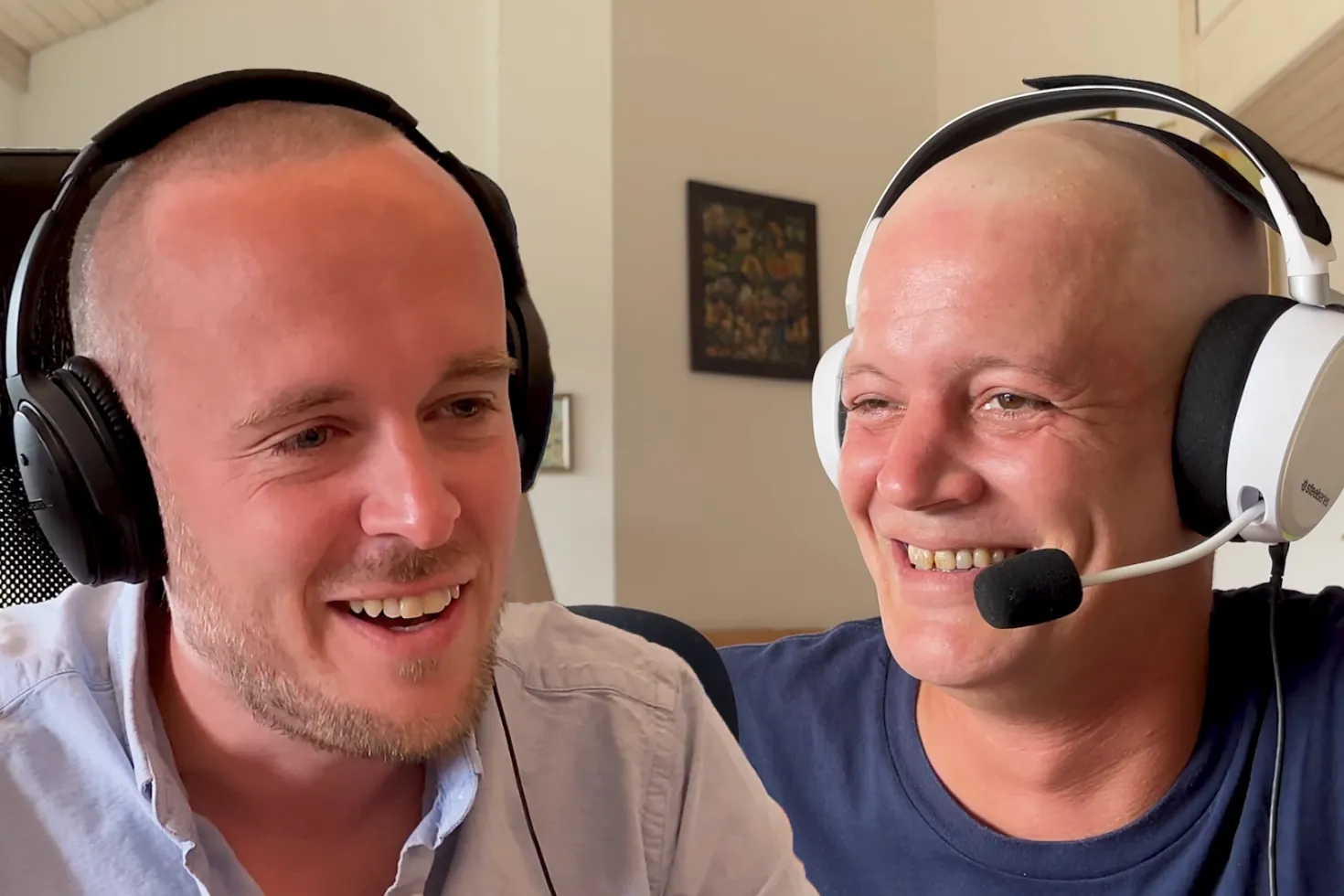
They decided to start a podcast, recorded remotely between the two countries, about Joey’s cancer journey, using humour to talk openly about cancer, the diagnosis, the psychological impact, and other aspects of managing the disease. They called it Having a Ball.
“At the beginning, Andreas was sure everyone would hate him because he and Joey joked so much about his cancer,” recalls Annemarie Barnes. “There were no taboos whatsoever. But that’s what Joey wanted.”
Humour was the point. Joey Barnes had noticed from his own experience that men do not generally talk so easily about what might be wrong with their bodies the way women do. “When you're a guy and you're in the shower and you feel something is off, you do not go to the bistro that evening, see your buddies and say, ‘hey, I felt a lump in my testicle’,” he said in one of his earliest episodes, a line his mother has repeated many times since. “But a woman would immediately tell her mother, her sisters, her daughters, her best friends, and everyone wouldsay: ‘Go to the doctor!’”
Joey had not gone to the doctor. By the time he was diagnosed, the cancer had spread. “He spent 140days of the following 16 months in hospital. He died on 13 October 2022,” Annemarie says.
Testicular cancer is most commonly diagnosed in men aged 20 to 34, though it can occur at any age. It is one of the cancers that can be detected and treated early, and in these cases the overall five-year survival rate is around 95%.
Joey’s cancer was not caught early. He had experienced back pain, which can signal spread to the lymph nodes along the spine – a common first site of metastasis in testicular cancer – but had assumed it was nothing more than ordinary backache rather than a warning sign of something more serious.
“Though there are other clear early symptoms, they can be easy to miss or dismiss – a heaviness, an irregularity, one testicle feeling different from the other,” Annemarie says. “Pain is not usually a feature, especially in the early stages. That is precisely the problem.”
By the time Joey was diagnosed, the disease had reached stage three, affecting his lungs and liver. He immediately had the diseased testicle removed, followed by four rounds of chemotherapy, which appeared to be quite successful in reducing the tumours. “The next step in his treatment was to be a retroperitoneal lymph node dissection – a major operation to remove the lymph nodes at the back of the abdomen, where testicular cancer commonly spreads first,” Annemarie recounts.
It was during the COVID-19 pandemic, when operating theatres were not running at full capacity, and three months went by before his surgery was eventually scheduled. We'll never know whether that made a difference – he might have died anyway – but it was a very long time to wait.
In the end, the surgery was cancelled, and he instead had several lung operations to remove tumours. This was followed by another four rounds of a different chemotherapy regimen, which was also unsuccessful. Eventually he underwent high-dose chemotherapy andan autologous stem cell transplant,which left him in a coma for a week. At various points, the treatment appeared to be working. Then, each time, the cancer returned.
Annemarie wrote to the doctors after his death because she wanted to find out what happened. “They said that COVID was possibly a factor. But there is also the question of how well he responded to treatment. He had been receiving cisplatin, the standard chemotherapy for testicular cancer, but some patients develop resistance to it. Joey very likely did,” Annemarie says. “But we don’t know for sure.”
“Humour rhymes with tumour”
Joey’s and Andreas’ Having a Ball ran to three seasons. Episodes were published roughly every three weeks and drew thousands of listeners around the world, promoted through Reddit, Instagram, and other platforms.
One early episode generated around 50,000 likes on Reddit alone, after Joey, learning he would lose his hair to chemotherapy, enlisted a professional photographer and a friend who was a hairdresser to document the pre-emptive shaving of his head.
The show covered far more than cancer. There were film references, music, and what Annemarie describes as a very fast, very black sense of humour with no subject off limits. “It wasn't just about cancer, and I think that's what got such a huge reaction,” she explains. It was funny as well as informative, the best way to encourage people to check themselves regularly and take symptoms seriously.
The last episode was recorded in hospital six days before Joey’s death, when Andreas had flown to Switzerland to be with him. They had always said they would continue until the end, even though both had assumed at the time that the end would be remission.
“What most listeners did not know – what most people in Joey's life did not know, actually – was that he was suffering from depression during those final months,” his mother says. “He was just a master at hiding it. He knew he was going to die very soon, and with a lot of pain. Who wouldn't be depressed? But he hid it. He had a psychiatric assessment early in his treatment, and they said everything was fine,” Annemarie continues. “But his mental health was never assessed again, and there was no follow-up.”
This is not uncommon. Regardless of income settings, psychosocial support is often not consistently embedded in cancer care. Emotional and social needs then go unaddressed or are not followed up over time, despite studies showing that a significant proportion of patients experience distress during treatment.
In his last episode, Joey said that if he could save one other man from going through what he had gone through by talking about this experience, his death might be worth something. For several months after Joey's death, Annemarie did not leave her home. “Eventually I realised that if I was to honour his wish, to pursue his work and raise greater awareness around testicular cancer, I had to do something,” she shares. “The idea for an association was the kind that comes to you at three o’clock in the morning.”
She had no prior experience in the non-profit sector. But she had worked for 35 years as an English teacher at a Neuchâtel high school, providing her with a wide network of former students, and a complete willingness to ask for help.
‘Having a Ball’, the Joseph Barnes Association for Testicular Cancer Awareness, was officially founded in June 2023. The association's lawyer and accountant both work pro bono. A friend of Joey's designed the association's distinctive logo.
The association is run almost entirely by volunteers. Annemarie, now 73, works on it full time, without pay. Its headquarters are her home, where she also stores the association's stock of branded merchandise. There are no offices. The budget comes from fundraising events – including an annual pétanque tournament, Joey’s favourite sport, held each August in Neuchâtel – members and corporate partners. It also organises free screening days, with volunteer urologists examining men and providing advice. This year, screenings will be offered in eight Swiss cities.
Among the sponsors, most notably, is Fujifilm, which has spread the association’s testicular cancer awareness message across its offices in nine European countries and ordered more than 100 branded T-shirts for its employees to wear during Testicular Cancer Awareness Month in April.
The main message of the association remains the one Joey articulated himself, which is raising awareness among men, and young men in particular, to seek help when something feels wrong with their bodies. “They fear what it might mean for their fertility, their sexual function, their sense of themselves, but none of those fears, in the case of testicular cancer, are well-founded,” Annemarie explains. “But they persist.”
Having a Ball became a UICC member organisation in 2026. “I realised right away that I could access this huge platform, with an outreach in 170 countries, where our message could reach far beyond our own association,” she says. “Breaking taboos, raising awareness of testicular cancer – that's what we want to keep going.”
Annemarie realises that she won’t be able to manage the association as she currently does indefinitely. The challenge now is to ensure that it can continue without her.
Joey’s podcast remains online and accessible through the Having a Ball website.
Last update
Thursday 02 July 2026