Blog
23 June 2026
How artificial intelligence is reshaping breast cancer screening
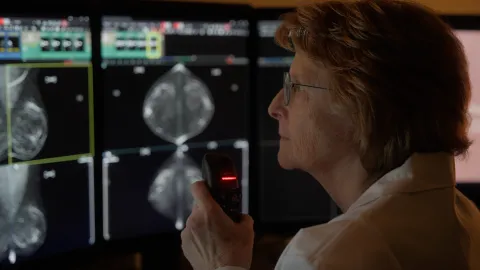
That’s how Janet Storella, a radiologist with more than thirty years of experience reading mammograms, describes her job. The process, she will tell you, has never been simple. Working as a radiologist in breast cancer screening can be demanding and often tedious, given the large numbers of asymptomatic scans that must be read.
When computer-aided detection was introduced to breast cancer screening in the late 1990s, Storella found that the poor user experience only led to distraction. By the time DeepHealth, a global health informatics company and subsidiary of RadNet, the largest provider of outpatient imaging services in the US, approached her to start testing a new AI-powered breast cancer screening workflow, she had reservations.
“I don’t need the AI to tell me that’s cancer,” Storella recalls thinking.
But RadNet’s chief strategy officer Greg Sorensen, a former radiologist himself, saw the benefit of having someone with a critical eye on board. “I wanted some sceptics that would really defend the interest of the patient,” he says.
According to the American Cancer Society, breast cancer is the most common cancer in women in the US, but screening remains uneven. Only about 63% of women in their 40s follow through with recommended mammograms, even as cancer becomes more prevalent in younger women. This unevenness can have a clinical cost.
About 10% of screening mammograms result in callbacks for additional testing, and false-positive results can lead to anxiety and unnecessary biopsies. Adding to the anxiety, women may wait days or weeks for results, and after an abnormal finding, it can take an average of 28 days to receive a biopsy.
The anxiety and inconvenience that come with the mammogram experience can deter some women from coming back. This is especially common among Black and Hispanic women, for whom mortality rates are higher and often linked to delayed screening. For some, additional structural barriers – including limited access to specialist centres, prior negative healthcare encounters and long-standing mistrust of medical institutions – can add even more friction points to the continuity of the screening process.
With those challenges in mind, RadNet deployed DeepHealth’s AI-powered workflow in January 2023. Known as the Enhanced Breast Cancer Detection (EBCD) programme, it aims to help radiologists manage high screening volumes whilst maintaining consistent interpretation standards across more sites – and to extend that consistency into the communities where disparities have historically taken hold. It is cloud-based and built to fit into existing healthcare workflows, making adoption in community settings possible without requiring specialist infrastructure and showing potential to act as an equalising force.
According to DeepHealth, the AI model supports radiologists throughout the reading and reporting process. It evaluates breast density, provides detection support, generates markings and measurements with colour-coded indicators of suspicion levels, and facilitates report writing.
Storella explains, “It’s like having my trusted colleague sitting next to me, helping me work through the most difficult cases.”
After the first radiologist reads and reports the scans, an AI-powered safeguard review activates. The model independently reviews the scan again, and if it flags continued high suspicion, the report is sent to a second expert radiologist for review. Clinicians retain full diagnostic authority, and reports are issued through standard clinical pathways.
According to Storella, the safeguard review can be particularly useful when patients have dense breast tissue, where both healthy tissue and tumours appear white on a mammogram — something she calls the “murky middle.” She adds that no physician wants to be the one to make the life-threatening mistake of missing the disease when this occurs.
“Every missed cancer represents a real person, and that really matters,” Sorensen says.
DeepHealth’s model accounts for the range in how breast cancer usually presents visually, across tissue types and demographics.
Early real-world data from RadNet’s deployment suggests promising performance, with increased cancer detection rates across tissue densities and demographic groups. Data from large-scale use shows a 23% increase in detection for women with dense breast tissue, a 20% increase for Black or African American women, and a 22% increase for Hispanic women. Some feel that these results show potential for narrowing gaps in breast cancer care tied to breast density and race.
“Finding more cancer is really important,” says Sham Sokka, chief operating and technology officer at RadNet. “Finding them across different population types in a similar way – that’s the real shift.”
One case stands out to Storella. A cancer, just five millimetres across – smaller than a pea – had been missed on an initial read. At that size, in dense tissue, it was exactly the kind of finding that falls into the “murky middle”: easy to overlook yet significant to catch. The AI flagged it. A second radiologist reviewed the scan, and the cancer was confirmed.
“That moment changed everything. It was sobering. I thought to myself, ‘Darn, that is a game changer.’ And that made me a complete convert,” she says.
Those results seem to be consistent with broader research. One study shows AI-supported screening increased breast cancer detection rates by 17.6%, from 5.7 to 6.7 per 1,000 women screened, without increasing recall rates. In a separate study, AI assistance improved cancer detection by 13.8% compared to screening without AI.
For Sokka, the ambition goes beyond detection rates. “Screening is one of the most important tools in bending the curve in the fight against breast cancer,” he says. “When trust grows, more women will seek screenings, and a screening programme built on that trust will allow us to create much larger, scalable programmes in the US and throughout the world.”
***
Disclaimer: This article discusses the use of health-trained AI models, which have limitations and may not always be accurate. AI does not replace professional medical advice; human experts remain responsible for its interpretation. For urgent or personal health concerns, consult a qualified healthcare professional.
Advertisement feature presented by DeepHealth and produced for DeepHealth by BBC StoryWorks Commercial Productions as part of the Rewriting Cancer branded content series presented by UICC.
Last update
Tuesday 30 June 2026