Lung cancer at 26: Rasika Bombatkar’s story of diagnosis, stigma, and advocacy
Diagnosed with stage 3B lung cancer at age 26, Rasika Bombatkar describes how assumptions about who gets lung cancer, social stigma, and limited access to psychosocial support, shaped her experience. She now volunteers with Lung Connect India Foundation, a UICC member.
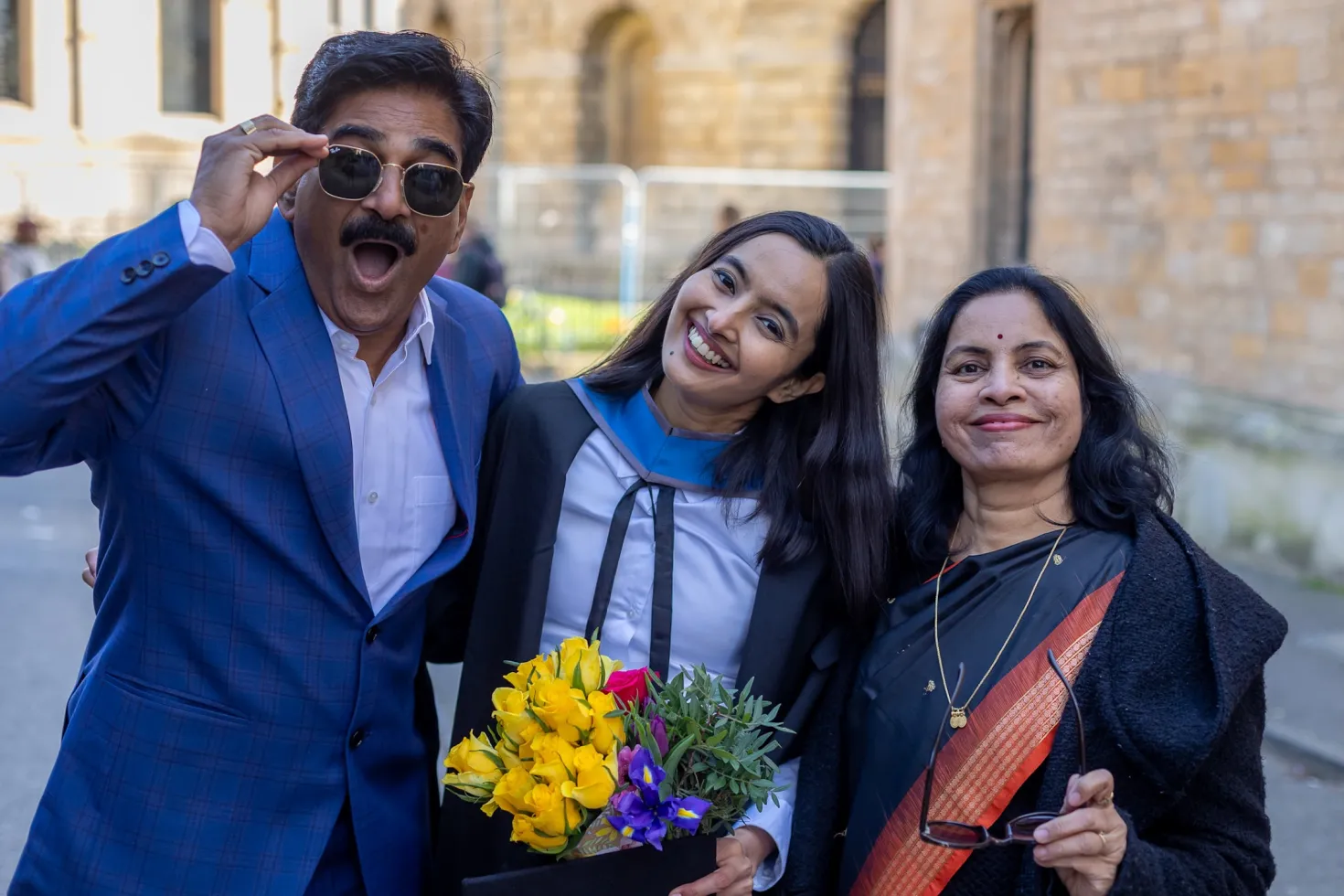
Ms Rasika Bombatkar obtains her Masters Degree at Oxford with her parents after being treated for advanced lung cancer, diagnosed when she was 26.
HIGHLIGHTS
- Rasika Bombatkar was diagnosed with lung cancer at 26 despite no typical risk factors, reflecting rising cases among young women without tobacco exposure.
- She received little explanation about prognosis, fertility or psychosocial support, leaving her to seek information online and navigate anxiety largely alone.
- Financial strain limited access to targeted therapy, forcing her to source a cheaper generic drug from abroad, while visible side effects and social stigma affected her self-image, work, and prospects within India’s arranged marriage system.
- Now working in the UK, she volunteers with Lung Connect India Foundation, a UICC member, to run a peer support ‘buddy’ programme, advocating for better information, open dialogue and more equitable cancer care for newly diagnosed patients.
Rasika Bombatkar was trained as a clinical physiotherapist in India and working in a hospital in 2022 when a persistent cough prompted a medical visit. She was 26 at the time. Neither she nor her doctors initially suspected lung cancer.
Ms Bombatkar’s account highlights how a lung cancer diagnosis can arrive without warning for people who do not fit common risk profiles – notably tobacco exposure, advancing age, and, increasingly, environmental factors air pollution – a rising occurrence among young women particiularly.
“Tuberculosis is the more prevalent diagnosis in India for someone my age. So for a week or two, that’s what we kept testing,” she said in a conversation with UICC. “I only did a CT scan after the tests were inconclusive. This was followed by a biopsy, which confirmed lung cancer.”
After diagnosis, treatment moved quickly. “Everything happened within one week,” she said, adding that this speed is “not the norm in India at all” but she benefited from the fact that her cancer was being managed in the same hospital where she worked.
This also meant, however, that the conversation around her cancer took place with colleagues she knew personally.
“It wasn’t really a doctor-patient relationship,” she explained. “I didn’t feel I could ask questions, even basic clarifications about the diagnosis, because it was delivered by people I worked with. Yet I had so many questions. I felt exposed, judged, and unable to switch into the role of ‘person who needs care’.
Her experience of not receiving information was not limited to the fact that she knew the team treating her. It reflected how care was organised more broadly. “I was never told about the prognosis, about what it’s going to look like, I was just told ‘we’re starting your chemotherapy on this date’.”
The lack of conversation also extended beyond medical details. “This is the brutal truth, I received zero support beyond treatment,” she said. “I wasn’t referred to psychologists, social workers – none of those things happened.”
Without structured support, she described turning to the internet for answers, which made her even more anxious. “The first thing you discover online about lung cancer are the very poor statistics and prognosis. And then that’s really not something that you want, that you should be looking at.” [Editor’s note: an online search of survival rates for lung cancer in India will show 10-15% after five years.] At one point she even questioned whether to start chemotherapy at all.
Financial and social impact
The financial implications further influenced her decisions. Her health insurance covered chemotherapy, but other parts of care, including surgery and ongoing medicines, still involved significant personal expense. And while genetic testing showed she could benefit from a targeted medicine, but at nearly 1 Lakh Rupees (approx. USD 1,350) per month, the cost put it out of reach.
“I eventually obtained a cheaper generic option from outside India, but the quality is not guaranteed. You’re just sending this money to a random person who you’ve never met and just hoping that they will send you the drug, and hoping that the drug will be the authentic one,” she explained.
The physical effects of treatment compounded the emotional burden, particularly when side effects were visible. Chemotherapy led to weight loss, while targeted therapy caused skin reactions, nail problems, and gastrointestinal issues. “The biggest side effect was a rash all over my body,” she said, describing how this affected her self-image and daily life at home. “I realised how many mirrors there are in my house, and at one point I didn’t leave my room at all.”
Even once treatment stabilised, she described living with ongoing side effects while returning to work and studying, and managing the mismatch between what others saw and how she was managing day to day. “No one really knows what you’re going through, they think it’s over, in the past,” she said.
Stigma, and gender- and caste-based discrimination
The fear and stigma that often surrounds cancer intersects in India with gender expectations. As a young, unmarried woman in India, Ms Bombatkar said her diagnosis affected how others assessed her place in the arranged marriage system.
“Everything just changes,” she said. “I am not valued for how much I earn or what I do, but as someone who will take care of her husband and children. If I am the one who needs to be taken care of, then I’m not a good fit. Suddenly this woman who was independent, a desirable match, is no longer interesting.” She also repeatedly encountered questions about hereditary risk, despite assurances from doctors that her mutation was not inherited.
Ms Bombatkar’s experience was further shaped by the Indian caste system, a social hierarchy that still influences access to education, jobs, and networks in India. Her family is officially classified as “other backward class” (OBC), a category used for communities considered socially and educationally disadvantaged, and which is linked to affirmative policies in central government services and education.
When navigating her illness, she found that she had limited informal networks to guide her through complex healthcare systems. As a result, she relied heavily on self directed research and independent information seeking.
She reflected that some individuals with stronger social networks may find it easier to access specialist care more quickly or mobilise financial support through established connections. Her experience highlights how differences in social capital and access to networks can influence how people affected by cancer navigate serious illness.
The power of the patient voice
In February 2023, Ms Bombatkar began speaking publicly about her diagnosis on social media. “I didn’t want to hide this, live with this fake personality the rest of my life,” she said.
Later, she moved to the UK for a master’s degree at Oxford University, and contrasted support systems between countries. She said her college connected her to disability services, a GP, and a therapist, and that doctors discussed issues, including fertility, that she had not been asked about previously.
This comparison led her to get involved in advocacy. Ms Bombatkar now volunteers with Lung Connect India Foundation, a UICC member, where she manages a peer support initiative for people newly diagnosed with lung cancer. “I manage the buddy programme, which provides one-on-one support for newly diagnosed patients.”
As she continues supporting others through the buddy programme, Ms Bombatkar said she is hearing many of the same concerns she once tried to manage alone – questions about treatment, uncertainty about what to expect, and the social pressures that follow a diagnosis.
She describes these exchanges reinforces the importance of accessible information and of the value of people being able to speak openly about their experiences.
Last update
Tuesday 10 March 2026