
Antimicrobial resistance and its impact on cancer care
Antimicrobial resistance (AMR) or drug resistance, including antibiotic and antifungal resistance, is a growing public health issue and needs urgent attention in countries around the world.

Antimicrobial resistance (AMR) is a growing global threat to health and wellbeing. The World Health Organization has stated that AMR is one of the top 10 global public health emergencies we are facing.
AMR was associated with 4.10 million deaths in 2021 and a reported 1.14 million people died as a direct result of drug-resistant infections and these numbers are set to increase. The economic consequences are substantial placing increasing pressure on already stretched health systems: resistant bacterial infections are projected to generate around US$412 billion in additional healthcare costs and US$443 billion in lost workforce productivity each year under the current level of action. These costs are driven by factors including increased hospital admissions, longer hospital stays, greater demand for intensive care and isolation beds, and the need for more expensive and intensive treatments. [1] [2]
Healthcare professionals are also forced to use less conventional antibiotics or a combination of different antibiotics to treat these infections, which are usually more expensive and which could also have serious side effects.
AMR could cut average global life expectancy by 1.8 years by 2035, effectively reversing some of the gains achieved through modern medicine. [3]
Furthermore, according to the FAO, if the issue of AMR is not addressed urgently, tens of millions more people will be forced into extreme poverty, hunger and malnutrition.
Upcoming Virtual Dialogues on AMR
Virtual Dialogue: The economic impact of antimicrobial resistance (AMR) on cancer care outcomes

Virtual Dialogue - AMR in cancer care: navigating the double challenge of access vs excess
Antimicrobial resistance happens when microorganisms ( such as bacteria, fungi, viruses and parasites) develop the ability to continue to grow, even when they are exposed to antimicrobial medicines that are meant to kill them or limit their growth (such as antibiotics, antifungals, antivirals, antimalarials and anthelmintics).
As a result, the medicines become ineffective and infections persist in the body, increasing the risk of spread to others. While antimicrobialresistance refers to all microbes that resist treatments designed to destroy them, antibiotic and antifungal resistance specifically deals with bacteria and fungi that are resistant to antibiotics and antifungals respectively.
Antibiotics are used in the treatment of many diseases and surgical procedure. Examples include organ transplants, blood infections, complicated deliveries, pneumonia and in cancer care. (see ReAct Group) Therefore, patients with infections caused by these drug-resistant bacteria are at an increased risk of poorer clinical outcomes, including death.
Overuse and misuse of antimicrobial medicines are major factors that have contributed to the development of drug-resistant microbes. In many places, antibiotics are overused and misused in people and animals, and often given without professional oversight.
Examples of misuse include when they are taken by people with viral infections like colds and flu, and when they are given as growth promoters in animals or used to prevent diseases in healthy animals.
Another major reason for the development of drug resistance is the lack of access to timely and appropriate treatments for infections, especially in LMIC.
Other important contributing factors to AMR include inadequate infection prevention and control (IPC), substandard/falsified medicines and a lack of access to affordable and appropriate diagnostics that give accurate and real-time results.
AMR undermines key advances being made in cancer care by adversely affecting cancer treatment outcomes and threatening the survival of people living with cancer.
There has been substantial progress in cancer care in the past decades, with key advances in surgery, radiotherapy and medicines, including the newer immunotherapies. The significant and growing threat of drug-resistant bacteria, however, is undermining all the above-mentioned efforts in cancer treatment.
People with cancer are more susceptible to infections due to the lowering of immune defences, while surgery and treatments like bone marrow transplants, radiotherapy and chemotherapy put the immune system under immense pressure.
It is estimated that approximately 1 in 5 cancer patients will need antibiotics during their cancer treatment.[4] Pneumonia and sepsis (as a result of bacterial infection of the blood) are among the most frequent causes of admission to intensive care units for cancer patients. In fact, it is estimated that 8.5% of cancer deaths are due to severe sepsis.[5].
Furthermore, People living with cancer are overall up to three times more likely to suffer infections from drug-resistant bacteria compared to those without cancer [6] (and a review showed higher mortality rates were associated with AMR infections). [7]
Antimicrobials likes antibiotics and antifungals are a key and indispensable part of cancer treatment – many patients simply have to take them – and for their benefit it is important to better manage the use of these medicines and address this crisis.

AMR is a serious global public health issue that needs to be addressed immediately and everyone has a role to play.
For concrete action steps that the cancer community, the cancer health workforce and policy makers can take to address AMR for better cancer care outcomes, please see:
Policy change on AMR
UICC supports the cancer community in addressing AMR and aligns its efforts with the WHO global action plan on antimicrobial resistance adopted by the World Health Assembly in 2026.
UICC is now seen as a leading voice underscoring the critical interconnection between AMR and cancer and championing evidence-based AMR mitigation strategies to safeguard the effectiveness of cancer treatments. Building on this, a three-pillar initiative for UICC’s work on AMR has been developed:
- Incorporating AMR mitigation strategies into National Cancer Control Plans (NCCPs) and mobilizing policy change
- Capacity strengthening of the cancer health workforce in AMR mitigation strategies (including Infection prevention and control (IPC), antimicrobial stewardship (AMS) and ensuring access to essential antimicrobials and diagnostics)
- Knowledge sharing, awareness raising and advocacy among the cancer and NCD community
The three pillars are mutually reinforcing: policy change creates the mandate, workforce capacity enables implementation, and advocacy sustains the momentum.
Self-paced courses
UICC provides self-paced courses on addressing the threat of AMR for better cancer care outcomes, accredited by the Accreditation Council of Oncology in Europe (ACOE).
Task Force on AMR
UICC convenes a Task Force focused on addressing antimicrobial resistance and its impact on cancer care and patient outcomes, bringing together experts from across the cancer and infectious diseases communities. These experts guide the UICC programme of work on AMR and cancer care.
The task force showcases current evidence, identifies research gaps in knowledge of cancer and AMR, shares best practices and ultimately engages the cancer community to collaborate and bring about policy change on addressing the threat of AMR.

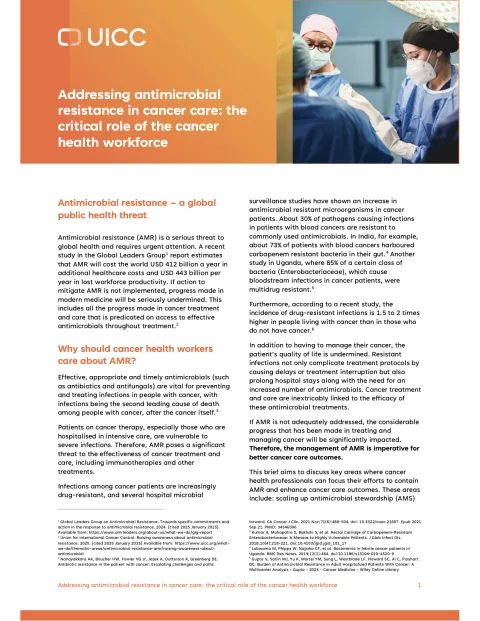

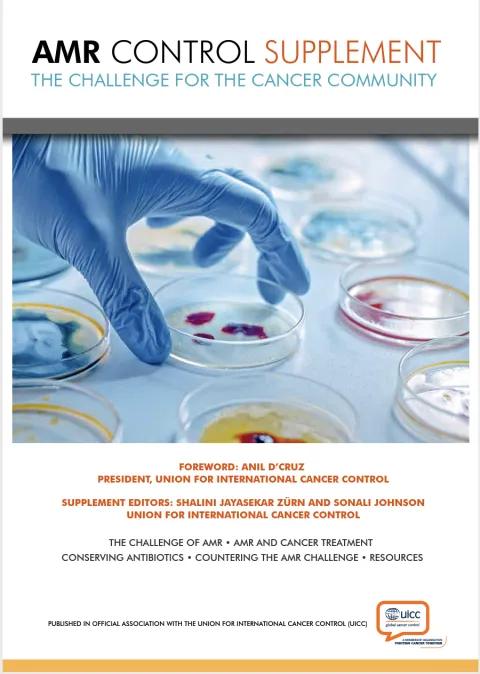

Latest UICC news and blog articles on AMR
Faith-based organisations help address antimicrobial resistance in Africa, closing a critical gap in cancer care

Why is addressing the bacterial AMR threat so crucial to cancer care patient outcomes?

New UICC policy brief outlines urgent steps to address AMR in cancer care


The threat of antimicrobial resistance (AMR) and its impact on cancer treatment is a priority for UICC.
UICC's actions on antimicrobial resistance

This page includes important resources on antimicrobial resistance, material for UICC's members and partners, infographics, videos and other important documents and links.
Antimicrobial resistance resources

World AMR Awareness Week (WAAW) is celebrated from 18-24 November every year to improve awareness and understanding of antimicrobial resistance.
World AMR Awareness Week (WAAW)
Last update
Wednesday 11 November 2026