How people’s firsthand experience can help change the delivery of cancer care
People's experiences with cancer and their unique needs can help reshape health and cancer care delivery by shifting the focus of healthcare systems from just the disease to a holistic, people-centred approach.
HIGHLIGHTS
- Half of the world's population lacks access to essential healthcare, with low and middle-income countries disproportionately affected by non-communicable diseases like cancer.
- Reorienting health systems around a people-centred approach can ensure greater equity in access to cancer care and address the unique needs of individuals.
- Patients, families, and communities should have a seat at the table in healthcare decisions, driving the conversation about their needs and preferences.
- People-centred care can maximise the value and impact of healthcare spending by ensuring investments achieve the expected results for both patients and policymakers.
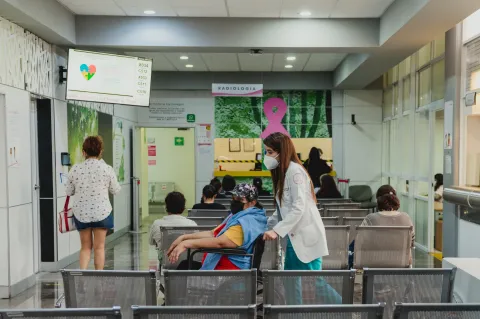
Half of the world’s population lacks access to essential healthcare, and where it is accessible, it’s described as ‘fragmented and poor quality’, according to the World Health Organization (WHO). As a result, people in low and middle-income countries are disproportionately affected by non-communicable diseases like cancer. The WHO describes this inequity as a ‘silent pandemic’ that transcends borders, languages, ethnicities and political divides.
For UICC, reorienting health systems around a people-centred approach to health care delivery could help ensure greater equity in access to cancer care and address the unique needs of individuals affected by cancer. This approach delivers care that not only meets medical needs but also addresses the emotional, social, and practical challenges that come with a cancer diagnosis.
“People centred care is allowing us to treat people with dignity, respecting their human rights,” Sonali Johnson, Head of Knowledge, Advocacy and Policy at UICC says. “We know that if we address some of these issues, the people receiving cancer treatment will have a better outcome and a quality of life."
“We can’t imagine what a new healthcare system looks like without allowing patients, families, and communities a seat at the table those decisions are made on,” says David Duong, Director of Global Primary Care at the Harvard Medical School Center for Primary Care, and the co-lead for the Lancet Group Global Health Commission on People-Centred Care for Universal Health Coverage. "They should be driving the conversation about what they want from their healthcare. I think we’re stuck in this current mindset of what healthcare should look like, but our care systems are not currently built around the needs of the patient and the needs of the person. So we have to change that.”
People-centred care prioritises partnership with individuals actively participating in their treatment and having their needs, values and preferences heard and respected. Clinicians guided by this framework ensure that patients receive personalised, equitable and inclusive care.
This method of care, according to the WHO, is critical when it comes to redesigning healthcare systems that are focused on the people being treated, rather than the disease being tackled.
“Our health systems have historically been provider-centric, focusing on what clinicians can do rather than what the patient needs based on their lived experience,” says Francesca Colombo, Head of the Health Division at the Organisation for Economic Co-operation and Development. “Transitioning to a truly people-centred model of care requires addressing this disconnect and making space for patients to be empowered as active partners in managing their own health and wellbeing.”
Colombo is also part of the advisory board for the Lancet Group Global Health Commission on people-centred care for universal health coverage. The group represents people with lived experiences as well as health care providers, policymakers, academic researchers and sector leaders from around the world.
She says there are three key pillars to successful people-centred care in health systems – collaboration, connection and community. Evidence has shown that integrating care models that are people-centred has led to individuals feeling better throughout treatment, being more trusting of doctors and increased efficiency of health services. Trust in providers is key, Colombo says, but it is something she believes needs to be worked on from the ground up, starting with how practitioners are trained to handle their patients’ needs beyond the clinical necessities.
“In my experience, I’ve found doctors and nurses, particularly doctors, feel they are over-skilled in technical areas but under-skilled in the ‘soft skills’ that are needed to carry out proper, effective people-centred care,” Colombo explains. “Managing relationships with patients, shared decision-making and conveying empathy are lacking. This disconnect reflects how health systems have been designed around clinical expertise rather than the needs of the patients.”
UICC Board Member Maira Caleffi agrees. “We need to work together, but we’re not going backwards, only forwards. Global organisations, such as UICC, have the potential to drive real, meaningful change,” she says.
Caleffi has worked in the field of cancer surgery for more than 40 years, becoming a specialist in breast surgical oncology at Guy’s Hospital in London, and President of the Board of Directors at the Institute of Cancer Governance and Control (IGCC). Alongside her role at UICC, Caleffi is Founder and Volunteer President of both FEMAMA and IMAMA, the Brazilian philanthropic breast health and patient advocacy groups. Her desire to play a bigger role in patients’ lives outside of her research and oncology work led her to create these charities.
“My work has put me in the shoes of my patients every day. I try to treat them with empathy, find out what’s going on in their lives and figure out what they need as a priority,” she explains. “Now, I see that patient groups are heard when it comes to sharing their experience and opinion on what needs to change. They have a place at the table, which is how it should be.”
Caleffi adds that delivering people-centred care need not be an expensive option. Duong echoes Caleffi’s feelings that the care systems in place focus on clinical outcomes driven by economic factors rather than patients’ needs. “We have built, I believe, a healthcare system across the world that’s actually a sick care system. It puts the needs of the physicians, providers and regulatory bodies first before the people who are in pain and need our help,” he says.
The economic rationale of people-centred care, Colombo believes, is powerful and goes beyond ethical considerations. “By ensuring the money invested in health is achieving the results expected by both patients and policymakers, this approach can help to maximise the value and impact of what’s being spent.”
To achieve a reorientation of health systems to place people at the centre of cancer care delivery, Duong feels strongly that the task cannot be accomplished without the right experts being a part of it. “We can’t get to high-quality health care without people’s voices and input. From health care workers, policymakers, the people funding it, the people regulating it, all their perspectives are needed,” he says. “But we can’t get there without involving patients and people in our communities. It simply won’t be possible without them too.”
The consensus among people-centred care advocates is that listening to patients’ needs and tailoring their care in response can help unite fragmented healthcare services across the world and deliver better care for the people who need it most.
Learn more about people-centred care and UICC's new World Cancer Day 'United by Unique' campaign
Last update
Tuesday 25 February 2025