Treating cancer in Ukraine: accounts from a doctor and a patient's family
Dr Inesa Huivaniuk of Kyiv Regional Oncological Center and UICC member GMKA speaks about how the health system in Ukraine struggles to maintain care standards. In a parallel interview, a family caregiver describes what it means to seek diagnosis and treatment while living under air raids, shortages, and disrupted services.
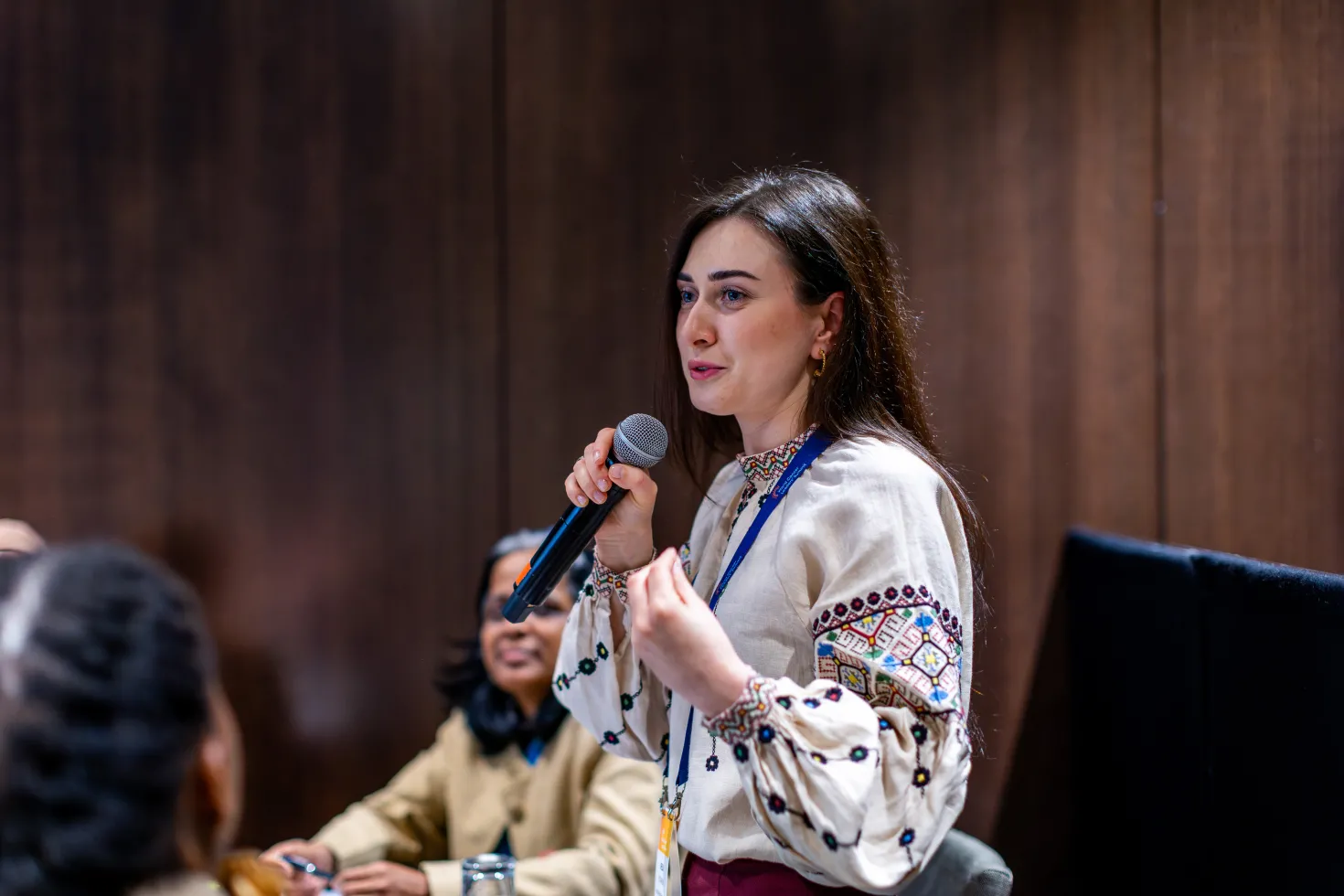
Dr Inesa Huivaniuk, MD, MPA, Co-Executive Director of GMKA Ukraine, a UICC member, and a surgical oncologist at the Kyiv Regional Cancer Center, at the World Cancer Leaders' Summit 2025. Despite constraints on advanced therapies, Ukraine is expanding access in specific areas, including planned new coverage for immunotherapy for eligible melanoma patients.
HIGHLIGHTS
- Attacks, displacement, and infrastructure damage have severely disrupted cancer services, in Ukraine yet clinicians have reorganised to restore and maintain surgery and essential care as best as the situation allows.
- The first months of the escalation of the armed conflict between Ukraine and Russia four years ago saw major care gaps, with medication shortages, destroyed equipment, and overwhelmed hospitals in the western part of the country. These were partially filled through EU evacuation programmes and donor support. While the situation is now more or less stable, severe challenges remain due to blackouts, overcrowding, shortages, and ongoing security threats.
- Partnerships, including those with GMKA and UICC, have enabled case discussions, education, and capacity-building to uphold quality care.
- Despite continued attacks and limited access to advanced therapies, recent progress includes national screening expansion, HPV vaccination, and new coverage immunotherapy used for the treatment of metastatic melanomaro mid-2026.
Ukraine’s healthcare system continues to endure under the weight of war, four years since the escalation of the armed conflict on 24 February 2022 with Russia.
Hospitals across Ukraine face blackouts, overcrowding, and shortages, with cancer services particularly affected by the displacement of patients, and ongoing security threats, given the long-term nature of cancer care. According to the World Health Organization, there have been 2,762 verified attacks on health care facilities in Ukraine, including missile strikes, shelling, and damage to power infrastructure, as of December 2025.
Despite these challenges, cancer professionals in Ukraine have reorganised services and continued delivering care, even during air raids. International collaboration has also become a critical lifeline for maintaining cancer care.
One such partner is the Global Medical Knowledge Alliance (GMKA), a UICC member organisation, one of whose key priorities is strengthening oncology capacity through education, clinical collaboration, and international knowledge exchange.
Dr Inesa Huivaniuk, MD, MPA, Co-Executive Director of GMKA Ukraine and a surgical oncologist at the Kyiv Regional Cancer Center, shared her experience with UICC about how cancer services have responded, what gaps remain, how GMKA, and international collaboration continue to help maintain services.
Just over four years ago, in what direction was Ukraine’s healthcare system heading with respect to cancer care?
We were moving very much in a Western direction, with European integration. We had good collaborations with European and North American clinics, and a lot of exchange projects. Our patients were also able to travel abroad to get medical help. There were ongoing healthcare reforms since 2019, and we were progressing both educationally and materially.
What happened to that progress after 24 February 2022?
The healthcare system was disrupted for several months. The first two months – February and March – were the most difficult. There were attacks on hospitals, not just people. A lot of buildings were ruined, equipment lost, and patient documentation destroyed.
There was also massive internal displacement. Patients from the south and east moved to the west, and hospitals there became overwhelmed – twice as many patients as usual. That affected cancer centres too. People were waiting and waiting, and there were medication shortages, blackouts, and poor connectivity. Many patients had no medical records with them. That made treatment very difficult.
How did you get organised to support people with cancer?
In March 2022, a programme was launched by the European Commission and Ukraine to evacuate patients. It started with cancer and later included trauma patients – both military and civilian. It allowed people to continue treatment abroad under the EU Temporary Protection measure. Initially, it covered many diagnoses so we evacuated many people, but over time the numbers dropped, as our system started recovering and were able to treat more patients, and centres in Europe were reaching capacity.
How were you able to restart cancer services inside Ukraine?
First, we had to understand who was still in the country. Many healthcare workers left. Once we knew who had stayed, we reorganised teams. We restarted with surgery, because it was the most feasible option. Even though many hospitals had lost equipment or buildings, basic surgical capacity often remained, and we could begin treating patients again.
Also, many surgeons chose to stay. I don’t know exactly how that happens. Maybe it’s something like a professional imperative, but we stayed. There were urgent cases, people who needed help, and so we just continued. That’s how it was.
Hospitals in eastern Ukraine, like in Kharkiv, started working again a bit later. But in the end, we’ve resumed delivering cancer services, even close to the frontlines. People just tried to get back to normal, as strange as that sounds, because there were so many patients.
What about medication shortages?
That was a big problem. Many drugs were imported, and the logistics were disrupted. Some storage sites were attacked. Centres in the west of Ukraine were overwhelmed with patients, but that didn’t mean they had twice the amount of medication to treat them. There were also delays with radiation therapy, sometimes up to six months at times. Systemic therapy patients were often sent abroad for treatment, as our capacity to provide those services was limited during that period. [Editor’s note: Systemic therapy refers to treatments such as chemotherapy or immunotherapy that affect the whole body, rather than targeting a specific area.]
Gradually, with help from donors, the EU, and international organisations, we were able to restore equipment and import drugs. Even during the war, that process happened relatively quickly.
How have international clinical partnerships supported care delivery?
One of the most practical forms of support has been digital collaboration through HealUA, a secure, AI-enabled mobile application developed by Global Medical Knowledge Alliance. The platform connects Ukrainian physicians with one another and, when needed, with medical experts abroad for peer-to-peer consultations and case discussions. This kind of rapid, day-to-day exchange helps us align decisions with current evidence and maintain a standard of care even during the war.
Has international assistance more generally held steady over time?
Yes and no. We don’t have as much help as in the beginning, which I understand – we are supposed to organise ourselves now. But many organisations, including UICC, still support us. Some help with medications, others with moving patients, others with education.
Global Medical Knowledge Alliance received three grants from the UICC Solidarity Fund in 2022 and 2023, which supported the strengthening of cancer and trauma care in Ukraine by mapping real‑time treatment capacity, providing and translating essential educational resources, and supporting international training opportunities for Ukrainian oncology practitioners. I myself attended the World Cancer Leaders’ Summit in 2025 and spoke at the World Cancer Congress in 2024 in Geneva about delivering cancer services during conflict, thanks to a UICC scholarship.
On the other hand, in addition to medicine shortages, we also can’t afford advanced therapies, not for everyone. Even before the war, there were budget gaps. Now the focus is just to keep the system going. For example, we can’t cover immunotherapy or targeted therapy for all cancer patients through the National Health Service.
Are there any signs of progress in treatment access?
Yes. Starting June 2026, the National Health Service will cover immunotherapy used for the treatment of metastatic melanomaro. This is possible because of a managed access agreement between the government and pharmaceutical companies. Patients won’t have to pay out of pocket.
How has cancer care been prioritised compared to other health needs such as cardiovascular disease or diabetes?
Cancer is the second leading cause of death in Ukraine, after cardiovascular disease, so it was already a priority before the war. For example, cervical cancer is very common among women here. Now, thanks to international collaboration, [1] HPV vaccination will be part of the national vaccination calendar. Starting this year, girls aged 12 and 13 will receive it for free. We hope to extend this to boys in the future.
Has prevention and screening continued despite the conflict?
Yes, we now have national screening programmes for cervical, breast, and colorectal cancer. There was a major communication campaign. Hospitals are paid by the NHS to provide screening, so they’re motivated. But there’s still work to do.
One major issue is patient pathways. Sometimes women come for a mammogram from a village 100 kilometres away. They get screened, but then go home. Nobody follows up. They don’t see their results or get linked to care. So the next step is to fix that, to make sure those who are screened don’t disappear from the system.
What does the reality of cancer care look like from a patient family’s perspective?
The pressures of delivering care are matched by the realities faced by patients and families. Below, Yelyzaveta, a family caregiver from Kryvyi Rih and Kyiv, shares her experience of trying to secure timely diagnosis and treatment for her mother suffering from melanoma, amid attacks, overstretched hospitals, and medication constraints.
How has the war affected your mother’s access to diagnosis and specialised care?
Living through a full-scale war becomes harder with every passing year, and for people facing a cancer diagnosis, it is an extreme test of resilience.
My mother is 73 years old. She is from Kryvyi Rih — a city under constant missile and drone attacks. Since September 2025, she has been undergoing treatment for multiple myeloma. The most challenging issue for our family has been access to specialised care.
Last March, my mother began losing weight rapidly. Her condition was already critical, and she needed hospitalisation. However, in a city of almost 700,000 people, there was only one nephrologist working in the public hospital system. We were initially denied admission to the nephrology ward, and only with great difficulty were we able to get her into the therapy department.
After completing all the necessary tests, doctors suspected multiple myeloma and referred my mother for further examination. But the earliest available appointment with a public hospital hematologist in the city was not until October, while a diagnosis and treatment were urgently needed.
The war made the situation even more complicated. Hospitals are overcrowded. Many facilities treat not only local civilian patients but also wounded soldiers and people evacuated from occupied or heavily damaged regions. As a result, waiting times for diagnosis and treatment can stretch for months, even when a patient’s condition is urgent. Blood is also in short supply — I had to find donors among all my friends.
How does the war affect the treatment process and the psychological state of patients and their families?
Life for cancer patients in Ukraine is a reality where you gather all your strength just to endure chemotherapy and its side effects, knowing that at any moment you could also be killed by Russian weapons.
On the day we arrived in Kyiv for a biopsy, a drone attack began. You sit in the hospital, hearing air defences working above you, and every explosion goes straight through your body.
During the winter of 2026, life became not just difficult, it became almost unbearable. Nighttime temperatures dropped to –20°C, there were heavy snowfalls and icy roads. Harsh weather, combined with massive attacks on infrastructure, caused frequent power outages, heating failures, and water shortages.
Still, I want to express my deepest gratitude to the physicians and nurses. They live under the same conditions – without electricity, often without heating, frequently traveling daily from surrounding areas through shelling and difficult roads. Despite this, hospitals provide a small sense of stability, with light, water, and warmth, giving patients and families at least a few hours of relief amid total chaos.
What kind of support do Ukrainian cancer patients and their families need most right now?
The most urgent support Ukrainian cancer patients and their families need is air defence and access to medicines. Without protection from attacks, all medical care is at constant risk. Without access to expensive medications, remission may be unattainable for those without sufficient resources.
Even when doctors do everything they can, treatment often stops where funding ends. Support from the international community in providing access to costly medications helps not just patients, but entire families fighting for a chance at normal life.
Patients and caregivers also urgently need psychological support. I am the sole caregiver for my mother, and the exhaustion of constant care, combined with war and shelling, takes a heavy toll. My mother refuses psychological help, despite having faced high-risk situations in her life, and I lack access to an onco-psychologist who could guide me in supporting her.
There is also a major lack of clear, accessible information on clinical trials, both in Ukraine and across the EU — where they are run, inclusion criteria, and how patients can realistically enroll. Doctors are under extraordinary workloads and face the same challenges as patients, so patients and families often have to navigate this on their own.
That is why international support is so critical: creating clear information channels for Ukrainian patients, and helping ensure access to modern treatment programs and clinical trials in the EU.
How have attacks affected your daily work in Kyiv?
It depends on where you are. In Kyiv, if there’s a bad night and you don’t sleep, it’s not easy to provide care the next day. Sometimes, if an attack starts during the day, we wait for the all-clear before starting surgery. But if we’ve already started, we don’t stop. The same is true for radiation and clinical oncology. Nobody stops.
Our patients they desperately need treatment. Some have lost their homes and families. And some tell us, “There’s an attack again and again, but I have cancer, I need my treatment.” What can you say? There are no words. You just do your job.
Have you experienced this personally during an attack?
Yes. In 2023, during the biggest attack on Ukraine’s children’s hospital, the main building was damaged. My hospital is nearby. We heard everything. In the operating room, we just paused for a second. But no one left. You look at your colleagues, and you know – no one is leaving the patient on the table. We keep going. That’s just how it is.
____________________________________________________________________________
[1] In 2024, UICC financed two initiatives to support progress in cervical cancer in Ukraine. The first was awarded to GMKA to support introduction and raise awareness of HPV vaccination. The second was provided through the Reimagining Cancer Research in Europe Initiative, and is a two-year implementation research project led by Zaporizhzhia State Medical University in Ukraine, in collaboration with Karolinska Institutet in Sweden, to enhance cervical cancer screening through HPV self-sampling.
Last update
Monday 23 February 2026