People-centred cancer care means designing care beyond medical treatment
A panel at UICC’s World Cancer Leaders’ Summit in Melbourne, explored the importance of care beyond medical treatment, to avoid lasting harm when people aren’t informed or involved in treatment choices, and called for system-level changes in communication, shared decision-making, navigation and data visibility to reduce inequities.
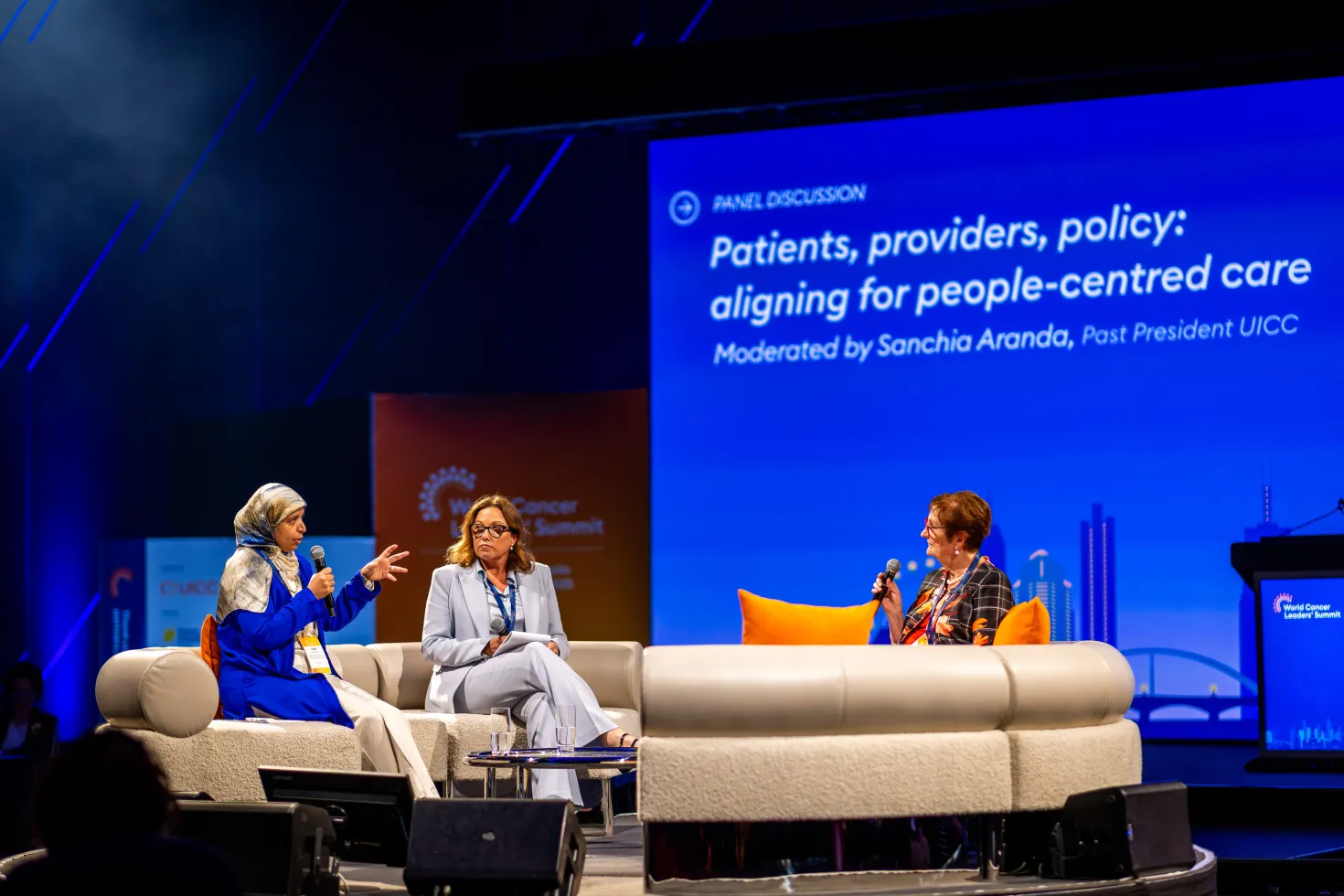
Ikram Eseghir, Founder and President of NABD‑BC2 (Morocco); Prof. Sanchia Aranda, Past President of UICC; Vicky Durston, Director of Policy, Advocacy and Support Services at Breast Cancer Network Australia (BCNA).
HIGHLIGHTS
- People-centred cancer care needs to be designed into health systems – not left to individual interactions or chance (video recording available).
- At a dedicated session at UICC’s World Cancer Leaders’ Summit in Melbourne, Ikram Eseghir, Founder and President of NABD BC2 (Morocco), shared the story of a young woman who lost her fertility after treatment because she was never informed or consulted about her options.
- Prof. Sanchia Aranda, Past President of UICC, stressed that people-centred care must be embedded in how services are designed, funded, and governed – not left to individual clinicians.
- Vicki Durston, Director of Policy and Advocacy at Breast Cancer Network Australia (BCNA), explained why lived experience must shape decisions – and how data gaps, including the historic lack of information on metastatic breast cancer, can leave groups invisible and underserved.
When a person with cancer is only treated for their disease, following specific protocols, with little regard for their needs outside of cancer, it can have dramatic consequences.
For example, a woman in Morocco who was 24 when she was diagnosed with breast cancer. She was successfully treated, but was never informed that she might lose her ability to have children, and was not engaged in any discussions about how treatment could be adapted to preserve her fertility.
Her story was shared by Ikram Eseghir, Founder and President of NABD-BC2 during a panel event on people-centred care at UICC’s World Cancer Leaders’ Summit in Melbourne. NABD-BC2 is a UICC member organisation based in Morocco that provides psychosocial support to people living with cancer, and a strong proponent for greater people-centred cancer care.
“Even after effective treatment and remission, this woman still regrets not having been informed, not having been asked about her preference,” said Ms Eseghir. “Her shows how a care pathway can meet clinical standards while still leaving a person with a lasting sense of loss.”
Prof. Sanchia Aranda, Past President of UICC, emphasised what this means for health systems and service delivery: “With 20 million new people diagnosed every year with cancer, the challenge is not only the relationship between a clinician and the person in front of them,” she explained. “It is how services are designed, funded, and governed. We have to stop thinking about people-centred care a relationship between an individual clinician and their patient, and… think about it at the person, service system, and policy levels.”
The session, which UICC is making publicly available on YouTube, sought to explore what is missing in how care is delivered. In different settings, panellists said, the same pattern repeats. People may receive clinically correct care, without being offered meaningful choices, without being part of decisions about their health. Groups may be left out of data, and then out of planning. And the ability to navigate the system can depend more on education, confidence, and connections than on need.
For Ms Eseghir, the fertility story was a stark example of what is lost when people’s values are not part of the care conversation. People-centred care, she told delegates, is about recognising that a person is “not just the disease or the tumour, but a set of emotions, with needs, preferences, values. The duty of the system is to ensure those values are taken into account in the treatment pathway.”
Vicki Durston, Director of Policy, Advocacy, and Support Services at Breast Cancer Network Australia (BCNA), also a UICC member, spoke about how quickly people-centred care can become a familiar phrase, but that does not change how decisions are made. “We throw around words like people-centred care,” she said. “What do we actually mean by that?”
Ms Durston described BCNA’s approach as building structures that bring the experiences of people who have had cancer lived experience into the process of decision making. “We have a programme where we provide training and education so that people who have had cancer can mobilise their lived experience in their storytelling,” Ms Durston said.
According to Prof. Aranda, this living experience is an important expertise, and it not symbolic. “It can help reshape priorities and reform systems,” she said. Durston agreed, while warning that participation without preparation can be performative. “We don’t want them to be just tokens, we want to ensure that they’re well prepared, and that both sides can interact.” That includes clinicians, researchers, and policy makers learning how to work with advocates.
Ms Durston’s most concrete example was about what happens when a group is not counted. In Australia, she said, data gaps have long made it difficult to understand the number and circumstances of people living with metastatic breast cancer, and to plan services accordingly. “People affected by metastatic disease pressed for change,” Durston recalled. “They said, ‘Enough’s enough. We really want to understand why we’re not counted, why we’re not visible, and what that actually means to us.’”
The consequences, she argued, are not abstract. “When people are not seen, they are not counted, and they are not prioritised,” she said. Durston described how cancer registry experts were eventually gathered to create a roadmap and secure commitments to count metastatic breast cancer more accurately.
Ms Eseghir said that the barriers looked different in Morocco, but the underlying dynamics were familiar. Some decision makers believe that a people-centred approach is going to be more costly, or that it cannot be a priority when access to medicines remains uneven. She also pointed to communication gaps between healthcare professionals and patients, and to cultural expectations that “it’s always the healthcare professionals who knows best”, which can make shared decision making harder to put into practice.
Those barriers, the panel suggested, sit at the intersection of quality and equity. Danielle Spence, a nurse living with metastatic melanoma who is also Director of Advocacy and Policy at BCNA, told delegates that her professional knowledge gives her options others may not have. “Knowledge is empowering, but not everyone comes with knowledge,” she said.
In her journey with cancer, Ms Spence received extraordinary support from a nurse, for which she is extremely grateful. She argued, however, that “a people-centred system cannot depend on gratitude, luck, or insider knowledge. We have to ensure that people are central to treatment decision making. We have to give them choices because it’s not just about treatment, it’s about what else is happening in your life.”
This has a real impact on survival outcomes also. “Even in a high-income country like Australia,” said Prof. Aranda, “if you’re in the lowest socioeconomic group, you’re 37% more likely to die of your cancer than if you’re not.”
People-centred care is not an abstract ideal, according to all panellists. It is a set of choices that health systems make – about communication, navigation, visibility in data, and whose expertise counts – and those choices shape whether people receive care that fits their lives, and whether underserved groups remain on the margins.
“The mindset needs to change,” Ms Eseghir said. “We tend to forget that we are human beings before being patients. Systems need to humanise the treatment pathway.”
Last update
Thursday 19 February 2026