How the Monash Partners Comprehensive Cancer Consortium supports people-centred cancer care through integrated models
An integration model led by MPCCC, a UICC member, rotates metro and regional oncology staff and embeds regional clinicians in metropolitan networks, reducing professional siloing, boosting trials and workforce stability, and helping remote patients receive city-comparable cancer care closer to home.
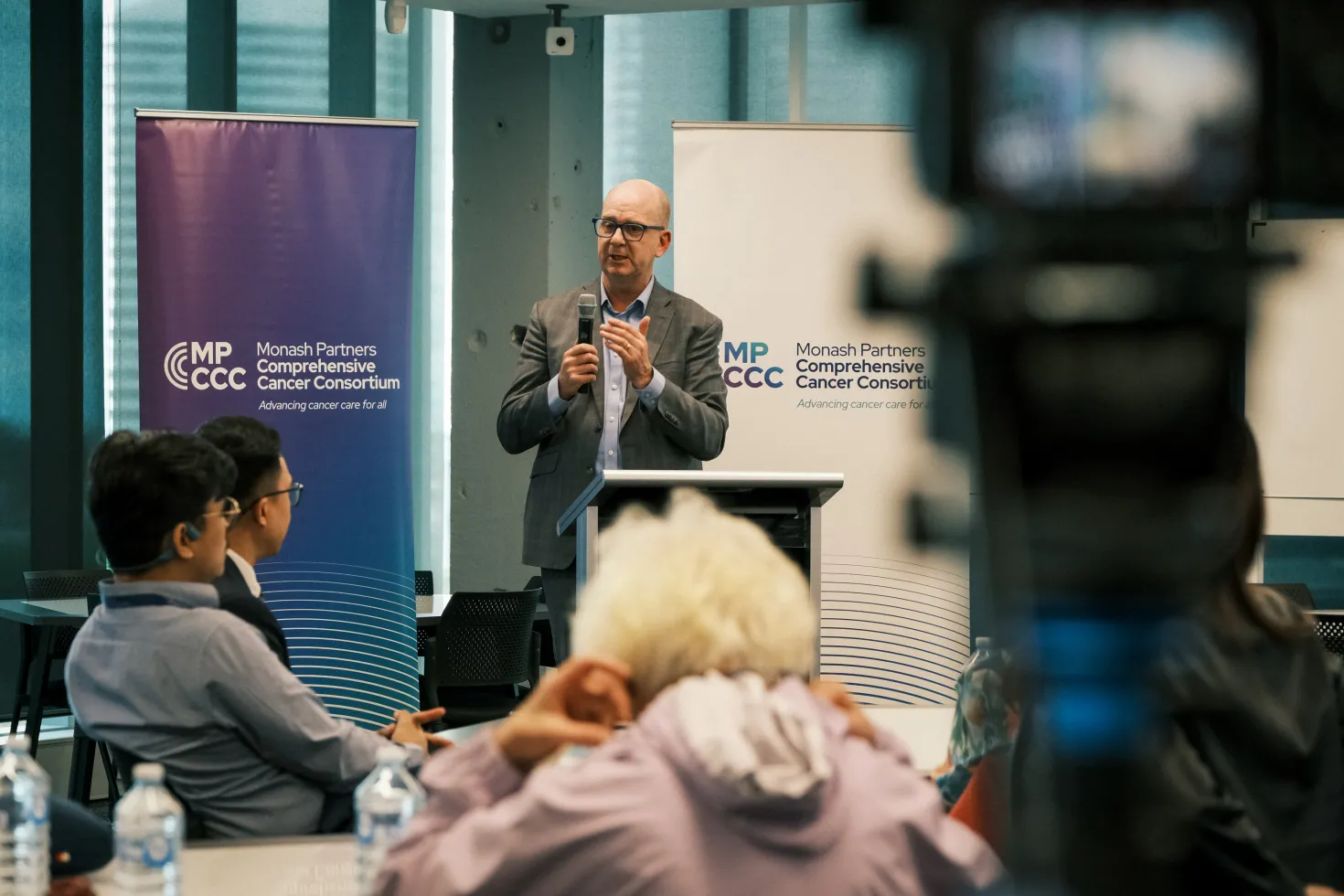
Prof. Mark Shackleton speaks to delegates at UICC's World Cancer Leaders' Summit in Melbourne, which MPCCC co-hosted. “To help ensure that people with cancer living far from urban centres can receive high-quality treatment closer to home, MPCCC has supported a practical integration model," explains Prof. Shackleton, who leads oncology services across a newly expanded regional health network in Victoria, Australia.
HIGHLIGHTS
- Clinicians in small or remote hospitals often lack peer networks, limiting access to up‑to‑date diagnostics, treatments and multidisciplinary input.
- The integration model developed by Monash Partners Comprehensive Cancer Consortium, a UICC member, rotates metropolitan and regional oncologists across sites, strengthening professional links and reducing siloing.
- Regional hospitals report major improvements: stable staffing, the establishment of clinical trials and better diagnostic capacity.
- The approach is now shaping state policy in Victoria and shows promise for adaptation in low‑resource settings through digital tools and exchange programmes.
Equity in cancer care and people-centred health care are often framed in terms of access – what prevents people from receiving the services they need, even when those services are available?
One challenge that is perhaps less visible, but just as critical, is the professional isolation experienced by clinicians in small or remote hospitals. This isolation can limit their access to the latest diagnostics and treatment, and even their knowledge about what is available in these regards, which in turn affects the quality of care that people with cancer receive.
The core problem of geographic inequity in cancer care is not simply about the distance a person must travel to reach a treatment centre, according to Professor Mark Shackleton, Co-Director of Monash Partners Comprehensive Cancer Consortium (MPCCC) in Melbourne, Australia, a UICC member who co-hosted the last World Cancer Leaders Summit in Melbourne.
He emphasised that local availability of doctors does not guarantee up-to-date care. Doctors in isolated settings may lack regular peer interaction, journal clubs, and access to the multidisciplinary input common in larger centres.
“An often overlooked driver of inequitable access to care is the siloing of the care workforce," he said in a conversation with UICC. "If you're working alone or in a very small group, you're usually ridiculously busy, and you just don't have that same professional community around you that can fulfil that sort of peer feedback, like getting an informal second opinion.”
Prof. Shackleton leads oncology services across a newly expanded regional health network in Victoria, Australia. Speaking from this experience, he explained: “To help ensure that people with cancer living far from urban centres can receive high-quality treatment closer to home, MPCCC has supported a practical integration model.”
This includes the rostering of metro clinicians across multiple sites – and sometimes vast geographical distances – including metro and regional hospitals. In turn, regional doctors are also employed part-time within metropolitan teams, granting them access to peer review forums, academic discussions, and specialist support networks such as the MPCCC’s Precision Cancer Programme that facilitates in molecular testing and matching genomic sequencing results to available therapies and clinical trials.
How integration is reshaping cancer care delivery
The model has had tangible results. In one regional hospital, Prof. Shackleton described it positive effects wherein an absence of clinical trials, staff shortages, and reliance on temporary locum doctors (short-term contracted physicians covering staff absences) were replaced over a few years of staff integration by the local availability of more than 20 clinical trials, a stronger and more stable clinical workforce, with professionals choosing to join and stay in the region, and improvements in diagnostic services and systems to monitor and improve the quality of care.
“Just by giving regional oncologists some clinical sessions in our partner metro site here – coming down to work in our clinics for half a day a fortnight, joining our email lists for educational opportunities, taking part in our case discussions, providing an extended peer network – five years later we’ve got people queuing up to join the regional team because they know that they will not be professional isolated,” said Prof. Shackleton.
These changes are making it possible for people with cancer in remote areas to receive care of comparable quality to those in major cities, which Prof. Shackleton considers a moral obligation.
“In a public system that is taxpayer funded, we have to meet people where they are, bring services to where they live as much as possible,” he said. “It is the responsibility of the health system to go and deliver the care to taxpayers who cannot travel to an urban centre for care, or do not want to, for whatever reason. I remember a case where a patient in my regional clinic declined to travel to the city for essential treatment. He told me, ‘No, doc, I’d rather die.’ People should not have to face that choice where at all possible.”
While this metro-regional integrated model began informally, it has influenced broader policy. The Victorian Health Department has recently adopted similar structures for health service delivery, formally merging and networking metro and regional health services under unified leadership. The CEOs of these services are thus now tasked with ensuring that regional health outcomes match those in the metropolitan branches of their services, a responsibility they in turn require their senior managers to deliver, fostering creative solutions – such as integrated workforces.
This model of clinical integration can also be adapted to low-resource settings, according to Prof. Shackleton. He emphasised that improving care in remote or low-resource settings is not always about immediately delivering the most advanced technologies.
“It’s not necessarily to make high-throughput whole genome sequencing available close to home to the entire population tomorrow, for instance,” he said. “More feasibly – and importantly - it’s about integrating clinicians into broader professional networks to reduce professional siloing. Digital tools can also support training and reduce isolation where physical rotation isn’t feasible.”
As an example he cites the work of Prof. Desmond Yip, Senior Staff Specialist in Medical Oncology at The Canberra Hospital and Professor at the ANU School of Medicine & Psychology. Prof Yip has developed exchange programmes enabling clinicians from the Pacific Islands to be embedded in Australian centres, building professional ties and accessing networks that those clinicians use to help them improve care upon their return.
Last update
Monday 09 February 2026