Pathways to support living after a cancer diagnosis
Prof. Nirmala Bhoo-Pathy from Universiti Malaya drew valuable insights thanks to a UICC Technical Fellowship with Prof. Yeol Kim of NCC Korea about the country’s integrated approach to supporting people after cancer, with a focus on return to work, financial resilience, and community reintegration.
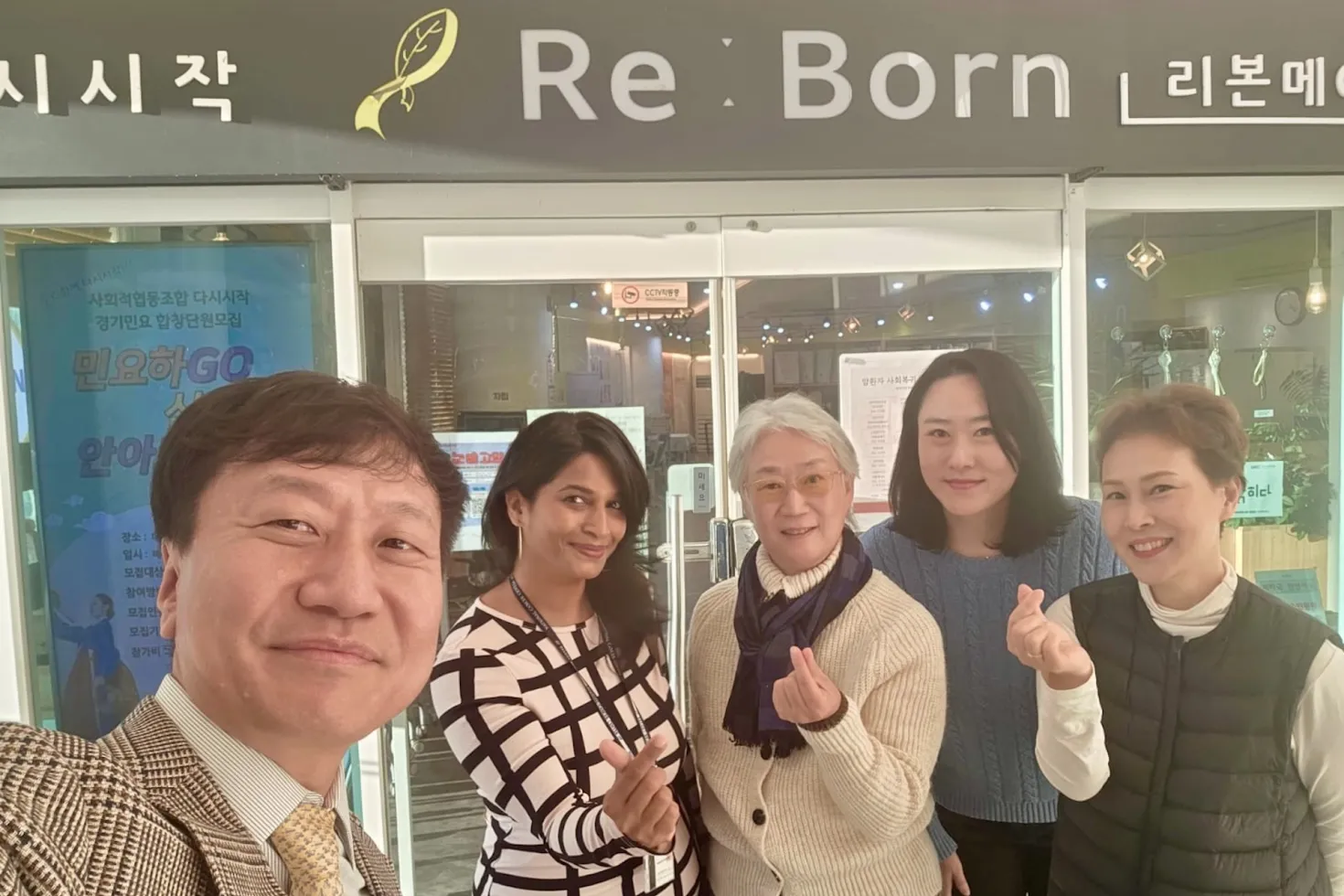
Prof. Yeol Kim and Prof. Nirmala Bhoo-Pathy (left) with the Re:Born team.
HIGHLIGHTS
- Survivorship needs are growing rapidly, yet support in many settings remains fragmented and overly hospital‑centred.
- Korea’s Re:Born Centre offers a multisectoral model linking clinical follow‑up with social, vocational, and financial support to help survivors return to daily life.
- A UICC Technical Fellowship enabled Malaysian researcher Prof. Nirmala Bhoo‑Pathy to study the Korean model and identify elements to strengthen survivorship and financial navigation in Malaysia.
- New evidence, including the Lancet Oncology Commission, highlights a “human crisis” in cancer care, with financial toxicity and unmet social needs underscoring the urgency of scalable supportive‑care solutions.
In many parts of the world, as cancers get diagnosed earlier and with advances in treatment, more and more people are surviving cancer. This is good news, but it also means that the need for robust and structured survivorship care systems is becoming increasingly urgent.
Yet in many contexts, support for life beyond cancer remains fragmented, with services concentrated in hospitals and limited capacity for community-based care and rehabilitation.
Prof. Yeol Kim, a family physician at National Cancer Center Korea, a UICC member organisation, said he experienced the gaps in through the routine follow-up care he conducted with patients after cancer treatment, realising that many of their needs lay outside clinical services. “There were people living alone without caregivers, suffering economic strain, or working-age people who were discouraged or prevented from returning to their work,” he explained in a discussion with UICC.
He said he began looking beyond the hospital for partners and practical solutions. “I meet the economic specialists. And social specialist and community leaders,” Professor Kim said. “So I asked to let’s build some somewheres to help our cancer patients to return to social activities… and return to their jobs.”
In 2017, the National Cancer Center of Korea (NCC Korea), in collaboration with Goyang City where NCC Korea is located, established the Re:Born Center. Located about one kilometre from the hospital, the centre is set in a former subway station building, making it easy to reach by public transport.
“The Re:Born Center is a kind of open space for networking for those having trouble reintegrating the workplace after cancer,” said Prof. Yeol Kim. “We provide free offices for the start-ups of cancer survivors, helping them return to jobs and rehabilitate into social activities.” These include a soap-making business and an entertainment group that produces educational materials.
Adapting survivorship care models to local contexts
Initiatives such as Re:Born can inspire models in other regions and health systems where survivorship support is still taking shape.
In Malaysia, the public cancer system is under pressure due to stalled health financing reforms, with knock-on effects for follow-up and supportive care, according to Prof. Nirmala Bhoo-Pathy, a public health physician and Professor of Epidemiology in the Department of Social and Preventive Medicine at the Faculty of Medicine of Universiti Malaya, a UICC member.
She said the situation is particularly difficult for people trying to return to work. “In the public sector it’s easier, and in some multinational companies (MNCs) there are stronger protections, but for people in non-MNCs, small and medium enterprises and the informal sector it can be a problem – people feel overlooked for promotions, made to feel unwanted, or given extra tasks to force them to resign, because employment protection policies are weak.”
In November-December 2025, Prof. Nirmala Bhoo-Pathy benefited from a four-week UICC Technical Fellowship hosted by Professor Yeol Kim at NCC Korea. Her objective was to study Korea’s integrated survivorship support model and identify elements that could inform policy and practice in Malaysia.
“This fellowship was a rare chance to see what integrated survivorship care looks like when it is designed as a system, not an add-on,” she explained. “Learning from NCC Korea and the Re:Born Center has given me concrete, transferable ideas to strengthen survivorship and financial navigation in Malaysia.”
The model is notable for its multisectoral design. Korea’s Cancer Control Act revisions have enabled a state-led survivorship strategy with clearly defined roles at both national and regional levels. While the National Cancer Center supports policy development, research, and training, 13 regional cancer centres deliver comprehensive cancer survivorship services, including needs-based triage, care planning, and psychosocial support.
During her fellowship, Prof. Bhoo-Pathy observed in detail how the system worked, from multidisciplinary case discussions and structured intake assessments to coordinated pathways linking hospital care with community-based supports. She also engaged with survivor-led enterprises, met with service-facing teams, and participated in scientific exchanges focused on financial toxicity and survivorship implementation.
One area of particular relevance to her work in Malaysia is the integration of financial navigation with survivorship planning. In recent years, Prof. Bhoo-Pathy has been developing a pilot financial navigation programme to help people with cancer manage costs, access support services, and maintain economic stability. Drawing on what she learned in Korea, she now plans to strengthen this model by embedding vocational components, employer engagement, and survivor leadership development.
“There are strong parallels between Malaysia and Korea when it comes to the challenges people face after cancer,” said Prof. Bhoo-Pathy. “In both settings, returning to work can be difficult, and many people experience financial hardship or insurance discrimination. The idea of the ‘right to be forgotten’ remains aspirational.”
The Re:Born Center’s emphasis on empowerment and self-reliance resonated with Prof. Bhoo-Pathy, particularly its use of survivor-led enterprises to create pathways back to income and purpose. “It’s not just about medical follow-up,” she explained. “What people often need is practical help – someone who understands their journey, who can help them navigate life after cancer, whether that means finding a job, dealing with paperwork, or just reconnecting with others.”
Prof. Bhoo-Pathy also highlighted cultural and systemic differences that affect survivorship care in Asia, noting the influence of collective decision-making in families, strong beliefs in traditional medicine, and the centrality of work and food in daily life. These factors, she suggested, must be considered when adapting survivorship models across countries.
Her next steps include debriefing with health authorities and partners in Malaysia, publishing findings, and convening stakeholders to pilot a Re:Born-inspired hub in the Klang Valley.
The relevance of this work is underscored by a recent Lancet Oncology Commission on the human crisis in cancer, in which Prof. Bhoo-Pathy co-led the economic section. The report argues that scientific and clinical progress in cancer diagnosis and treatment has not been matched by progress in how care is experienced. It describes a “human crisis” marked by fragmented, costly, and impersonal care systems, where people living with cancer and families can feel unheard, unsupported, or harmed by structures that prioritise disease metrics over connection, communication, and continuity.
The economic section highlights how financial toxicity is often driven by health-related social needs that sit outside treatment itself, such as transport, food security, housing, and caregiving. A Malaysia evidence panel cited by Prof. Bhoo-Pathy reported that patients made a median of two trips per month for cancer care, travelling 40 km per trip, with a monthly out-of-pocket travel cost of MYR 88 (USD 21), and around one in five incurring potentially catastrophic transport costs (more than 10% of household income).
Prof. Bhoo-Pathy and her fellow Commissioners issue in the report a call for the urgent need to fund and implement psychosocial and supportive care interventions at scale: “Supportive care and financial navigation are among the most scalable and cost-effective interventions, yet remain unavailable to most who need them.”
Last update
Thursday 21 May 2026