Nigeria's path to cervical cancer elimination: Challenges, data, and people-centred care
Dr Zainab Shinkafi-Bagudu, President-Elect of UICC, highlights in an interview with UICC the progress Nigeria has made in HPV vaccination and political commitment, but the country still faces major obstacles in cervical cancer elimination due to poor data systems, limited screening coverage, high treatment costs, and widespread misinformation.
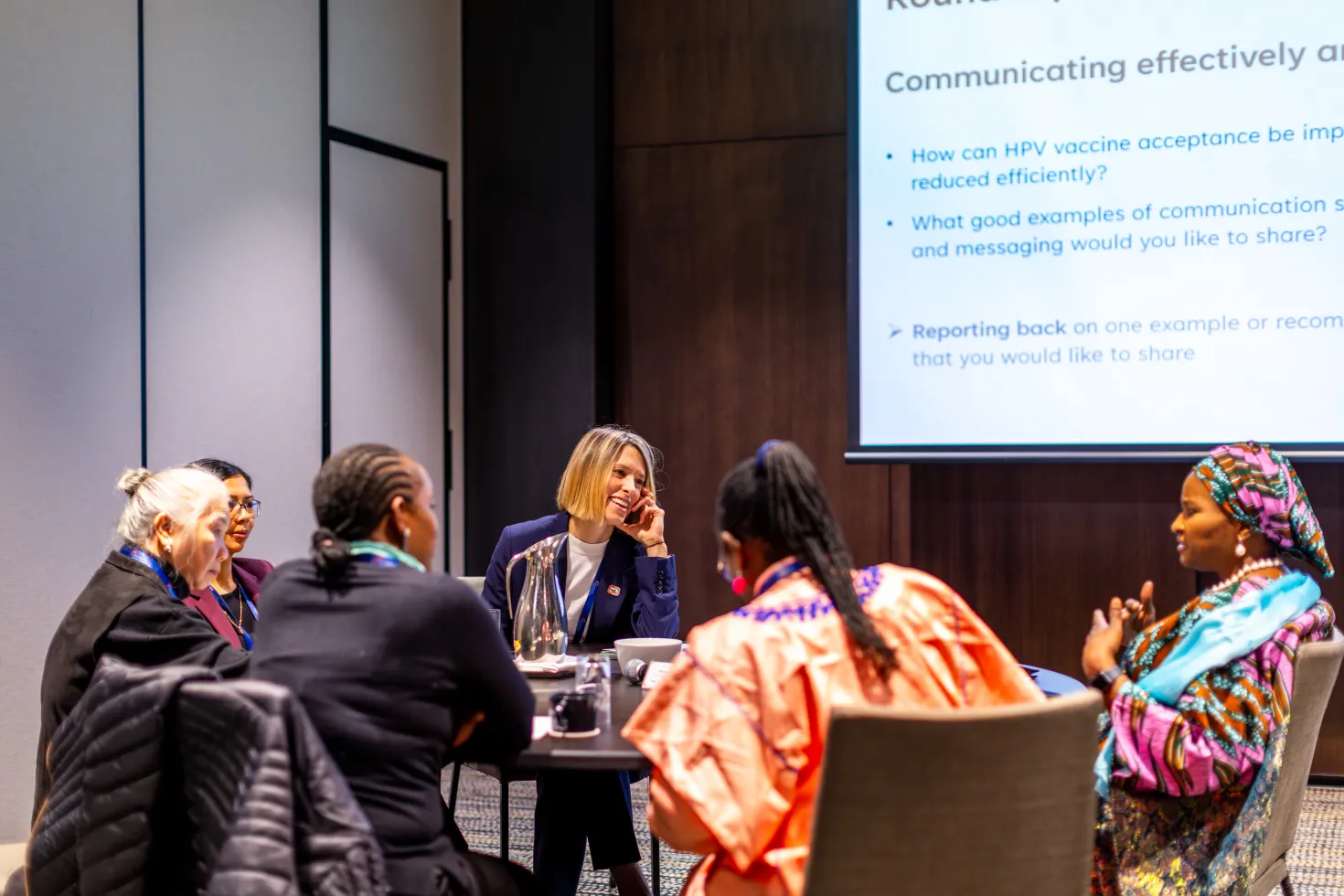
Dr Zainab Shinkafi-Bagudu, President-Elect of UICC, speaking at a workshop on increasing access to HPV vaccination and testing at UICC's World Cancer Leaders' Summit in Melbourne, November 2025.
HIGHLIGHTS
-
Roughly 90% of cervical cancer cases in Nigeria are diagnosed at advanced stages due to limited screening, low health awareness, and weak data systems.
-
Around 17 million Nigerian girls have received the HPV vaccine since 2023, yet this falls short of WHO's 90% coverage target by 2030.
-
Misinformation, limited public engagement, and high screening costs hamper vaccine uptake and sustainable programme scaling.
-
Civil society and multi-sector task forces are helping bridge policy and care gaps, but healthcare system fragmentation continues to hinder access and outcomes.
Cervical Cancer, despite being one of the preventable cancers, is also a disease that represents great inequities in health outcomes, with a disproportionate number of deaths carried by low- and middle-income countries.
In high-income countries with robust health systems, and some lower-resource settings such as Rwanda that have managed to prioritise their response to the disease, routine vaccination against the human papillomavirus (HPV) that causes cervical cancer, routine screening for pre-cancerous lesions, and timely treatment of the disease, have contributed to significantly reducing the number of related deaths.
Indeed, Australia recently announced that it recorded zero cases in 2021 of cervical cancer in women under the age of 25 (latest available data), recognising the huge benefit of HPV vaccination, and is on target to eliminate the disease by 2035.
Poorer countries, however, mostly in the global south, display systemic weaknesses that greatly contribute to delayed diagnosis, alongside limited access to prevention and treatment. As a result, about 94% of the 350 000 deaths caused by cervical cancer occur in low- and middle-income countries. Thus, the highest rates of incidence and mortality are in sub-Saharan Africa, Central America and South-East Asia.
In Nigeria, these challenges are especially acute, despite effective strides and political commitment towards eliminating cervical cancer as a public health problem.
As the global health community marks Cervical Cancer Awareness Month this January, Dr Zainab Shinkafi-Bagudu, President-elect of UICC and CEO and Founder of the Medicaid Foundation in Nigeria, a UICC member organisation, points out persistent gaps in data collection, access to prevention and care services, and community engagement that hinder national efforts.
She said that most women in Nigeria are diagnosed only when the disease is far advanced, with around 90% of cervical cancer cases presenting at stage three or four. This, she explained, reflects low awareness of symptoms, the absence of routine screening, and gaps in access to care that mean many women remain undiagnosed and untreated until the disease is severe.
“A real problem, right from the outset, is the lack of reliable data," Dr Shinkafi-Bagudu said. “The cancer registration system is weak, and so the way government at all levels, responds and even how people respond is not ideal. A lot of women are therefore undiagnosed, untreated, and we don’t capture them because we don’t know they exist.”
She explained that for many years, Nigeria’s cancer registration system was fragmented and inaccessible to key stakeholders. It was also previously housed within a single institution, limiting collaboration and data sharing.
Recently, however, responsibility has shifted to Nigeria’s National Institute for Cancer Research and Treatment, also a UICC member organisation, which has begun overhauling the country’s data collection system. It is working with the African Cancer Registry Network, with the support of the International Agency for Research on Cancer, to expand registries, deploy updated software, and build human capacity.
“Hopefully we will soon see better, more robust cancer registries with more capacity, both in terms of human capacity and tool,” said Dr Shinkafi-Bagudu. “Only then will we be able to capture more precisely what is actually going on – and act on that knowledge.”
The aim, she noted, is to develop a more inclusive and functional system with trained personnel and modern tools, so that data accurately reflect the scope of cancer cases in the country – a necessary foundation for policy, funding, and care.
HPV vaccination: a highly effective prevention measure for cervical cancer
Since the introduction of the HPV vaccine in Nigeria in 2023, the country has achieved notable reach in vaccinating approximately 17 million girls between the ages of 9 and 15, however, this is of a total eligible population of an estimated 60 million girls. This is largely below the goal of 90% of the target population by 2030 laid out in WHO’s Global Strategy to eliminate cervical cancer.
“Misinformation remains a substantial barrier to full coverage,” Dr Shinkafi-Bagudu explains. “Anti-vaccine narratives, often distributed through WhatsApp in multiple local languages, continue to undermine public trust.”
In a pilot study conducted by the Medicaid Cancer Foundation, comprehensive education campaigns proved effective, showing vaccine uptake was not significantly affected by misinformation when there was early and sustained engagement of the general public, and awareness was raised around the benefits of vaccination.
“We spent almost two years educating the students as well as the teachers and other community gatekeepers. What it shows, is with the right preparation and the right information, you can pre-empt the misinformation,” said Dr Shinkafi-Bagudu.
In contrast, the recent national vaccine rollout was hampered by insufficient communication. "Many families, especially in rural areas, did not receive clear, accessible information about the HPV vaccine,” Dr Shinkafi-Bagudu explained. “Mothers were not adequately engaged or educated, so some would allow vaccination, others wouldn’t. These leaflets, jingles, flyers – how many people can read them?” She stressed that effective outreach requires not just materials, but trusted messengers and local engagement strategies adapted to the context.
She also explained how misinformation and anti-vaccine sentiment can be countered by reaching out to influential religious communities. Dr Shinkafi-Bagudu recounted recently passing by a church with thousands in attendance, implying a trust and belief in the church structure: "Any message that is passed there, will be easily accepted. That is where we can effectively shift the narrative from prejudice and anti-vaccine sentiment to understanding the enormous health benefits of HPV vaccination."
Still, she noted that the fact that 17 million girls in Nigeria have received the HPV vaccine in only two years marks significant progress, as it is a significant number given the size and complexity of the national population. “We could have done worse – but we did well and efforts are on-going,” she said, stressing again the need for better coordination and community communication to reach more girls and counter misinformation more effectively.
While Nigeria still benefits from Gavi support, and the endorsement by WHO of the effectiveness of a single-dose HPV vaccine can help reduce costs and increase reach, the sustainability of vaccination at scale remains uncertain long term.
The importance of screening as secondary prevention
At the heart of Nigeria’s efforts to implement the three pillars of cervical cancer elimination – vaccination, screening for precancerous lesions, and timely treatment – is the National Task Force on Cervical Cancer Elimination. The task force has grown into a broad-based partnership that brings together government bodies, development agencies, and civil society organisations.
The task force, of which Dr Shinkafi-Bagudu is vice chair, is working to implement a screening strategy, as recommended by WHO, that relies primarily on HPV testing. The initiative includes training and ongoing support for primary healthcare workers, enabling them to deliver screening services at the community level.
Dr Shinkafi-Bagudu noted that while screening efforts are progressing, affordability remains a major barrier, particularly when it comes to HPV testing kits. “If manufacturers are unable bring the costs down, if it stays at the current high level, it’s going to be really hard for us to keep the programme going on the scale we need,” she said. “High costs are making it difficult to plan and to reach the number of women we’re aiming for.”
The target is to screen 50% of eligible women and treat all detected precancerous lesions by 2027, as part of Nigeria’s national goals. Current coverage, however, is about 15%, according to Dr Shinkafi-Bagudu, and she said it’s unlikely going by the current rate, that the country will meet its goal.
Treatment, the third pillar of elimination
On access to treatment for those diagnosed, three funding streams have emerged: the National Health Insurance Fund (targeting cancer, renal, and cardiovascular diseases), the Cancer Health Fund (operating via e-wallets in seven tertiary centres), and private sector-led initiatives.
Yet the system remains difficult to navigate. "Even in urban areas, many people don’t know about interventions. The awareness of the funds is not widespread," said Dr Shinkafi-Bagudu, adding that doctors, often overstretched, are unable to offer full guidance.
Civil society organisations, including Medicaid Cancer Foundation and many other UICC members are helping people with cancer understand and access financial support, but their reach is limited.
Nigeria’s experience demonstrates that achieving elimination is not solely a medical task, but one requiring social trust, inclusive policy, and local engagement.
"We are doing something, and it is a lot more than we were doing in the past – in a properly researched and evaluated way," Dr Shinkafi-Bagudu ended on a positive and forward-thinking note.
UICC members address barriers to HPV vaccination
At the World Cancer Leaders’ Summit 2025 in Melbourne, UICC President Ulrika Årehed Kågström and UICC President-elect Zainab Shinkafi-Bagudu participated in a workshop hosted by UICC focused on accelerating uptake and increasing access of HPV vaccination.
Sharing their experiences in their respective countries of Sweden and Nigeria, alongside other UICC member organisations from around the world, the workshop facilitated discussions on practical ways to boost HPV vaccination and reach cervical cancer elimination targets.
The participants, many of whom have benefitted from a project grant from UICC to support their work, highlighted the need to tackle myths and hurdles to receiving consent, to the opportunity of school-based programmes and community champions.
Last update
Friday 10 July 2026