Community-led solutions expand access to HPV vaccination in cervical cancer prevention efforts
UICC member organisations in 10 countries significantly increased HPV awareness and uptake of vaccination through community-driven strategies, with support from UICC grants, demonstrating the crucial role of civil society in advancing global cervical cancer elimination goals.
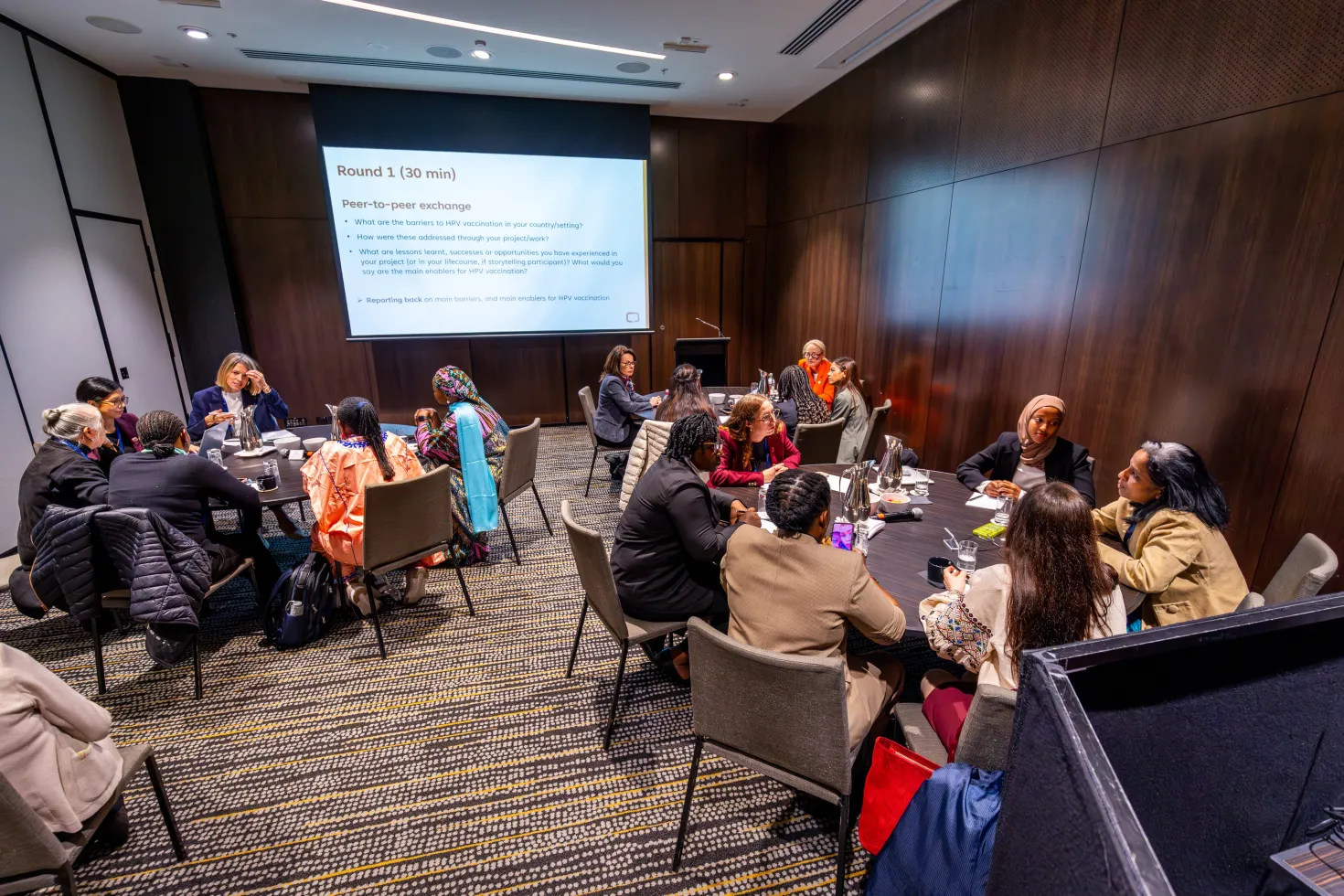
UICC organised a dedicated workshop on progress and challenges in HPV vaccination at its World Cancer Leaders' Summit 2025 in Melbourne, Australia, which was attended by several recipients of UICC's HPV grants.
HIGHLIGHTS
- 10 UICC-funded initiatives led by member organisations reached nearly 800,000 people, and supported HPV vaccination for over 20,000 adolescents using locally tailored strategies.
- Mongolia’s Arkhangai Province nearly tripled its HPV coverage rate, reaching a national high of 88.9% through community education and health worker training.
- In Kenya, the civil society coalition KENCO trained frontline workers and influenced national health policy, supporting over 4,000 vaccinations and contributing to a switch to a single-dose schedule.
- In the Philippines, the Philippines Cancer Society integrated HPV vaccination into wider cancer prevention work, helping draft a local ordinance and leveraging cancer survivors as community advocates.
As part of its work supporting the local implementation of WHO’s Global Strategy to eliminate cervical cancer, UICC provided grants to civil society initiatives aimed at overcoming barriers to vaccination against the human papillomavirus (HPV), a major cause of cervical cancer.
Providing further evidence of the importance of HPV vaccination, recent findings from long-term studies have shown the significant long-term impact of the vaccine.
Throughout 2024 and 2025, 10 UICC member organisations implemented year-long projects to address persistent challenges to increasing access and uptake of HPV vaccination in their communities, such as misinformation, stigma, access constraints and low awareness of risk factors. UICC supported these efforts by providing project grants to member organisations, totalling USD 200,000.
As Cervical Cancer Awareness Month is marked this January, their achievements illustrate the critical importance of civil society engagement in the elimination strategy, and how locally driven efforts can drive progress toward the target of vaccinating 90% of girls against HPV by age 15, laid out in WHO’s Global Strategy.
In total, the 10 projects reached nearly 800,000 people through awareness and mobilisation activities, provided vaccines for more than 20,000 adolescents, and trained over 1,000 key stakeholders. Also as part of the projects, 126 local resources were developed to raise awareness about cervical cancer and HPV vaccination.
Organisations in several countries also engaged with health authorities and decision-makers to improve policies, national cancer control plans, and delivery models, including school-based vaccination strategies, mobile vaccination units, outreach with existing municipal or city-level services, church-based approaches, community and family-supported identification and referral of adolescents for vaccination, and digital campaigns targeting communities and providers.
Tackling vaccine hesitancy and access through local strategies in Mongolia
In Mongolia, the National Cancer Council focused on Arkhangai Province, where vaccine hesitancy and organised opposition to HPV vaccination posed a significant barrier to the effective rollout at the point when the national HPV vaccination programme was being integrated and launched in late November 2024.
To shape the intervention, the project conducted a small-scale study, including an online survey with 392 parents across all 19 soums (second-level administrative divisions in Mongolia, acting as rural districts) and the provincial centre, and focus group discussions with 20 parents, to identify misconceptions and trusted information sources.
The findings informed a shift toward tailored, community-based engagement. Based on the study, the project developed targeted social media content, delivered outreach and education activities that reached 30,000 community members, and held focused sessions with parents who were hesitant or refusing vaccination.
In total, the project reached 4,600 parents and teachers, and more than 300 health professionals. They were trained on the importance of HPV vaccination and provided with practical tools and standardised communication materials.
At the start of the intervention in mid-December 2024, HPV vaccine coverage in the province was 31%. By December 2025, the project reported coverage of 88.9%, with 4,918 of 5,531 eligible adolescents vaccinated, nearly reaching the 90% target outlined in WHO’s Global Strategy. The province became a model for other regions, with its approach shared nationally and adopted by partners including UNICEF and UNFPA.
“Support from the UICC was vital to the successful implementation of this initiative, enabling Arkhangai Province to become the first in the country to reach the highest HPV vaccination coverage at the national level – and to serve as a role model for other provinces. The initiative demonstrated that local engagement, backed by modest funding and strong partnerships, can achieve meaningful outcomes in complex settings.”
— Tsetsegsaikhan Batmunkh, Founder and CEO of the National Cancer Council of Mongolia
Driving policy change and building stronger health systems
In Kenya, the Kenya Network of Cancer Organisations (KENCO) worked in informal settlements in Nairobi County, where low awareness, persistent myths, and access constraints have contributed to low uptake since the national HPV vaccination programme was rolled out in 2019.
A total of 99 frontline actors were trained using a Ministry of Health–accredited curriculum, including 40 Community Health Promoters, 10 Community Health Assistants, and 49 KENCO member representatives. Participants were supported with job aids and materials designed to reinforce consistent, accurate information, including national manuals and an HPV vaccination ‘frequently asked questions’ resource.
Other actions – such as household visits, schools, churches, women’s groups, and community gatherings – reached 49,750 people directly, supported by 12,000 printed information, education, and communication materials. Digital outreach further expanded reach.
Media engagement was designed to support accurate reporting and wider public understanding: with 64 journalists were sensitised through a media breakfast, and seven television and radio appearances reached an estimated 215,000 people with messages on cervical cancer prevention and HPV vaccination.
KENCO reported early movement from awareness to action through referrals and service uptake, including 1,356 women referred for screening, 1,296 screened, and 4,104 girls vaccinated through community and school-based mobilisation.
In parallel, the project contributed to a more supportive enabling environment for HPV vaccination. Through advocacy and participation in technical processes, the project supported improvements in two national policy documents and plans, including the National Cervical Cancer Elimination Action Plan, and contributed to discussions on how to finance cancer services. It also supported policy dialogues related to delivery, including the national shift from a two-dose to a single-dose HPV vaccination schedule, adopted in November 2025.
“The training (of CHPs) greatly strengthened the capacity of Community Health Promoters in my subcounty. They are now more confident, equipped with accurate information, and better able to educate the public about cervical cancer and the HPV vaccine. We are already seeing a positive shift – community members are showing greater openness to vaccination and openly seeking or consenting to HPV vaccination for their girls. This initiative has not only empowered our frontline workers but is helping us build a more informed and healthier community. We are truly grateful for this support, which is contributing directly to national efforts to prevent cervical cancer.”
– Emilio Nyabende, Subcounty Community Health Strategy Coordinator. KENCO
Using legislation and community action to secure long-term access to HPV vaccines
The Philippine Cancer Society (PCS) expanded its work on breast and cervical cancer prevention by integrating HPV vaccination into its ongoing ACT NOW Plus initiative in Quezon City.
Combining digital campaigns and on-the-ground mobilisation, the project produced 90 educational materials and reached over 5,000 people with information about HPV vaccination. The project also facilitated the vaccination of 2,364 individuals with a first dose and 1,859 with a second dose.
At the systems level, PCS trained 135 stakeholders, notably local health professionals and policymakers. It also supported the implementation of the recently passed Quezon City Cervical Cancer Elimination Ordinance, with guidelines on HPV vaccination.
The organisation involved cancer survivors as advocates and used policy engagement to support sustainability, ensuring that the initiative helped create what PCS described as a foundation for lasting change.
“The ACT NOW Plus project is not just a campaign; it's the foundation of a new health policy. By turning cancer survivors into HPV vaccination advocates, we have proven that the most powerful tool for public health is a community empowered by knowledge and supported by law. The Ordinance in Quezon City is a beacon showing that eliminating cervical cancer is a commitment, not just a dream."
– Dr Corazon Ngelangel, President, Philippine Cancer Society
Learn more about the grants and see the full list of recipients
Last update
Friday 10 July 2026