“Laying the groundwork for change”: enhancing early detection of breast cancer in Libya
A Libyan initiative is training female healthcare workers to improve breast cancer detection amid resource and cultural challenges. Interview with Dr Muna Abusanuga, Head of Department, National Cancer Institute of Misrata.
HIGHLIGHTS
- The National Cancer Institute of Misrata in Libya launched its first structured early detection project supported by a UICC grants initiative, introducing clinical breast examinations (CBEs) in polyclinics.
- 46 female healthcare providers were trained, surpassing the original goal of 40.
- Gender sensitivity and community outreach, including radio announcements and engaging male family members, were key to gaining trust and participation.
- Future plans include a broader study aiming to provide free clinical breast examinations (CBE) for 5,000 women from Misurata, with the goal of integrating breast cancer detection into primary healthcare nationwide.
Early detection is one of the most effective strategies in improving cancer outcomes, enabling treatment to begin when it is most likely to be successful. For breast cancer – now the second most commonly diagnosed cancer globally just behind lung cancer – early detection can significantly reduce mortality and lessen the intensity of treatment required.
Yet in many low- and middle-income countries (LMICs), where 60% of global breast cancer deaths occur, a combination of low awareness, weak health infrastructure, and social stigma means that many women still present with advanced disease, often in stage III or IV. Libya is no exception.
To help address these disparities, UICC awarded a series of project grants to member organisations across 18 countries in 2021 as part of its Breast Cancer Programme. These grants supported local, evidence-based initiatives to improve access to and delivery of early detection services for breast cancer.
One of the grantees was the National Cancer Institute (NCI) of Misrata, Libya, which developed and implemented a project focused on building the capacity of healthcare providers in polyclinics to conduct clinical breast examinations and to promote early detection within their communities.
Dr Muna Abusanuga, Head of Department at NCI Misrata, spoke to UICC about the goals of the project, its outcomes, and what insights their experience might offer to other cancer organisations.
Dr Abusanuga, can you tell us about the role of the National Cancer Institute of Misrata and the specific challenges Libya faces in early cancer detection?
The NCI of Misrata is one of five major cancer care centres in Libya. We are responsible for the Midland region, which includes around one to 1.5 million people – but we don’t have exact numbers because our last census was in 2006. We provide diagnostic and therapeutic services, including radiotherapy and some advanced diagnostic testing. We’re also a teaching centre, involved with medical education and local postgraduate programmes.
This project was our first real step in early detection. Before that, we had done awareness activities for breast and colorectal cancer—mostly short campaigns over a day or two. They weren’t part of a structured public health approach, but they were still based on scientific principles. Most patients here still present at a late stage, especially for breast cancer, which accounts for about 25% of new cases.
What led you to focus specifically on breast cancer for this initiative?
As a community medicine specialist, I have always wanted to work in prevention. In 2022, I contacted IARC and started working with them on a pilot project. They introduced me to the UICC grants opportunity and encouraged us to adapt our project to apply.
We chose early diagnosis – not screening – because in Libya we don’t have the resources to run a screening programme. Early diagnosis was more suitable for our situation. The idea was to test ourselves – see if we had the capacity and commitment to take the first steps.
What were the main goals of the project, and how did you implement them?
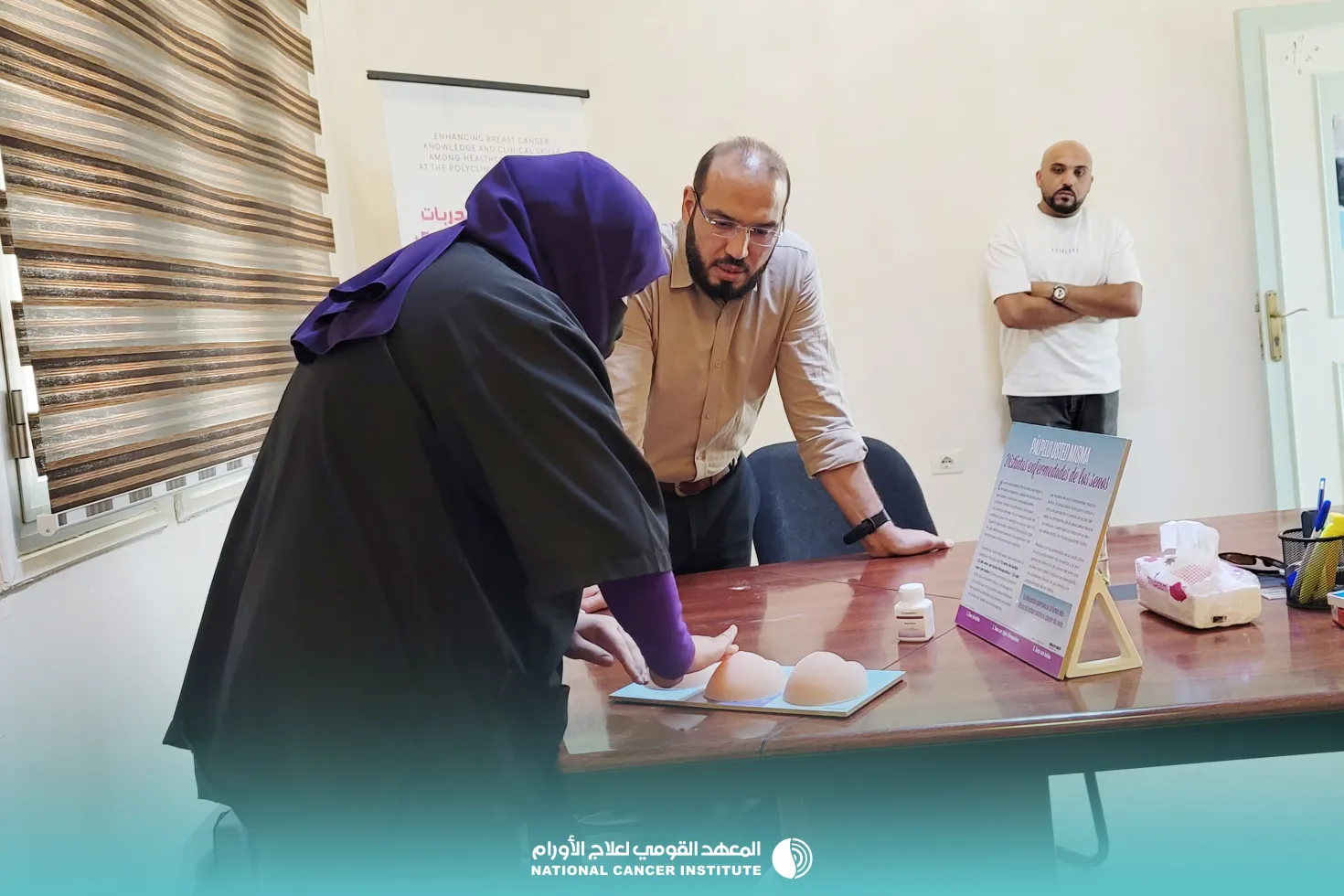
We had three goals: to enhance knowledge among female healthcare providers about the benefits of early detection, train them to detect abnormalities through clinical breast examination (CBE), and prepare a group of master trainers to lead future work.
Originally, we planned for 40 participants, but actually managed to train 46. On the first day, participants received training through short presentations and brochures in Arabic, which we adapted from international materials to suit the local context.
We also administered a Knowledge Attitudes and Practice (KAP) questionnaire both before and after the session – on the same day – to assess their learning. Although this approach could introduce some bias, it was the most feasible method given our constraints. We also developed a CBE checklist as an additional tool to support the practical component.
How did you reach women in the community to participate in the programme?
We collaborated with a local radio station in Misrata, which was a key partner in raising awareness. Before each clinic visit, we ran short interviews and promotional segments explaining the purpose of the programme – that women could come to the polyclinic to receive a clinical breast examination from trained female healthcare workers. We also introduced our team and clarified the process so that women would feel comfortable attending.
The response was very positive. Despite only four or five days of radio promotion before each clinic day, we reached 98 women in total across the four locations. In some cases, the number of attendees exceeded what our small teams could manage, and we had to stop accepting new participants by midday. This showed that women in the community are eager to access services when the invitation is appropriate, respectful, and trustworthy.
Did you encounter any reluctance or cultural barriers around breast cancer – including stigma or discomfort in speaking about or being examined for such a sensitive issue?
In our society, there are definitely challenges when it comes to breast cancer. People don’t always feel comfortable talking about it, and in many cases, the word “breast” itself can make conversations difficult. There’s also a fear – women worry about what a diagnosis might mean, and sometimes there’s shame, especially around being examined.
We knew this in advance, and it was very important to us to have only female staff involved in the clinical breast examinations. Everyone conducting or observing the exams was female. We mentioned this clearly in our radio announcements, and it was something we planned for from the start because we expected it might be an issue.
And yes, in a few clinics, male family members came first – brothers, fathers, husbands – to check who would be in the room. They wanted to make sure the team was entirely female before allowing their relatives to participate. But when they saw it was true, they agreed, and some even came back later with the women. This wasn’t a barrier in the end – it was something we expected, and we handled it by making sure everything was in place.
Also, the male polyclinic directors were very helpful. They made space for us, adjusted the schedules, and supported the programme. Most of them have experience treating late-stage cases and were very willing to do something that might improve early diagnosis.
So, while there are cultural sensitivities, we didn’t face strong resistance. Once the programme was explained clearly and people saw how it was being run, the community responded well. I think trust came from that – from doing things in a way that respected the local context. The good reputation of NCI Misurata has helped too.
What other challenges did you encounter during the implementation?
Our team was small, and we had to split up to supervise all the sessions. That was a challenge. Also, in one clinic, the number of women was so high that we had to stop taking new arrivals by 11:00 a.m.
Another concern came from outside – after we posted about the project on our institute’s Facebook page, we were questioned whether it was legal to collaborate with an external organisation, specifically UICC. Although we had secured all required approvals from the Ministry of Health and the ethical committees, including written consent, we were aware that such concerns could arise. We addressed them discreetly and were able to move forward without disruption.
One of our major challenges came at the beginning, when UICC withheld our name from the grant's list for a few months due to the unique and complex situation in Libya. The institutional bank account was also a critical issue, as outgoing transactions were restricted. Fortunately, the International Agency for Research on Cancer (IARC) stepped in to help, and UICC agreed to an exception allowing the use of the NCI director’s personal bank account, which didn’t face the same limitations.
What are the next steps for your early detection work?
We are now preparing a pilot study. The goal is to reach 5,000 women through six polyclinics over 18 months. We’ve already received approvals from the Ministry of Health, the National Cancer Control Authority, and our ethical committee. We’re working with the Documentation and information centre of Ministry of Health (MoH), Libya and with Misurata University (Human resources training and development centre, and IT college) to collect data electronically.
This will help us assess whether it’s feasible to establish breast clinics at the primary care level. It’s not just a local project – we hope it will inform a national approach. The final results of this pilot study will also support stakeholders at the national level in drawing lessons from the experience.
What lessons from your project might benefit other organisations working to improve early detection?
We learned that prevention needs to be well planned – it’s not just about awareness lectures. You have to plan carefully and work closely with the community. Even with limited resources, we found we could make progress because of the support from our staff and the wider community. In addition, it gave us the confidence to be part of any future international cancer prevention activities.
We also found that many people – including male leaders – were willing to support the project once they understood it. That kind of support is very important. This experience helped show others in our institute that early detection isn’t just an idea – it’s something we can actually do, step by step.
This all helped show our colleagues that prevention programmes can be rigorous and evidence-based – not just informal lectures or campaigns – and that we can implement them systematically, even in a low-resource setting.
Further related reading
Enhancing breast cancer knowledge and clinical skills of healthcare providers in Misrata, Libya
Last update
Monday 04 May 2026