Shaping the next phase of the ATOM Coalition
The new Executive Director of the Access to Oncology Medicines (ATOM) Coalition, Natasha Shah, outlines the work ahead to expand access to cancer care in low- and lower-middle-income countries through local partnerships, capacity-strengthening and effective pathways to innovative medicines.
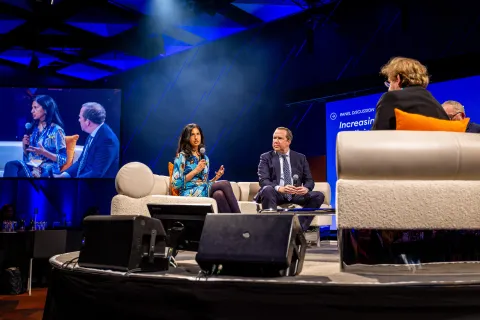
Natasha Shah, Executive Director of the Access to Oncology Medicines (ATOM) Coalition, on a panel on "Increasing access to cancer medicines and technologies" at the World Cancer Leaders' Summit 2025 in Melbourne, alongside Martin Fensch from Daiichi Sankyo.
In August 2025, Natasha Shah was appointed as the new Executive Director of the Access to Oncology Medicines (ATOM) Coalition, a multi-sector initiative launched in May 2022 by UICC to expand access to essential cancer medicines in low- and lower-middle-income countries (LMICs). With a new three-year business plan for UICC on the horizon, as well as early learnings emerging from the Coalition’s work across eight countries, Natasha is focused on driving innovation, deepening partnerships, and scaling impact.
In this interview, she explains what lies ahead for the ATOM Coalition, what it will take to close the cancer care gap in LMICs, and how she’ll measure success in the years to come.
What excites you most about leading the ATOM Coalition at this moment?
The honest answer is everything. It is an exciting time to join the ATOM Coalition, because it has demonstrated initial success in all three of its key pillars: innovative access pathways, health financing and capacity strengthening. Based on this foundation, we will be launching our next three-year strategy in early 2026. It is an ambitious plan focused on growth, meaningful impact and being a catalyst for change – because patients are waiting.
More broadly, it is an important time because we are at the crossroads in global health, cancer care and access. There have been great shifts recently in the global health funding landscape, which means as a community we need to be creative about how to support equity and access in LMICs. At the same time, we are witnessing advancements in technology that can move the needle in cancer care, especially in AI-enabled technology and diagnostics, with more rapid and sophisticated biomarker testing technology. The majority of the world’s population growth is projected to be in LMICs so the cancer burden will rise if it is not addressed. Because of these forces it is a critical time to address equitable access to health to ensure the cancer care gap doesn’t continue to widen because of them. My hope is for the ATOM Coalition to be a beacon and catalyst for positive, innovative change to close the care gap in LMICs.
What are the biggest barriers ?
There are several bottlenecks. A key one is the lack of quality-assured medicines and diagnostics. If they are available, the costs may be out of reach for the majority of patients. This ties in with a need for financial coverage for cancer care. Structurally, fragmented supply chains, and weak regulatory or forecasting systems, can lead to stock outs, delays or interruptions in care. Lastly, an adequately trained workforce and lack of equipment can also be a key barrier.
This is why the ATOM Coalition model has three pillars: capacity strengthening, access to medicines and diagnostics, and health financing to address these barriers holistically, because you cannot just pull on one thread of the problem.
The ATOM Coalition now has 45 partners across public, private, and civil society sectors and growing. How do you ensure alignment ?
The partners include some of the most influential and leading organisations addressing the burden of cancer worldwide. Together, we can pioneer new solutions to address complex problems, and the ATOM Coalition acts as a coordinator and catalyst to bring these organisations together to drive change. One thing that makes it easy is that we all have the same purpose, and we are working towards the same goals.
To support this, in 2026 we will attend and host several dedicated in-person forums for Coalition partners to problem-solve and share learnings together. These include ASCO, the World Health Assembly, UICC’s Cancer Planners Forum in May in Geneva, and the World Cancer Congress in Hong Kong in September.
When you are doing new things, it is important to be mindful of what works, what doesn’t, and adapt accordingly. One of the first things I did when I joined the ATOM Coalition as Executive Director was engage with our partners and governance to hear their perspectives. We also organised two virtual roundtables to get inputs from our partners on Coalition strategies. To ensure alignment the ATOM Coalition has a clear governance and advisement structure, this also includes the governance of the broader UICC organisation.
Work is already underway in 8 countries including Zambia, Mongolia, and El Salvador. What lessons are emerging from these early efforts?
The ATOM Coalition uses a country-driven approach, where needs are identified locally to ensure solutions reflect local priorities. By building partnerships with local authorities and technical stakeholders, we create a self-sustaining model for long-term success, which will continue to influence and impact cancer care even after an initial three-year period of engagement.
Through these efforts, four cross-country priority needs have emerged as areas for scale across ATOM countries: (1) training to support compliance in regulatory requirements, (2) improved monitoring of regulatory authorisations issued and procurement processes, (3) standardised forecasting methodologies and digital technologies as well as (4) continuous educational and training opportunities for diagnostic and pathology professionals.
Next year, we plan to launch a regional access hub, which will engage several countries with shared borders. In doing so, the Coalition can impact more patients, faster.
Many global health initiatives focus narrowly on one disease or intervention. Cancer is inherently more complex. How does the ATOM Coalition’s approach reflect this complexity?
A person with cancer would need diagnoses, a treatment regimen that could include medicines, supportive care, radiotherapy and/or surgery, monitoring, management of adverse events and patient navigation. This is not something one organisation can tackle alone. The key to our approach is in the strength of our Coalition of partners, which allows for a coordinated, end-to-end and patient-centred approach.
Because cancer care can involve so many aspects of health care, this inherently means integrating into broader health systems and overcoming siloed efforts ATOM’s country-driven approach is also well-suited to delivering flexible, context-specific solutions that are adaptable to different countries’ needs.
In the longer term, what conversations should the global health and cancer community be having to drive lasting solutions for access?
Three things come to mind: investment, affordability and fragmentation. Current investment in NCDs does not reflect the burden of these diseases in LMICs. The global health community needs to direct greater resources, investment and attention on NCDs including cancer.
Affordability of oncology medicines is a significant barrier for patients, and diagnostics and treatment equipment are a big cost for countries. The community is beginning to think of new approaches to finance cancer care and the launch of the Global Cancer Financing Platform is one great example.
Lastly, in the case of cancer, it is vital that there are no fragmented approaches. Given the complexity of cancer care, a holistic, multi-faceted approach with differentiated partners is the only way access can sustainably work and create change where it truly matters – for the person with cancer.
Five years from now, how will you measure success ?
Great question. I like to joke that ultimate success is being fired because there is no more work to be done. This will be when two things have happened: First, an innovative medicine or technology is available in LMICs within twelve months of its first availability in high income countries; and second, the chances of five-year survival for a given cancer is the same no matter where you live.
Last update
Wednesday 14 January 2026