Elena’s second mother. The one who helped save her life.

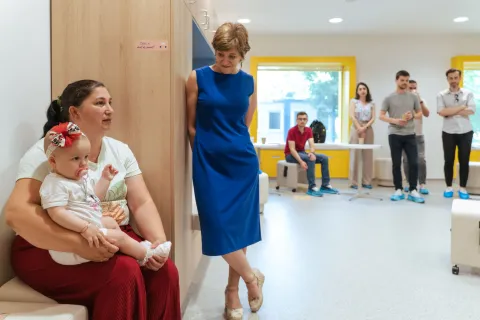
Roxana (sitting, left) cared for her niece Elena (on her knees) for 10 months while the child was undergoing cancer treatment in Romania.
Marking the end of Childhood Cancer Awareness Month, Gabriela Teodora Vătafu of the Dăruiește Viață / Give Life Association, a UICC member, explores a Romanian woman’s 10-month hospital journey caring for her young niece diagnosed with adrenal neuroblastoma, all while apart from her own children.
Up to the age of two and a half months old, Roxana had only seen Elena twice, when she had gone to visit her. Elena was her husband’s niece, and Roxana lived in another town, 50 km away. When Roxana visited Elena the second time, she noticed that the baby’s belly was much more swollen than normal. Roxana was not a doctor, but she was a mother. The mother of four children.
She advised Elena’s mother to take her to the doctor’s office. After doing some tests in Buzău, Elena’s parents took her to Bucharest, because they hadn’t received an exact diagnosis. At Marie Curie Hospital, in the capital of Romania, the doctors performed more tests and they found out what was wrong: an adrenal neuroblastoma with hepatic metastases. In short, cancer and liver cirrhosis.
Together with a team of physicians, they immediately scheduled a biopsy. But her belly continued to swell even after the surgery and the wound wouldn’t close. Elena’s mother was shocked. When Roxana called to ask for the news, she could feel that something wasn’t right. She wasn’t the same person anymore.
“Just hearing about this disease makes you almost lose it. You lose hope and you feel that all is lost. It’s only when you go through something like this that you can understand. For a mother, the health of her child is the most important thing”, Roxana told us.
When she understood the situation, Roxana talked to her husband and they decided to help. She got a T-shirt and a pair of slippers and came to sit with the baby in the hospital for one night. When she got there and they asked her who she was visiting, she didn’t even have the patient’s full name. She didn’t leave for three weeks, and even then, it was only to get more stuff from home.
Elena’s mother was suffering from depression, she couldn’t go back to the hospital with her. “It was very difficult,” Roxana told us, in a tone both assertive and modest. “But even if there was only a 1% chance for her to survive, there was still hope. I said I’d take the baby to the hospital. Elena would be fine.”
Together Roxana and Elena were moved from the surgery to the oncology ward. “When I got to the oncology ward, I didn’t think I could do it. Not even for a week. Staying for a few months seemed out of the question. There were 40 of us and only one bathroom. I slept with my head on the metal rail of the bed. Every day I saw blood and all kinds of tubes. It was hard. But I had a medical team who was there for me. If there were ever any moments where I lost hope, Dr. Mihaela Smărăndoiu would help me get it back.”
Elena started chemotherapy. She was responding well to the treatment, but her belly kept swelling. The disease was progressing. At a certain point, her liver started showing signs of failure. When the doctors came into the ward, they looked at her, exchanged glances and said nothing. But they changed her line of treatment and continued to fight for Elena.
Alone in the hospital with a three-month-old baby who had little chance of surviving was not easy for Roxana. Beside the doctors and nurses, Roxana always found support from her husband. He told her how strong she was and that he had faith she could do it. “For ten months, I bounced her on my legs so she wouldn’t cry, so she wouldn’t get upset – so she wouldn’t be in any pain. I was afraid to fall asleep, so that nothing would happen to her.”
The nights were the hardest; the baby would fall asleep, but Roxana’s thoughts wouldn’t stop. “In there, the days just go on and on, and the nights seem endless. In the evenings, I went over everything that happened during the day and I could see that things weren’t getting better. I was far away from my children. Away for the holidays. Away for their birthdays. And I didn’t even know if we wouldever be able to take Elena home. But I never lost faith.”
As daylight struck, Roxana would start all over again. Leaving your own children at home in order to save another person’s child was something few people could understand. But Roxana hadn’t deserted her children. She had just chosen to be in a place where another mother couldn’t be.
Roxana’s husband used to work in Bucharest from Monday to Friday, and he only went home to Buzău on the weekends, but in the 10 months Roxana was in the hospital, he went home every day, to be there for their children.
“Even though no one from the family could come into the hospital, I never felt alone. They could only come so far as the hospital door, but I knew they were there for me. I used to show them the baby through the window.” They kept in touch by phone: “Luckily we live in this technological age. During the day, while Elena slept, I’d call my children and talk to them. We’d do homework together. They understood, because they loved Elena so much.”
Elena also fought. Her liver was showing signs of improvement. The swelling started going down. There was less fluid, but a new tumour showed up on her right adrenal gland. “When you’re fighting against this disease, you’re afraid to be happy for any good thing that happens. But I was sure we’d get through this as well,” Roxana said.
In February, the doctors recommended she get a scintigraphy [a diagnostic imaging technique that uses radioactive isotopes to visualise the function of organs and tissues]. The test wasn’t available for children in Romania. Assisted by the medical team at Marie Curie Hospital, Roxana managed to take Elena to Italy. “When we got to the Vatican, the doctors there were astounded. What the medical file said and what I had in my arms were two different things. The file made it look hopeless, but the baby looked great.”
When someone leaves for the hospital, they arrive with their own story, but often they come back with everyone else’s, too. From her own experience, as well as that of other mothers she’s met, Roxana knows that when you find out your child has cancer, your first thought is to leave the country. She saw, however, that you can get good treatment in Romania as well. You can get physical, emotional, even financial support here, too.
When they returned from Italy, Elena continued to receive chemotherapy and finished the final round in April. “The tumours weren’t active anymore. When the doctors decided to remove her chemo port, that’s when the others started to believe that Elena had a chance of living. That the hard part was behind us. That Elena would be able to play, to go to kindergarten, to get into all sorts of mischief.”
Elena’s mother had moved in with Roxana’s family and was responding well totreatment for her depression. That’s when Roxana’s husband decided to bring in Elena’s sister as well, a little girl aged 10, so that she could live with them and stay in school.
Roxana has continued to take Elena for check-ups and further tests every two months, and will continue to do so for the next five years. “I’d like for the parents going through this to not lose hope. Even when everyone is telling you there’s nothing more to do, you need to believe. The impossible can become possible. Elena is like a hanging plant – she just hangs on to life with all her might. I took her by the hand and she just wouldn’t let me go.”
When they came in for her last check-up, Roxana and Elena got to visit the Children’s Hospital built by Dăruiește Viață, with the support of our donors. “It’s weird to say, but I was happy going into the hospital. It’s more than we could ever want for our children. It’s a sterile environment, with new equipment. It’s a place where you can go and keep your hopes up.”
After almost a year in the hospital, Roxana knows what it’s like to be there and she looks wistfully at the spaces for children: the playroom, the gym, the relaxation room. She thinks it’s very important for the children to be able to move around. “In our case, the hospital became our second home, but it’s difficult when you’re only 50cm away from another patient’s bed.” She was glad to see all the wires and tubes are now hidden inside the furniture, and not in plain sight. Every little detail can make a difference for the emotional state of the patient and the person caring for them.
Roxana told us her story in a voice that was strong, but gentle at the same time. When we asked if she’d like to send out a thought to the people who donated for this hospital to be built, it was only then that we felt her quiver for a moment. “What you’re doing can be measured in smiles from the children and hope for the parents. A little goes a long way. You can’t be there with us, but you can help by donating. It can really mean another chance of living. Richness is not all about what you’re putting aside for yourself, but also what you can give to others.”
Every life matters. Every story changes us a little bit more. Every experience we share makes us more aware of the hard times children with cancer and their families go through. The month of September is all about them. Together, we can fight for extra chances and faith to look towards the future.
Last update
Friday 29 September 2023